Decades ago, Emperor Sigurd united Rivellon under the singular banner of the empire through the joint efforts of Maxos the Mage and a mysterious figure known as The Architect. The ancient technology supplied by The Architect allowed the three to subjugate the lands through technical supremacy. For many years, the three worked together, supporting Emperor Sigurd and ushering in an era of peace. However, this peace was short-lived, as all three men fell in love with the same woman of great beauty, Aurora.
Divinity: Dragon Commander is set in the now fractured Rivellon Empire after the death of Emperor Sigurd. While Aurora's affections had eventually been won by Emperor Sigurd, her life was ultimately claimed by The Architect in a fit of jealousy. In the years that followed, tensions rose across Rivellon as Emperor Sigurd sought comfort in base pleasure and sired many bastards. The bastards of Sigurd all vie for the throne of Rivellon while its people suffer an unending war.
However, one hope yet remains for Rivellon: the secret love child of Emperor Sigurd and Queen Aurora, whose blood holds not only the draconic lineage of Aurora but also the only rightful claim to Rivellon—The Dragon Commander.
Divinity: Dragon Commander is set across three acts, as the Dragon Commander battles their way across Rivellon, defeating their bastard siblings and other grave threats. Accompanying them on this journey is their benefactor and guardian, Maxos, who sought out the Dragon Commander to bring an end to the war. Maxos called upon forbidden techniques to procure a massive flying ship and rallied a team of advisors to counsel The Dragon Commander.
The grand narrative is fairly straightforward, with a bit of an act-three twist to keep the player on their toes; however, the true storytelling is found in the character interactions between The Dragon Commander and the ship's inhabitants. Story arcs fall into three categories, pertaining to either the politicians, the generals, or the spouse. For example, one general looks down upon all other races, so their questline is largely about how this perspective is either evolved or reinforced by The Dragon Commander's direction. There are four questlines for the generals, four potential wives, and numerous decisions to make on behalf of the politicians. Collectively, this yields a rather surprising quantity of voice-acted dialogue for an RTS, which is generally well-performed and well-written.
Candidly, the character interactions and narratives are among the most enjoyable aspects of Divinity: Dragon Commander. There were several moments when I found myself more interested in the next part of a general's story than in any of the upcoming RTS battles. Decisions are typically limited to binary decision trees with the cast, usually either encouraging or dissuading them from a course of action. The Dragon Commander's choices are rarely limited to a single character, as they influence standing among factions and can have a minor mechanical impact on the army. It is an interesting idea, which unfortunately reduces some of the cast to caricatures of political ideology. One general was the former queen of a women-led nation, so most interactions with her are some variation of deciding The Dragon Commander's stance on women's rights. Similarly, another provides an outlet for The Dragon Commander's stance on same-sex relationships, etc. It is a dynamic that leads to generally predictable interactions with many characters and dampens character writing that is otherwise generally enjoyable.
In terms of actual gameplay, Divinity: Dragon Commander is a sort of weird mixture of Civilization, Risk, and StarCraft. The first component of the game pertains to managing political reputation, which is influenced by all the things described in previous paragraphs, such as decisions about same-sex marriage, banning nudism, allowing euthanasia, etc. The political factions always have opposing views on subjects, so appeasing one faction will enrage another. Factions are associated with various parts of the map, and when their approval is too low, it reduces the efficiency of the resources on that map tile. Thus, there is an incentive to strategically appease the factions. While making the decisions was fun, I felt the factions generally did not significantly impact the gameplay experience.
The second aspect of the game—and probably my favorite aspect—is the grand strategy-style Risk board, which The Dragon Commander uses to act and react to the war. The maps are split up into many smaller regions, which can be captured by either moving a unit into an unoccupied tile or by defeating an occupying force. Each army has its own capital tile and will lose if that tile is occupied by an opposing force for more than one round. At the start of each round, armies receive gold and research points based on the tiles they occupied at the end of the previous round. Rounds consist of building units, moving units, buying buildings, or playing cards. Cards allow The Dragon Commander to influence the map by preventing certain unit types on a tile from moving for a turn or by reducing the gold earned on an opposing tile. Cards can be earned from certain buildings after a few turns. Generally, I really enjoyed this aspect of the game, as it felt satisfying to establish a strategy of controlling the sea to slowly choke off enemy resources and ultimately see that strategy pay off.
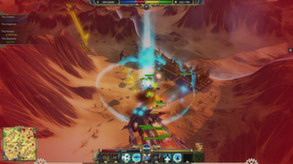
Whenever a round ends with units entering the occupied tile of an opposing army, the round ends in a battle phase. During the battle phase, The Dragon Commander can either allow the battle to resolve automatically, pay a general to resolve the fight at a technical advantage, or take command themselves. If a fight is resolved automatically, losses are determined based on a random percentage. Thus, in rare instances, an overwhelming force might still suffer many casualties. When personally commanding fights, Divinity: Dragon Commander finally reveals itself to be an RTS. Unfortunately, this third and final component was probably my least favorite aspect of the experience.
There is only one resource in this RTS—units—which generate more quickly when resource centers are controlled. These resource centers are spread around the RTS maps in fixed locations. If a unit approaches an unoccupied resource center, they take it over nearly immediately and are then free to build on top of it; however, if the resource center is taken by an enemy first, then it must be destroyed before being claimed. It creates a rather bizarre start to every single match, where The Dragon Commander needs to rush units to all corners of the map, desperately trying to claim a spot first. Several units offer special abilities, but they would require micromanaging beyond my capabilities to make use of effectively, though of course the AI can use them flawlessly. Divinity: Dragon Commander then answers the question of how we can make this rather frustrating RTS game more interactive by allowing The Dragon Commander to literally transform at will into a dragon with jetpacks and rain fire upon the enemy forces. Admittedly, this was a bit fun, but it felt like its efficacy as a tactic fell off sharply in the third act.
Overall, Divinity: Dragon Commander falls into the bucket of games that I had fun with but would find difficult to recommend to others. It is doing a lot of things at once, which collectively give it a unique identity, while also not executing on any of those ideas remarkably. The game also has weird pacing, notably allowing the player to effectively soft-lock the enemy forces in Act II, farming basically endless resources as they prep for Act III, which subsequently makes that act a walk in the park. Then again... it features a dragon with a jetpack strapped to its back.