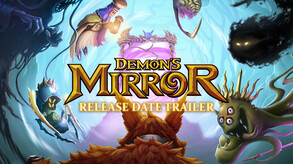
Step into the Demon’s Mirror and enter a fantastical, nightmarish world in this roguelike deckbuilder! Strategy meets the arcane in a unique fusion of deck-building and chain-3 mechanics. Can you face your demons and come out unscathed?
Modeled estimate, not a reported figure. How we estimate →
Media

About


Genres
Stats
All-time low is the lowest price we've recorded for this game since we started tracking it.
Languages: English, French, Simplified Chinese, German, Russian, Portuguese - Brazil, Japanese, Korean, Traditional Chinese, Spanish - Spain
Engagement
Hours played at review time, across 40 reviews with recorded playtime.
Reviews
Themes across 40 recent reviews and how positive each mention is. A keyword signal, not full sentiment analysis.
positive critical· bar length = how often the theme comes up
Reviews
Awesome idea, very clunky and boring. It makes me irrationally angry that the developer had such a wonderful concept, but somehow managed to make it unfun to play. Costs 2 energy to do the match 3, but you only start with 3 energy? Why doesn't it just cost 1? Why is every single fight tedious and boring? At least the things blatantly copied from Slay the Spire are decent, but it's just not enough to save this game in it's current state. I really hope either this developer figures it out and makes it fun to play, or someone else takes the reigns and makes a fun match3/card game roguelike, because it's a great idea.
TL;DR This is an enjoyable enough deckbuilder with a twist of chaining items on a board for resources, but with a direct competitor like Across the Obelisk out there, the slower pace of runs, the less innovative map design, lack of character progression, and anemic storylines, you will get the most enjoyment if you prefer the revealed mechanics of new cards and items that happen after multiple runs in the game. Longer version: This is a deckbuilder that clearly has been built on the legacy of games like Slay the Spire, but whose immediate visual and mechanical precursor is the very deep and expansive Across the Obelisk. You have a number of action points per round that can be spent on playing cards (the games main twist) to collect resources from a board in a "link in a chain all the same type of resource." As many people have stated before in reviews, this is not the same as match-3 mechanics, so while the grid may make you think it will play like the match-3 combat mechanics of older games like Puzzlequest, this is a different beast altogether. The match board's resources are your primary way of getting large resources; while attack cards in your hand might do some damage, a long chain of crossed swords will usually do more. A shield card in your hand might only give you 3 or 4 damage mitigation for that round, whereas a long chain of shields might give you 7-14. The two other resources (green energy and diamonds) work to enhance or fire off effects. the problem is that when you generally start with 3 action points a round and collecting one chain of resource son the board usually costs 2 (though there are various mechanics of mitigation of that cost) the game feels like it is creating an exhausting opportunity cost to try and look to chaining resources (the game's more unique mechanic). This is particularly true of the green energy resource, whose presence can enhance some cards (if you have x amount of green banked, some cards might add near double their normal effect value, for example) or be spent as a required resource costs for some cards that require both green and an action point cost. Why is that a problem? The green resource decays by half every turn, making it feel a bit punishing to collect. There are three different characters you can play that each have their own card pools: A bruiser with basic mechanics; an enchanter whose unique twist is the "influence" mechanic, that permanently reduces health bars, cannot be removed or healed by monsters, and bypasses shields; and an archer whose "shock" mechanic is a damaging debuff that starts at a counter number (say 3) and then every time you gather resources from the board, it fires off once damaging the creature for the amount of chock they have and reduces the shock counter on them by one. Each hero has a different mechanic in their cards to manipulate the board in some manner with cards that usually cost no action points. The mechanics shine best in some of the combat designs, particularly a few bosses. One standout boss is a two faced creature that alternately shields it's front or back -- when you chain damage from the resource board it hits the "back", when you do damage from a card it hits the "front." As soon as you hit the creature it swaps it's shield orientation, making the order of operations in your attacks more thoughtful. However, the game suffers in a number of ways compared to it's Across the Obelisk competitor. 1. The storyline is barely extant and unlocking the conditions to defeat the "hidden final boss" ends up feeling a bit anticlimatic after you do it. The very cool monster designs just don't really hint at any greater worldbuilding and while visually cohesive, it really feels generic. 2. the "branching map nodes" that are common in games like this (Slay the Spire (StS), Across the Obelisk(AtO)) are here as well, but implemented in a manner that feels pretty basic and not very interesting. Unlike AtO, interetsing questline events are completely random, so when you get a random event, ti doesn't usually drive you to seek out specific other pathways to complete the quest. (There is a small exception with an event like the dragon egg, but mostly they are just random and don't lead to significant changes in your path choices.) Most routes have only a few branching choices and some of the paths are a bit nonsensical (for example, you might enter a shop tile and buy stuff with your gold. The next node is a random event with no branching pathway, The next is another shop -- and since most random events don't gain you gold, it's kind of silly not to at least put a choice of a combat encounter spaced between them.) 3. Deckbuilders have three important basic mechanics at their heart: acquiring new cards, upgrading cards in your hand, and pruning cards from your deck. Demon's mirror after multiple runs does have some interesting card variety for each hero, allowing them to be built a few different ways, and each combat gives you a choice of three possible cards to acquire. Upgrading a card is uncommon but feels fair enough, but PRUNING cards is super rare and is paced pretty poorly. 4. While there is a set of buffs and debuffs you can choose as you make successful runs in the game to increase challenge (think the mirror in Hades, and again you see this is AtO) there is zero character progression (more StS than AtO or Hades) so that completing runs does not give you nee options to buffs, starting cards, or other unlocks that might increase the game's longevity. Again, it is a good game and I have put over 60 hours into it, so I have enjoyed it. I just wish the devs would tweak it a bit more. Imagine if after each run you got a temporary boon for the next run without increasing the difficulty, and each run whenever you successfully finished all three worlds gave a minor permanent buff / skill and finishing off the final boss gave a great permanent buff. This could be anything from thinsg liek giving a chance to purge a card after every x number of combats or after every miniboss and boss (increasing risk/ reward mechanics.) Maybe you might get a buff that makes the first card upgrade at shops free. maybe you could have revealed the name of some of the random events on the map which might help you more strategically plan out your route. Maybe you could start with a specific card in your deck, certain cards being upgraded, reduce the decay of green sources each round, diminish the number of diamonds you need to collect before firing off your special power -- there are lots of interesting possibilities here that would play to the mechanics-focused game here, because there just isn't any story reward worth mentioning. This is a polished, enjoyable game that only suffers from some stiff direct competition with AtO. The mechanics make for longer runs so it also doesn't quite feel as snappy as some competitor roguelike / roguelite deckbuilders, the story is thin and there could really be more / better incentives for repeated runs. But it is slick, polished, focused on mechanics first and worth your time if you are willing to get past the initial very constraining opening few runs. Oh, and ♥♥♥♥ the smoke monster miniboss that punishes you for using skill cards (which make up about half of your cards, including all cards that manipulate thr board and cards that shield you). That fight is worse than most of the bosses and really could use rebalancing.
[h1][b] TLDR: Decent CCG with a unique matching board concept. Largely fails to impress due to majority of cards being subpar for deck mechanics. [/b] [/h1] [h1]PROS: [/h1] ✅Interesting gameplay mechanics with the matching board ✅Solid deck themes ✅Good “Customizable” difficulty [h1]CONS: [/h1] ➖The matching board attacks can be too punishing at times ➖Uncreative from a roguelike card perspective (Almost a copy of Slay the Spire) ➖Double the RNG with match board and decks ➖Many cards and trinkets are just plain bad You’re going to see me mention Slay the Spire a ton here, so here is my review for comparison's sake: https://steamcommunity.com/id/Synikx/recommended/646570?snr=1_5_9__402 [h1] [b] Content (Game world/Narrative/Length) – [3/10] [/b] [/h1] Game World: Demon’s Mirror (DM) takes place in a game world that is very similar to Slay the Spire (StS) - you have your battle world and the pathing map. The pathing map is nearly identical to StS, you have your battles/elites, bonfires, shops, and events. Just some mechanics are flipped around, like shops don’t offer discard options, they only do upgrades. The battle world is where DM really changes things up, mostly through the matching board that inhabits the entire right side of the screen. Other than the matching board, you have your enemies, trinkets, scrolls (potions) and can easily view all their information and enemy intents. The matching board is interesting how integrated it is into the gameplay, but I’ll cover that more in the mechanics area. Overall, aside from the matching board, DM has an almost 1:1 match to StS. While imitation is the best form of flattery, and StS is one of my favorite games, I can’t help but acknowledge how absurdly similar they are. It's like the devs played StS and decided to remake the entire game with very slight changes, at least from the game world perspective. Mechanically things start to diverge, but it's almost shocking how much of an obvious influence StS was on DM. Narrative: Small and insignificant story. There is some semblance of a story and how the end is connected to the beginning, but it's not the point of the game. Length: It can be relatively short, like all roguelikes, you can complete a single run within an hour or two. Single runs are generally slower here in DM than StS. The true value in the length is the replayability, and I think that DM has less reasons to play it repeatedly. [h1][b] Gameplay (Mechanics/Difficulty) – [6/10] [/b] [/h1] Mechanics: This is where the tiny nuances of DM start to differ from StS, thankfully. So, right off the bat the biggest part of DM that differentiates itself is the matching board. You can match like icons infinitely touching and diagonally. You have 4 match options - shield, attack, and 2 different resources green and purple. Green powers up card abilities, but fades slowly over each turn. Purple allows you to do 1 of 3 options, unique to each character. Speaking of characters, there are 3 options - your more attack-focused brawler, the damage-over-time type, and the combo-focused DoT type. I’m very much oversimplifying here, but I do feel like each character is different enough to where it's not so much an obvious copy of StS as the game world is. The matching board integrates nicely mechanically with each character - each has different methods of utilizing the board to compliment their kit. I think for me the problem comes with the cards itself. Most of the cards I’ve seen, especially “Build-defining” rare cards like you get after boss fights, are just boring at best and detrimental at worst. I would often struggle to find any good cards to add to my deck. I completed 1 winning run as Wulf and ended it with about ~15 cards in my deck, skipping tons, to create a strength deck that used a multi-attack card to one-shot enemies. It just feels like poor design when a huge amount of your cards do not feel exciting to get in a CCG game. So is DM better than StS? I don’t think so, but I also don’t think it's bad. I applaud the match board, but I do wish there were cards that focused on using it 100% instead of just being a side component. It seems like each character has a sort of build to focus on, but each build only uses the board to collect green resources, while the others are more of an option if you need them. This leads to the board being underutilized because you have attack and defense in your deck, while the purple buffs are ehh… TBH, I think the board should be buffed to make it more useful - 2x attack and 2x shield could make it much more useful, especially because shields fall off so hard later in the game. Difficulty: I think that DM is harder than StS. Maybe it's just that StS has better deck themes to exploit, but in DM, I was using all of the optional boons from the start and was only able to finish a single complete run within 7 hours. For all intents and purposes, if I enable every possible buff that lowers my end score, the game should be considered easy mode, but that isn’t so much the case here. Speaking of buffs, I do really like how the difficulty works. You choose different modifiers that help or hinder your gameplay to create a type of personalized difficulty. [h1] [b] Graphics (Quality/Performance) – [7/10] [/b] [/h1] Quality: The one area that DM surpasses StS in my opinion is the graphics and animations. There are battle animations and movements here in DM that StS simply doesn’t have without mods. Aside from that, the UI is also almost the same, which is a great thing because StS has a wonderful UI that shows the player tons of information, so if anything were to be copied it should definitely be the UI. You can mouse over icons to see what they do and cards define their abilities when hovered over. Even easier here in DM is to quickly view the card upgrade by right-clicking. Great job. Performance: I encountered no bugs or performance issues. i9-13900KF | RTX 4090 | 64GB RAM | 1440p @ 240hz | installed on SSD [h1] [b] Audio (Sound Effects/Music) – [3/10] [/b] [/h1] Sound Effects: Basic. Cards and match board all have sound effects. There is no voice acting that I noticed. Music: Nothing really interesting. [h1] [b] Replay Factor (Longevity) – [5/10] [/b] [/h1] Not tons of replay value, but decent, as expected with most roguelikes. You can do repeat runs to unlock cards and trinkets. Aside from unlocks and achievements, there are no leaderboards or daily runs. DM could really use some sort of online aspect to have longevity. [h1] [b] Final Verdict – [6/10] [/b] [/h1] Demon’s Mirror brings some good and unique concepts to the CCG roguelike area. For me, the major thing that makes the game worse than Slay the Spire is that the cards do not feel worthwhile to get. This should be #1 priority in any CCG game is to nail your cards and make your deck builds interesting. DM is close in this regard, I believe some tweaks to make the match board more worthwhile and a buff/redesign on half the cards could go a long way. I do recommend this game, but I also believe there are much better options out there. [h1] [b] Recommend? [Y/N] [/b] [/h1] [h1]Yes[/h1] You can find my curator page here: https://steamcommunity.com/groups/Synik_GR
Quite a fun game! It basically mix deckbuilder with a match-3-like ressource collection mechanic(it's more about moving pieces and doing the longest connection of the ressource you need in one go), and it DO succeed at making that formula works well in a way that feel cohesive and not artificial. each of the 3 character have significantly different gameplay and even thought the simpler character sounds like the best solution, the more complex one ended up being more fun to play as, without feling too risky to use. The fight CAN get slow, but thankfully there's some difficulty modifier you can activate to turn all into your advantage, and the game won't penalize you for doing that, so that ultimately wasn't an issue in the end. The unlocks that 'improve' your characters with more possible cards and relics are also slow to be dished out, however everyone come already with enough tool to beat the game so that too wasn't an issue ultimately. The only real downside is that there isn't a tons ov possible variation in the ennemies and bosses between playthrought. there IS some, enought to keep you entertained until you fully finish the game, but it also mean that the replay value will be little afterward if we don't count the modifier that make the game harder. Still, as someone that enjoy slay the spire-style games and can be picky about them, this is definitely one of the good one, This game was a welcome surprise! :) ...oh and the 3 playable characters are cuties, that also help! :P
A tighter, harder, and more mentally demanding Slay the Spire clone whose big gimmick feature is a match 3 taking up half the screen that can be used with your energy instead of playing cards to gain damage, block, build meter, unlock character abilities, etc. and honestly the blend of the two seems JUST barely not fluid but thats a hard thing to judge - the two elements definitely do not detract from one another.
Addictive — and really smart! If you like a tough but fair puzzle game with great atmosphere and a ton to discover, don’t hesitate to pick this up.
Having beat the true ending to Demon's Mirror I think it's a great game. But it can be quite hard to play. You get a choice of three characters and there's two ways to beat your opponents (and yes, you will almost always be outnumbered). One is making use of the cards and the other is matching tiles. You need to make use of both to actually beat the game but you really have to control how much either action costs. It's not easy but in comparison to some others (like Banner of Ruin) this really can be done with enough practice. As far as the art direction goes it's nice, the monsters are perfectly monstrous and the protagonists all have really good anthro designs. My favorite part is how the lore is delivered, it's mostly done through the cards. The true ending ties everything up but the perceptive will understand why every character is stuck in the mirror realm and why simply from looking at the names of the cards and the card art of each character. Characterization through card art is an inspired choice. If you are like me and you still love that Match 3 era of gaming that games like Bejeweled popularized but you also like the deck building system that Slay the Spire popularized then this game will really fill that void well. (If you want match 3 but without the cards I would recommend Witching Stone which is also a good game). Now, if you are post purchase and still stuck and want some kind of help. Here's my advice. Wulf: Focus on strength and cards that deal bonus damage with strength and essence. Draga: Draga has a cycle. Match a tile when cost is one, matching a tile lowers the cost of the cards in your hand. Play a card with 0 cost (or hold onto it for later) or another insight card. Repeat that pattern and it doesn't really matter what cards you have. Axo: Axo has a special tile that lowers the cost of a match when used in any tile match with two of them making the cost zero. So the objective is to get a bunch of these tiles through cards and willpower and deal a lot of damage through attack tiles and cards that apply shock debuffs (that go off everytime you match a tile). The First area you want as many encounters as possible, especially boss encounters, Second area you want to avoid boss encounters and always have a trail that leads to a campfire. Third area you want as few encounters as possible. Priortize any other event, even merchant areas when you're broke. Every fight gets harder the longer it goes on so cards and trinkets that make tile matching and card plays more affordable or free are pivotal to maintaining momentum. And just take Calculating. It's the best card in the game.
Great combination of two genres. I love how easy it is to play with a controller as well.
已退款。 节奏拖沓,单局流程太长,教程2个小怪就打了半天。 攻击三消的概率被防御技能暴击那些稀释了很多。 不好玩。
Très bon mélange de slay the spire et d un genre de candy crush. Le jeu est hyper dur par contre car il demande une habileté logique
Related
Related
Trends
Concurrent players on Steam, sampled daily since tracking started.
Audience
Estimated from the language of this game's reviews — a proxy for where players are, not official Steam demographics.
Related
| Voodoo Detective | $57.5K | 370 | 95% | $9.99 |
| Dark Legion VR | $57.5K | 128 | 70% | $19.99 |
| the World According to Girl | $57.5K | 149 | 70% | $9.99 |
| Dark Moon | $57.5K | 161 | 47% | $9.99 |
| Double Dragon IV | $57.5K | 815 | 60% | $3.49 |
| Trivia Vault: Mini Mixed Trivia 2 | $57.5K | 122 | 60% | $13.99 |