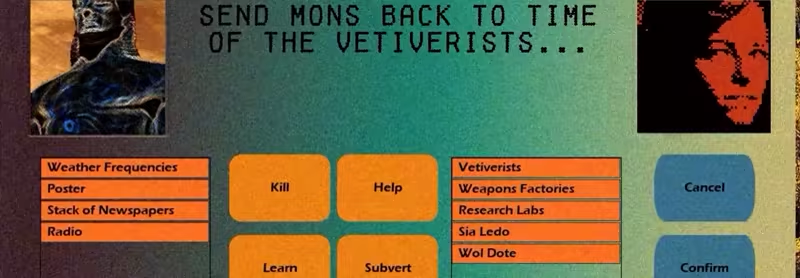
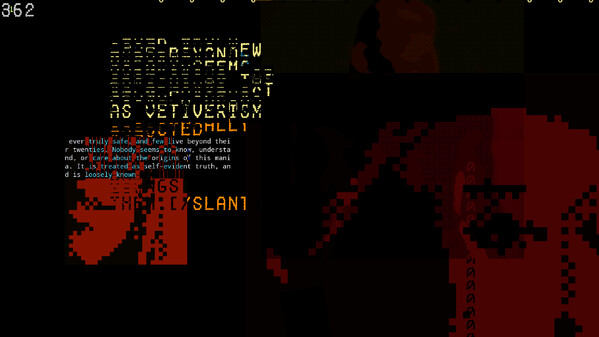
Control history in Decade - a groundbreaking indie adventure. Explore an alternate past. Discover how its ideas develop, distort, and disappear. Seed new movements, destroy others. Subvert the rise and fall of empires, art, ideologies, and individuals in this experimental narrative game.
Modeled estimate, not a reported figure. How we estimate →
Media

About
Decade is an experimental adventure game where you will send children back into the past - ten years at a time - to learn how the world ended, and what you can do to change it.

Investigate documents, technologies, and artefacts to understand history. Manage the children and their abilities as they age dramatically. Try to make the right decisions as you create multiple futures that you can venture into.

20 FMV endings to discover
A deep and complex narrative (Over 50k word script)
9 unlockable themes - each with its own soundtrack
A unique and compelling gameplay mechanic

Decade is a first-time solo-dev project.
Stats
All-time low is the lowest price we've recorded for this game since we started tracking it.
Languages: English**languages with full audio support
Engagement
Hours played at review time, across 40 reviews with recorded playtime.
Reviews
Themes across 40 recent reviews and how positive each mention is. A keyword signal, not full sentiment analysis.
positive critical· bar length = how often the theme comes up
Reviews
Very interesting game to say the least. While the ending depends on the choices you make, it's not evidently clear what choices you have to make. Instead of pointing you towards a objective you are completely in free roam to change history based on the information you have at hand. Solid game
Things I learned from this game: - I follow Rosianism - I do not wish to murder the author of this game because of a disagreement on the nature of beauty
Decade's got that sort of razzle-dazzle that you'd get from a very good New Age science fiction paperback: introspection without preaching, aesthetics backed by substance, and, best of all: a sense of humor. My only regret is that I wolfed the whole thing down too eagerly. This is a game meant to be sat and thought on. I wholeheartedly recommend it if you're an anthropology guy, an appreciator of culture in all its forms, or you think that graphic design is totally ♥♥♥♥♥♥♥'.
Decade, developed and published by Last Piscean, is a deeply unconventional narrative strategy game that leans more toward interactive fiction and conceptual design than traditional gameplay. It’s built around the idea of reshaping history through indirect intervention, asking players not to act within a world, but to interpret it, manipulate it, and gradually understand the forces that led to its collapse. The result is a slow, intellectually demanding experience that stands out for its ambition as much as for its occasional opacity. The premise immediately establishes a sense of tension and purpose. After a catastrophic event known as the “metal rain” devastates humanity, you find yourself in a bunker with three surviving children and access to a time machine. The central mechanic revolves around sending one of these children back into the past for ten years at a time. They return older, changed, and carrying the consequences of your decisions—whether in the form of knowledge, artifacts, or entirely new interpretations of history. This looping structure creates a layered system where each decade becomes both a continuation and a re-evaluation of previous actions. Gameplay unfolds through menus, reports, and conversations rather than direct control. You never see the past firsthand; instead, you piece it together through the fragments your characters bring back. This design choice shifts the focus from action to analysis. Each decision—who to send, what tools to provide, what ideological direction to pursue—has far-reaching consequences that ripple across timelines. Over time, you begin to recognize patterns and connections, slowly building an understanding of how different movements, events, and philosophies contribute to the world’s eventual downfall. What makes Decade particularly compelling is how much it trusts the player. It offers very little guidance, expecting you to engage with its systems through careful observation and experimentation. The narrative is dense and often abstract, filled with fictional ideologies and historical threads that require attention to fully grasp. When it works, this creates a powerful sense of discovery, as players begin to unravel the logic behind the game’s world. However, this same complexity can also be a barrier, making the experience feel overwhelming or unclear, especially in the early stages. The children you send through time are more than just tools—they are central to both the mechanics and the emotional weight of the game. Each has unique traits that influence how they interact with different eras, and these traits evolve as they experience multiple timelines. Watching them age and change adds a subtle but meaningful layer of consequence, reinforcing the idea that every decision carries a personal cost. It’s not just about fixing the timeline; it’s about how those attempts affect the individuals involved. Structurally, the game encourages multiple playthroughs. There are numerous possible outcomes, each shaped by the choices you make across different decades. Many of these endings are far from ideal, reflecting the complexity of the systems you’re trying to influence. Rather than offering a clear path to success, the game presents a series of possibilities, each revealing new information and prompting further experimentation. This iterative approach gives Decade a strong sense of replayability, though it also means that progress can feel slow and sometimes repetitive. Visually, the game is intentionally minimalistic. It relies on simple interface design and understated visuals, keeping the focus on text and decision-making. This approach reinforces its conceptual nature, but it may also make the experience feel less immediately engaging for players who prefer more dynamic presentation. The audio design follows a similar philosophy, providing subtle background elements that support the tone without drawing attention away from the narrative. Where Decade struggles is in its accessibility and pacing. The heavy reliance on text and abstract systems can make it difficult to fully understand the impact of your choices, leading to moments where progress feels more like trial and error than deliberate strategy. Repetition can also set in as players revisit similar scenarios in search of different outcomes. These issues don’t undermine the game’s core ideas, but they do make it a more demanding experience than most. Despite these challenges, Decade succeeds in offering something genuinely unique. It’s a game that prioritizes thought, interpretation, and long-term consequence over immediate feedback. Its exploration of themes like ideology, causality, and the nature of change gives it a depth that is rarely seen in more conventional titles. It may not appeal to everyone, but for those willing to engage with its systems, it offers a rewarding and thought-provoking experience. In the end, Decade is less about winning and more about understanding. It asks players to think critically, to experiment, and to accept that solutions are rarely straightforward. That ambition makes it uneven at times, but also memorable in a way few games achieve. Rating: 8/10

while i feel i'm a bit too stupid for what the game expects of you to progress, as i've felt my reading comprehension being pushed to its limits, this is an incredible pseudo mixed media experience, with a catching philosophical dialogue attached to it. post-modern kino's journey
it's quite an achievement to be so descriptive with so few words and to be so vast in scope with sparse visuals. kinda like this review!
The things you choose to lose
this goes insanely hard the person who left the review saying they wish they'd taken more time vs wolfing it down -- that is definitely true, take your time with this, it's very thoughtful and deserves consideration
It's a really fun game for people who like sci-fi, time shenanigans and uncovering a rich story of clashing philosophies. However, over the last hour I played, the game crashed 5 times when I'd skip too much dialogue. If this gets fixed, then it's gonna be real close to a 9/10 game. --- [b]DO NOT PLAY THIS GAME IF YOU HAVE PHOTOSENSITIVE EPILEPSY![/b] I'm only photosensitive so I could manage with my screen filters, but all endings have bright colors and flickering video filters, and some have rapidly changing images and flashes (like the Salvage Ending).
Very cool idea for a time travel story and the narrative that goes with it; how each time somoene is sent back, they have to live out 10yrs of their life there until they can return, and it changes their personality/traits in some way, as well as their attributes they take with them can influence time as well. Very cool. In a nutshell, you have a team of 3 people (3 kids) that you need to selectively send back to different periods of time to try and influence a better (or different) outcome for the future. Because right now it's raining metal and has torn humanity to pieces. That alone is pretty metal... Pun unintended, sorry... But because each person ages 1oyrs on each travel, they have a finite amount of times to send them, as well as any other outlier attributes that can influence/altere the outcomes made (I woin't say too much). The only drawback is to be prepared to re-read some repeat dialogue on multiple playthroughs - there is a lot of magic in the first time around, and some of that willl dissapate with repeat plays but to be honest, as long as you're ok with reading a lot of text, it's really quite engaging and also fascinating to see how many different ways humanity can screw up Earth. :D I bought the game ouright based upon a YT review, but it looks like there is a demo now, so I would say to find out if this is something for you, try out the demo. It is definietly a innovative experience to try though.
Related
Related
Trends
Modeled estimate over time, reconstructed from Steam's monthly review histogram.
Momentum
Pace estimated from the game's recent review growth (our daily snapshots) at its own sales-per-review ratio — a momentum signal, not booked sales.
Audience
Estimated from the language of this game's reviews — a proxy for where players are, not official Steam demographics.
Related
| Enchanted Blacksmith | $22.8K | 78 | 81% | $9.99 |
| 血姬:双生 (Vampiress: Eternal Duet) | $22.8K | 91 | 85% | $9.99 |
| DREAMOUT | $22.8K | 90 | 93% | $9.99 |
| Queen's Quest 4: Sacred Truce | $22.8K | 96 | 65% | $14.99 |
| Ghost Encounters: Deadwood - Collector's Edition | $22.8K | 172 | 48% | $6.99 |
| Galaxy Girls | $22.8K | 144 | 67% | $9.99 |