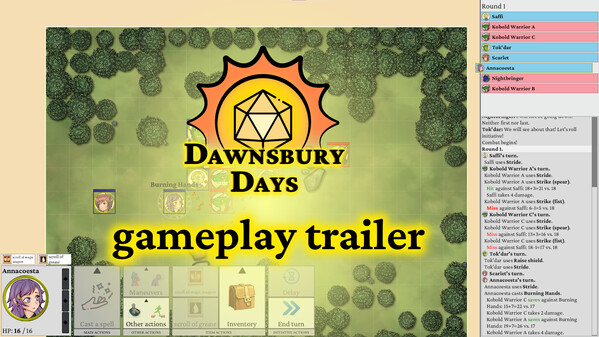
Lead a group of childhood friends through their first adventures in a turn-based tactical RPG played under the rules of PF2E, the second edition of a powerful OGL ruleset. Customize their builds, acquire loot, and level up, and ultimately defeat the sinister enemies who threaten your hometown!
Modeled estimate, not a reported figure. How we estimate →
Discounts
Every price cut of more than 20% we have observed, in each market that quoted one, with this game's chart position on either side of it. These are episodes, not a model: a sale is one event, and one event cannot tell you what the next one will do.
For scale, across Steam · Top Sellers · Brazil over the last 30 days: the 25 chart moves that followed a price cut of more than 20% went a median of 10 places towards #1, and the 2,413 moves with no price cut behind them went 2 away. One store, one chart, one country — it is the only place we have enough observations to say even that.
Prices outside the United States have been collected since 6 August 2026 and chart positions since 19 July 2026, so a cut older than that has no market to compare and a market that joined later has no history yet. Nothing here is converted between currencies.
About
Dawnsbury Days is a turn-based tactics roleplaying game with cRPG elements that's based on the rules of PF2E, the second edition of a powerful tabletop ruleset originally published under the OGL.
You play as the Dawnsbury Four, a group of four young heroes from a small town. You choose their class, feats, spells, and other abilities as you lead them through a quest to save their home town from a multitude of dangers, and then further adventures beyond.
You will fight monsters and face dangers, yes, but you will also make friends, acquire loot, and level up, and eventually — hopefully — you will defeat whatever sinister force is behind all the dangers that have beset Dawnsbury for the last seven years.
The main adventure can take about 4 hours for a single playthrough (about 13 hours total including expansion follow-up adventures), but you can then replay it with different party compositions and besides the main adventure path, you can also try and defeat some of the powerful foes in additional scenarios in free encounter mode.
A complex rule system which makes for strong strategic gameplay, highly faithful to the tabletop rules
Extreme character customization
9 ancestries (Dwarf, Elf, Gnome, Goblin, Halfling, Human, Leshy, Oozekin, Orc)
17 classes (Alchemist, Barbarian, Bard, Cleric, Druid, Fighter, Champion, Kineticist, Magus, Monk, Oracle, Psychic, Ranger, Rogue, Sorcerer, Strategist, Wizard), each with different play patterns
300+ feats and 450+ spells to further customize your characters
More available through mods
20+ encounters in the main adventure path telling a story of childhood friends braving their first serious challenges in adventuring, and 30+ additional scenarios in free encounter mode (more available with the Profane Barrier and Good Little Children Never Grow Up DLC expansions)
Full voice acting for every single line, with cutscenes at the beginning and end of every encounter
Character level cap is 4. (It increases to 9 with the DLC expansions; and to 15 with the upcoming Four-Leaf Clover expansion.)
Highly moddable: Support for custom maps, encounters, campaigns, portraits, rules, classes and more
Each turn, you get three actions to spend on moving, attacking, casting spells, taking combat maneuvers, drinking potions, and defensive or other actions.
You can preview the effects and success probability of all actions before you commit and weigh your options. All combat encounters are balanced, but many are difficult: To win the game reliably and consistently on harder difficulties, you will want to make use of almost all of your options.
Every +1 matters: Buffing your allies, and demoralizing or flanking your enemies are often better options than making a third attack in a turn which would be affected by a very punishing multiple attack penalty anyway.
This game is a cinematic experience, where you fight one combat encounter after another, and these fights are interspersed only with (fully voiced!) cinematic cutscenes. The game doesn't waste your time: animations are lightning fast, cutscenes skippable, and you can really focus on the engaging combat experience.
Or you can choose an easy difficulty, and enjoy the story of the Dawnsbury Four, young adventurers full of hope and optimisim grappling with their first real challenges.
Ever since the Night of the Shooting Stars seven years ago, the small town of Dawnsbury has been beset by dangers. The nearby volcano hasn't ceased erupting, support from neighbouring towns has lessened and kobold brigands terrorize the countryside. What's more, the Golden Candelabra, an artifact that protected Dawnsbury for generations, has been lost that same night.
But now new heroes may rise up: you play as the Dawnsbury Four, a group of childhood friends who have trained for years under the tutelage of the town mentor Roderick, and you are now finally ready to embark on your first quest: to find and retrieve the Golden Candelabra and bring it back to Dawnsbury where it belongs.
But even that may only usher in further dangers and provoke whatever sinister force is behind all these woes...
Dawnsbury Days uses the rules of PF2E, the second edition of a powerful tabletop ruleset originally published under the OGL, and strives to remain as faithful to them as possible, so that the gameplay of Dawnsbury Days mirrors your experiences when playing with friends around the table.
You play exclusively in turn-based mode on grid-based battlefields, and you can preview and review all dice rolls required to make attacks, saving throws or to deal damage.
The game also aims to replicate the elusive 'feel' of a tabletop roleplaying game, with story, characters, and encounter design all in service to that goal.
You choose your characters' ancestry, heritage, background, class, subclass, ability scores, skills, feats, spells and items — and that's just at level one.
On each level up, you select from additional feats (and for spellcasters, spells) to further customize your character.
There is an extreme variety of weapons, armor and worn and consumable items to complement your character.
But you can also choose to skip all of that and use one of the many pregen characters which are pre-built for each level, complete with items, and you can even have them level up automatically.
Besides the main adventure path, you can also fight additional scenarios with minimum story but with the same engaging gameplay.
You can also download custom encounters created by modders from the Steam Workshop for additional challenge and variety. Some of these can be really difficult and unique!
Dawnsbury Days is fully moddable, and there are already 100+ mods available on the Steam Workshop. With mods, you can add custom ancestries, backgrounds, classes, feats, spells, and even variant rules. Documentation on how to create custom mods, including example mods, is included with the game and is available in the Steam community hub as well; and there are modder support channels on the Dawnsbury Days Discord server.
Dawnsbury Days is a single-player game.
However, you can use Steam Remote Play Together to play it with your friends. In this mode, one player hosts the game, and other players can control the game with their mice and keyboards as well. Each player can then control their own character.
You can further combine this with the in-game "GM mode" which allows you to precisely control each enemy creature instead of having the computer move them automatically.
The Dawnsbury Days base game focuses on combat encounters, though it does have some exploration and downtime elements — enhance your weapons with runes, find secret doors, buy and sell items, deal with hazards.
In the first expansion (character levels 5–8), you will see more exploration sequences, optional sidequests, and noncombat social encounters as well.
The second expansion (character level 9) is even more freeform and is nonlinear — you will see out-of-combat skill checks, dialogue trees, conversations with secondary NPCs, and a lot of optional hidden secrets.
The third expansion (character levels 10–15) is a true cRPG. You will gain a home base that you can improve and customize, you will collect and read books, and complete sidequests. You will speak with many enemies with dialogue trees, often affecting combat or even entirely preventing combat based on conversation. Your choices early on will affect the story later. The game becomes even more nonlinear and often offers multiple ways of dealing with a problem.
Genres
Stats
All-time low is the lowest price we've recorded for this game since we started tracking it.
Engagement
Reviews
Themes across 84 recent reviews and how positive each mention is. A keyword signal, not full sentiment analysis.
Reviews
Even as a complete beginner to pf2e its easy to get into. The devs also do not use AI.
I'd like to echo a lot of the other very positive recommendations here. This is a real gem. It strikes a great balance between customizing a small team of characters without feeling bogged down in excessive detail management. It focuses on quickly moving into a variety of combat encounters. Being thrown immediately into the action again and again was refreshing given it barred the time sink of pre-casting defensive spells or the like. You can simply focus on trying to develop an effective team that has to react fast with every new battle.
Media

Related
Related
Price dynamics, follower growth, revenue and sales trajectories with interactive tooltips
This and every other Pro feature is free until October 20, 2026. A free account is all it takes.
Languages: English**languages with full audio support
Hours played at review time, across 84 reviews with recorded playtime.
positive critical· bar length = how often the theme comes up
A wonderful way to engage with PF2E
I don't feel the need to review games very often, but Dawnsbury Days is just so good. It's not just that it's good, but it has heart and character oozing out of every pore. Can't recommend enough.
An absolute slam dunk of argument in favour of "I want shorter games with worse graphics made by people who are paid more to work less". This is an extremely faithful translation of Pathfinder 2nd edition into the tabletop, and captures all the depth and strategy that make the tabletop game so enjoyable. As a fantasy grid-based skirmish simulator, it's superb. The graphics are simple and the UI is basic but this is all extremely functional - my only real critique of the visual presentation is that it took me a long time to figure out how to swap runestones between weapons, which hampered my first playthrough a fair bit. The plot is extremely simple (essentially a way to contrive one combat scenario after another) and the voice acting is cheesy but very charming, and the base game doesn't really do much with PF2's non-combat gameplay, though this gets developed a lot more in the expansions, especially in Good Little Children Never Grow Up. Some branching narrative choices and more noncombat challenges and puzzles would go a long way to capturing an authentic tabletop experience. Overall, if you ever wanted to try Pathfinder 2nd edition, or if you just want the feel of a tabletop RPG as a computer game, I'd really recommend Dawnsbury Days, it's an absolute gem of a game.
I just finished the first campaign and the game surpassed my expectations. You can really customize your party as you like (only the voice-gender is locked for each character) but all the rest has all the build potential of other Pathfinder games.
Dawnsbury Days is a good-natured little game that punches above its weight. It's less of a CRPG than it is an encounter simulator, primarily focused on combat, though as a combat simulator it's very competent. If you don't mind that the story evokes a child's storybook rather than an epic fantasy adventure, and you can look past the gets-the-job-done graphics, there's a good time to be had here. It's important to point out that this game employs the Pathfinder 2e rules, and brings with it the benefits and drawbacks of that system. I quite like it relative to something like D&D. Build variety is superior and it's more balanced overall. It's nice that the three-action economy means that turns aren't (always) wasted if you fail something; it also feels a little more streamlined than D&D's distinction between actions, bonus actions, and movement. However, it's a complex system and Dawnsbury doesn't really tutorialize it, instead providing a manual to look over. I suspect that someone new to the rules -- especially if they're not a seasoned TTRPG player -- could find it a little confusing or daunting. Its implementation of the rules is pretty good, with some caveats. The game does make some changes to the rules to accommodate the game's design, such as how recall knowledge is handled. That's all fine, honestly. Some of the classes are closer to their tabletop versions than others, and some are missing, though I think there are mods for basically all missing classes. The feat selection (feats are like abilities you can choose for your character as you level up), especially general and skill feats, is quite limited. There's rarely anything useful to pick from as I level up the characters. General feats aren't intended to massively empower your character, but the selection here is such that it's hardly worth taking the time to choose one. The game really could've used just a few more. And some other feats are missing for reasons I don't understand (like Doctor's Visitation, which IMO is half of what makes the medic archetype worth taking). Further, some skills and abilities just aren't very useful in this context. Social skills don't really come up, for example, and neither do the broad knowledge skills (e.g. religion or arcana) or crafting. This definitely isn't a typical CRPG that rewards you for investing in non-combat skills. I think this might be improved in the second DLC, but I haven't made it quite that far yet. Finally, and it's kind of an elephant in the room if you're familiar with PF2e, but this uses pre-remaster rules. The reasons for this lie at the feat of licensing. My understanding here is limited, but it's something to do with the fact that the pre-remaster rules are licensed under the Open Gaming License (OGL), whereas the post-remaster rules are licensed under the Open RPG Creative License (ORC). These are not compatible. The exact nature of the conflict is unclear to me, but the end result is that Dawnsbury Days will not be getting a remaster glowup. It's not a *huge* deal, but for someone (like me) who came into Pathfinder after the remaster, it's a bit of an adjustment. That said, the game offers a very extensive modding API, and you can drag the game most of the way to the remaster by piling on the right mods. This won't change everything (for an obvious example, the characters break the fourth wall by referencing rules that don't exist anymore, like alignment). But it suffices. In the scheme of things I consider all of those caveats nitpicking. All in all: at its asking price the game is a steal, and it's [i]constantly[/i] being updated and improved by the dev, so your five bucks (or whatever) seems like it'll buy you continued support. DLCs are being developed, too. If the idea of a breezy combat simulator using the best mass-market tabletop RPG system appeals to you, this is a must-buy.
Good fun and one of your best bets if you want to see how a pf2e class works before playing it in a campaign. The game is largely premaster but the modding API is kind enough that folks made mods for most things you might desire.
This game good as ♥♥♥♥ I've never played pf2e before but I picked it up really quick and breezed through the main campaign heading to the DLC now! :)
Kinda cheesy plot. The voice acting makes me think there's something wrong with mic quality. The tokens representing the characters doesn't even have a uniform artstyle. Honestly? This is the best approximation of what it's like to play VTT simulator with friends at an actual role playing session when they do their best amateur roleplay attempts. It's no Baldur's Gate, but it was enjoyable. Really impressive implementation of Pathfinder 2e mechanics even though I found during playtime that I still preffer DnD. The only major issue I could find was that it really was just encounter to encounter combat, Not until the second dlc skills play a major role and even then it's way too short for the asking price. I got it on sale, you should get it on sale. Get the first DLC even if you skip the second one.
Players by region
Where this game's players are, estimated from review languages.
Related
| Game | Estimated lifetime revenue | Reviews | Review score | Price |
|---|---|---|---|---|
| $303.3K | 632 | 83% | $19.99 | |
| $7.4K | 51 | 96% | $2.99 | |
| $54 | 1 | 100% | $2.49 | |
| $0 | 0 | 83% | Free | |
| $1.3M | 3.4K | 95% | $7.49 | |
| $272K | 700 | 93% | $17.99 |
Related
| Game | Estimated lifetime revenue | Reviews | Review score | Price |
|---|---|---|---|---|
| $49.4K | 110 | 75% | $19.99 | |
| $49.4K | 776 | 94% | $3.99 | |
| $49.4K | 137 | 90% | $14.99 | |
| $49.4K | 76 | 87% | $16.99 | |
| $49.4K | 450 | 82% | $4.99 | |
| $49.4K | 299 | 90% | $4.99 |