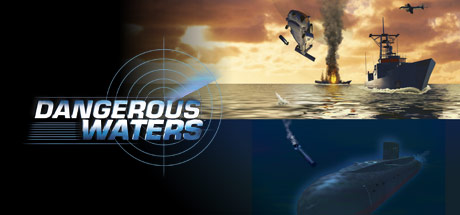
Dangerous Waters is a demanding and uncompromising military simulation that remains one of the most detailed portrayals of modern naval combat ever released on PC. Developed by Sonalysts and published by Strategy First, the game was never designed to appeal to a broad audience. Instead, it targets players who crave realism, procedural depth, and a genuine understanding of how modern naval warfare actually functions. From the moment you step into your first mission, it is clear that Dangerous Waters prioritizes authenticity over accessibility, asking players to think like real-world naval officers rather than arcade pilots or action heroes.
The gameplay revolves around commanding a wide range of naval platforms drawn from contemporary military arsenals, including nuclear-powered submarines, diesel-electric submarines, surface combatants, maritime patrol aircraft, and helicopters. Each platform can be controlled at multiple stations, allowing players to jump between sonar, navigation, fire control, radar, and command roles as needed. Rather than simplifying these systems, the game models them with remarkable fidelity, forcing players to interpret sonar contacts, manage sensor noise, plot intercept courses, and carefully plan weapon deployments. Combat is rarely immediate or flashy; instead, it unfolds slowly, often over long stretches of tense silence punctuated by moments of sudden, decisive action.
Submarine warfare is where Dangerous Waters truly distinguishes itself. The game places enormous emphasis on acoustic stealth, positioning, and patience, making undersea combat feel like a high-stakes chess match played in near darkness. Players must constantly balance speed against noise, depth against detection risk, and aggression against survivability. Identifying a contact is rarely straightforward, as sonar returns can be ambiguous or misleading, demanding careful analysis and cross-referencing. This creates a level of psychological tension that few games manage to replicate, where victory often comes from outthinking the enemy rather than overpowering them.
Surface and air warfare add further layers of complexity. Managing a surface ship requires attention to radar coverage, missile defense, and coordination with allied units, while aircraft operations introduce entirely different tactical considerations such as search patterns, fuel management, and sensor range. The game encourages players to think holistically, combining assets rather than relying on a single platform. Success often depends on information superiority — knowing where the enemy is before they know where you are — reinforcing the game’s core theme that modern naval combat is as much about data and detection as it is about firepower.
The structure of Dangerous Waters supports long-term engagement through campaigns, standalone missions, and a powerful mission editor. Campaigns place players within broader geopolitical conflicts, lending narrative context and strategic continuity to individual encounters. The mission editor, meanwhile, has played a major role in the game’s longevity, enabling a dedicated community to create and share custom scenarios that expand the experience far beyond the original content. This community-driven ecosystem has helped keep the game relevant years after its release, especially among hardcore simulation enthusiasts.
Presentation is utilitarian and reflects the game’s age, but it serves its purpose effectively. Visuals focus on clarity rather than spectacle, with much of the action conveyed through tactical displays, sonar waterfalls, and radar screens rather than cinematic views. While the 3D graphics and interface feel dated by modern standards, they remain functional and readable. Sound design plays a critical role, particularly in submarine operations, where subtle audio cues can mean the difference between remaining hidden and being detected. The inclusion of voice command support further reinforces the simulation mindset, allowing players to interact with systems in a way that feels surprisingly immersive.
The most significant barrier to entry is the game’s learning curve. Dangerous Waters demands time, study, and patience, often requiring players to consult manuals or community resources to fully understand its systems. Tutorials are limited, and the game assumes a level of prior knowledge that can be intimidating for newcomers. However, for those willing to invest the effort, this complexity becomes one of its greatest strengths, offering a sense of mastery that few modern games attempt to deliver.
Ultimately, Dangerous Waters stands as a benchmark for realism-driven naval simulations. It is not flashy, forgiving, or easy to approach, but it offers an unparalleled depth of tactical and procedural gameplay that continues to reward serious players. While casual gamers may find it overwhelming or outdated, those with an interest in military simulation, naval strategy, or submarine warfare will discover an experience that remains intellectually engaging and deeply satisfying even years after its original release.
Rating: 7/10