Chinatris, developed by 仓鼠动力 and Args Studio and published by Gamirror Games, is a fascinating experiment that merges traditional Chinese linguistics with the universal appeal of puzzle gaming. At first glance, it seems like a simple twist on the falling-block formula pioneered by Tetris, but a few minutes of play reveal something entirely different. Instead of geometric blocks, the player is tasked with manipulating the building blocks of the Chinese written language—radicals and strokes—to form complete characters. It’s a concept that feels both ingenious and culturally rich, transforming the structure of Chinese script into an elegant mechanical system. Each falling piece represents a linguistic component, and the player’s goal is to align and combine them to construct correct characters. Success brings both satisfaction and learning; when a character is completed, its pronunciation appears, giving the player a subtle educational reward layered within the gameplay loop.
The game’s mechanics blend familiar puzzle conventions with language-based logic. Radicals descend from the top of the screen, and the player must place them correctly to form legitimate characters from a given set. The challenge lies not only in recognizing which components fit together but also in anticipating future pieces and making spatial decisions before the screen fills. As in Tetris, poor planning can quickly lead to chaos, but in Chinatris, mistakes feel more cerebral than physical—an incorrect combination may yield an invalid character, forcing players to start anew or rethink their sequence. This system fosters a rhythm that’s both meditative and mentally demanding. For native Chinese speakers, it becomes a playful test of recall and structure; for learners or those unfamiliar with the language, it operates as an intuitive introduction to character construction. It’s a rare game that manages to function simultaneously as an educational tool and a deeply engaging puzzle experience without sacrificing either purpose.
Visually, Chinatris takes a minimalist approach that perfectly complements its cerebral nature. The interface is crisp and uncluttered, emphasizing clarity over flair. Each radical is represented as a clean, high-contrast symbol, easily distinguishable even in the midst of quick decision-making. The muted backgrounds and restrained color palette prevent distraction and allow players to focus entirely on the interplay of shapes and meanings. The sound design follows the same philosophy of restraint. Gentle audio cues mark successful combinations, while subtle background music provides an ambient calm that supports concentration. The overall effect is one of quiet focus—the kind of atmosphere that invites players to lose themselves in thought rather than in sensory overload. The simplicity of the presentation also ensures the game runs smoothly on virtually any system, making it as accessible as it is conceptually ambitious.
As players progress through the stages, Chinatris gradually escalates in complexity. Early levels serve as an introduction to basic radicals and straightforward combinations, easing players into the system’s logic. Later puzzles introduce rare characters, time constraints, or irregular combinations that require quick recognition and planning. The pacing feels deliberate, allowing players to internalize the mechanics before truly testing their mastery. Some stages, however, can feel punishingly dependent on luck. Because the order of falling radicals is partially randomized, there are moments when success hinges as much on timing as on knowledge, leading to occasional frustration. Yet these instances rarely overshadow the overall satisfaction of solving a puzzle through insight and precision. When everything aligns—a perfectly timed piece, a correctly formed character, the smooth unveiling of pronunciation—the game rewards the player with a quiet sense of accomplishment that few puzzle games manage to evoke so elegantly.
One of the most interesting aspects of Chinatris is how it bridges the gap between linguistic structure and spatial reasoning. It encourages players to think about Chinese characters not as abstract symbols but as living systems built from modular parts. This awareness mirrors how native speakers learn to read and write, turning the player’s engagement into something akin to the process of literacy itself. Each character becomes a puzzle, a miniature architecture of meaning, and every successful build reinforces both skill and understanding. In this sense, Chinatris accomplishes something few games even attempt—it transforms cultural knowledge into an interactive framework. Whether intentionally or not, it becomes a form of digital cultural preservation, presenting the logic and artistry of Chinese script to a global audience in an approachable way.
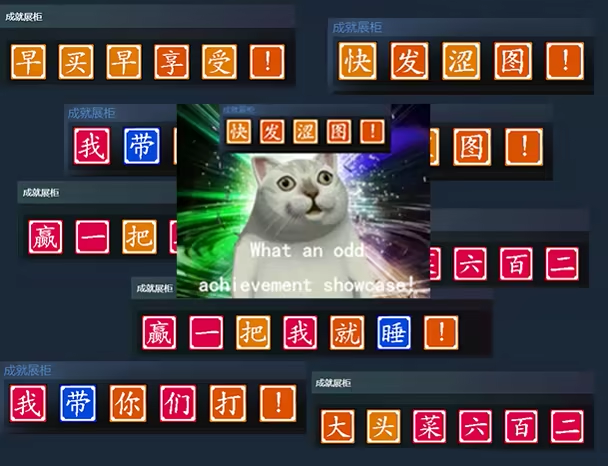
Technically, the game performs admirably. Its lightweight design ensures smooth operation even on modest hardware, and load times are practically nonexistent. The controls are responsive and intuitive, whether played with a keyboard, mouse, or controller. The inclusion of achievements and progression goals adds replayability, encouraging players to chase perfection or aim for higher scores. Still, some may find that the visual sameness and slow evolution of the core loop eventually lead to fatigue. The game’s focus is narrow by design, and while that focus gives it strength, it also limits its variety. For those seeking spectacle or narrative, Chinatris will feel sparse. For those drawn to intellectual challenge and elegant minimalism, however, it offers a uniquely rewarding experience.
Chinatris stands out as a work of quiet brilliance—a game that merges the logic of puzzles with the art of language in a way that feels natural and inevitable once experienced. It captures the meditative satisfaction of pattern recognition while teaching, almost subliminally, the structure of one of the world’s oldest writing systems. It’s not a flashy or emotionally charged experience, but it’s one that lingers, inviting reflection long after a session ends. As both a puzzle game and a cultural artifact, it succeeds through clarity of purpose and elegance of design. For players seeking something thoughtful, precise, and genuinely original, Chinatris is a small gem that rewards patience and intellect in equal measure, standing as a testament to how games can educate, challenge, and inspire through the simplest of mechanics.
Rating: 8/10