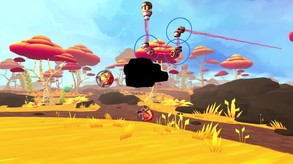
Carpe Lucem challenges and entertains players by transferring classical 2D puzzles into the virtual space. It creates a whole new way of interacting and playing mind teasing puzzle games and it made nobody sick in hundreds of demos at trade shows. VR equipment such as HTC Vive or Oculus required.
Modeled estimate, not a reported figure. How we estimate →
Media

About
Stats
All-time low is the lowest price we've recorded for this game since we started tracking it.
Languages: English
Engagement
Hours played at review time, across 40 reviews with recorded playtime.
Reviews
Themes across 40 recent reviews and how positive each mention is. A keyword signal, not full sentiment analysis.
positive critical· bar length = how often the theme comes up
Reviews
Очень приятная игруха. Расслабляет. Остается только собраться обратно, и решить, покупать ли ее за полную стоимость. Я сходу прошла половину уровней. Может дальше и пойдет "жесть" :) Но сейчас ощущение, что игра короткая, да и графика дух не захватывает, прсто хорошая. Хотя там есть возможность самому создавать загадки, должно быть тоже интересно. Приобритением в целом довольна. Электриков хорошо на этих паззлах тренировать.
Slow paced, relaxing puzzle games in beautiful cartoony enviroments.
Really fun and relaxing game. I made a 2 minute review here! https://youtu.be/I97Qbn-_zKc
Un superbe jeu de casse tête en 3D dans une ambiance zen. Un des must de la VR et qui change des autres jeux que l'on trouve actuellement pour les casques. Ne pas hésiter !
Beware no Oculus support but otherwise this game is amazing. It is basic but very calming and enjoyable, with later puzzles being fairly challenging. User created puzzles are also support.
Carpe Lucem – Seize The Light VR, developed by Hammer Labs and published by Application Systems Heidelberg, is a thoughtfully designed virtual reality puzzle experience that transforms the simple concept of manipulating light into a fully immersive, spatially driven challenge. Built specifically for VR platforms, the game embraces room-scale interaction and 360-degree environments to create a meditative yet intellectually engaging adventure. Rather than relying on action-heavy gameplay or cinematic spectacle, it focuses on calm exploration, hands-on experimentation, and the quiet satisfaction of solving optical puzzles in three-dimensional space. At its core, Carpe Lucem revolves around guiding beams of colored light through intricate mechanical environments in order to activate and bloom stylized flowers. The player interacts with a variety of optical tools—mirrors, prisms, filters, teleporters, and magnets—each of which alters the path, color, or direction of light. Unlike traditional puzzle games confined to flat screens, every object exists physically within the player’s immediate VR surroundings. You reach out with motion controllers to rotate mirrors, reposition prisms, and adjust devices in real space. This tactile manipulation reinforces the illusion of presence and transforms abstract puzzle mechanics into something almost tangible. The progression unfolds across three distinct thematic worlds, each introducing new mechanics and gradually layering complexity onto earlier concepts. Early levels function as gentle tutorials, encouraging experimentation without imposing time limits or penalties. There is no sense of urgency; instead, the design promotes curiosity and patience. As players advance, puzzles demand more intricate configurations of reflective surfaces and color combinations, requiring careful spatial reasoning and multi-step planning. What begins as a simple redirection task can evolve into a carefully orchestrated sequence involving several interconnected components. One of the game’s strongest qualities is its atmosphere. The visual style blends steampunk-inspired mechanical elements with dreamlike landscapes. Floating structures, softly glowing flowers, and whimsical environmental details create a tranquil yet mysterious ambiance. The lighting effects themselves are particularly well executed, with beams refracting and scattering convincingly in ways that enhance immersion. Complementing the visuals is an adaptive soundtrack that shifts subtly as puzzles progress, reinforcing a contemplative mood rather than heightening tension. The use of VR technology is not superficial but integral to the design. Puzzle components surround the player, often positioned at varying heights and angles, encouraging physical movement within the play space. Looking around, stepping closer, or adjusting one’s position can reveal new perspectives on a problem. This spatial freedom differentiates Carpe Lucem from non-VR puzzle titles, as solutions frequently require thinking in full three-dimensional terms rather than on a flat plane. Importantly, the game avoids artificial locomotion that might cause discomfort; the stationary nature of the environments contributes to a comfortable and accessible VR experience. While the gameplay is rewarding, its scope is relatively modest. The main campaign includes roughly a few dozen levels, which can be completed in a relatively short timeframe by experienced puzzle players. However, the inclusion of a level editor and Workshop support significantly extends the experience. Players can design and share their own puzzles, introducing new configurations and challenges beyond the original content. This community-driven aspect enhances replayability and keeps the game relevant long after the base levels are solved. Accessibility is another notable strength. The intuitive mechanics make it suitable for newcomers to VR, offering a comfortable introduction to motion controller interaction without overwhelming complexity. At the same time, later puzzles provide enough layered logic to satisfy players seeking deeper challenges. The absence of timers, enemies, or high-stakes consequences makes it a relaxing experience, particularly appealing to those who prefer thoughtful problem-solving over reflex-driven gameplay. Technically, the game performs smoothly and maintains stable frame rates essential for VR comfort. Interactions feel natural with motion controllers, though the experience is most immersive when using room-scale setups. Seated play is supported, ensuring flexibility for different hardware configurations. The interface remains minimal, allowing the focus to remain on the puzzle environment rather than intrusive menus or HUD elements. Ultimately, Carpe Lucem – Seize The Light VR succeeds as a contemplative puzzle experience that fully embraces the strengths of virtual reality. It transforms the manipulation of light into a tactile, spatial activity that feels uniquely suited to VR hardware. While it may not offer an extensive campaign or high difficulty ceiling for seasoned puzzle veterans, its atmospheric presentation, thoughtful design, and community-supported longevity make it a standout example of early VR puzzle craftsmanship. For players seeking a calm yet mentally engaging experience that highlights the immersive potential of VR, it is a polished and satisfying journey through light and reflection. Rating: 7/10
cannot control game with quest 3, review 04/2025
Very good Game but not compatible with occulus Touch :-(
Lovely product; really enjoyed playing, just wish it was longer!
2 Minute Video Review → https://youtu.be/pPKZIKZbZp0 I'm surprised that I've never heard of this game until recently. It's a real unappreciated hidden gem. Serene, beautiful, challenging puzzle game. Highly recommended.
Related
Related
Trends
Concurrent players on Steam, sampled daily since tracking started.
Audience
Estimated from the language of this game's reviews — a proxy for where players are, not official Steam demographics.
Related
| Desert Law | $4K | 50 | 62% | $2.99 |
| Death Motel | $4K | 77 | 79% | $2.99 |
| UnderBackrooms | $4K | 71 | 38% | $3.99 |
| Escape From Russia: Mobilization | $4K | 289 | 84% | $0.49 |
| Light Fairytale Episode 2 | $4K | 63 | 95% | $2.49 |
| The Walking Vegetables | $4K | 198 | 89% | $0.99 |