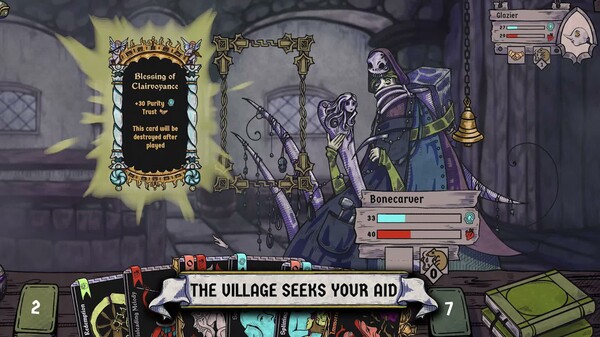
A grim medieval deckbuilder where you use your dubious healing methods to protect bizarre villagers from the corrupting influence of ancient evils.
Modeled estimate, not a reported figure. How we estimate →
Prices
The United States storefront in every case, so this compares stores and not countries.
Discounts
Every price cut of more than 20% we have observed, in each market that quoted one, with this game's chart position on either side of it. These are episodes, not a model: a sale is one event, and one event cannot tell you what the next one will do.
Reviews, worldwide (the counter carries no country): 0.57/day in the week to Aug 17 → 10.71/day in the week after.
For scale, across Steam · Top Sellers · Brazil over the last 30 days: the 25 chart moves that followed a price cut of more than 20% went a median of 10 places towards #1, and the 2,413 moves with no price cut behind them went 2 away. One store, one chart, one country — it is the only place we have enough observations to say even that.
Prices outside the United States have been collected since 6 August 2026 and chart positions since 19 July 2026, so a cut older than that has no market to compare and a market that joined later has no history yet. Nothing here is converted between currencies.
About
Take up the mantle of a medieval barber surgeon in BLOODLETTER, a deckbuilder inspired by the arcane art of tarot, ancient remedies of the flesh, and the surrounding superstitions.
4 Dreadful entities, each a foul spirit with its own wicked win condition and design
Each entity to be cleansed on three different difficulties
Unlock new content after a successful cleanse
80+ Cards bearing unique incantations, illustrations and titles
6 Blessing and curse cards capable of turning fate itself upon its head
11 Villager abilities letting you upgrade your deck and influence your run
10+ Transmuters changing the usability of your cards in the context of the active transmuter
1 Fantastical realm, steeped in medieval myth, mystery, and dread
100+ Story snippets welcoming you into the eerie world of BLOODLETTER
Take heed, barber-surgeon: the path of the bloodletter is not for the faint of heart. Salvation or damnation await.
Genres
Sums Steam only; GOG publishes no volume signal, so the true total is higher by an unknown amount.
| Store | Price | Audience | Score | Chart | Est. revenue |
|---|---|---|---|---|---|
SteamYou are here | $15.49 | 254reviews | 80% | — | $100.9K |
| $15.49 | 1ratings | 100% | — | not modelled |
Matched by title — a reused name can pair the wrong games. * is a critic aggregate. Prices and positions are each store's United States storefront; Epic charts worldwide. Audience and Score too, except Steam's, which is worldwide.
Engagement
Reviews
Themes across 164 recent reviews and how positive each mention is. A keyword signal, not full sentiment analysis.
Reviews
Fun little game. Has potential. Splendid art. Buuuuuut currently it is: 1. highly repetitive 2. not immersive , especially when your neighbors have no name no lifestory no nothing 3. as doctors, we want something to do other than just treating patients 4. monotonous music, fix it plz 5. not rewarding enough - noticed the change of looks and gestures but not enough Like I said, the game has potential, but now it`s far from complete, so looking forward to your next update and hopefully there`ll be more to chew on :) Oh and by the way, love the sound when you place the bloodstone into the socket plz don`t change it
bug很多,我玩了一个小时遇到了包括但不限于,猜忌消失的卡位能强行使用卡牌,选择恶魔阶段如果取消选择就无法再选,需要退出到主界面才能再次选择,3个宝剑碎片都放在框里但无法正常触发等,不过美术风格和玩法算是一个亮点,总的来说推荐这个游戏玩,如果能把这些影响体验的bug修好那就更好了。
Media

Related
Related
Price dynamics, follower growth, revenue and sales trajectories with interactive tooltips
This and every other Pro feature is free until October 20, 2026. A free account is all it takes.
Stats
All-time low is the lowest price we've recorded for this game since we started tracking it.
Languages: English*, German, French, Spanish - Spain, Japanese, Korean, Portuguese - Brazil, Simplified Chinese, Traditional Chinese*languages with full audio support
Hours played at review time, across 164 reviews with recorded playtime.
positive critical· bar length = how often the theme comes up
先说结论,不推荐,不推荐,不推荐,可玩性和随机性做的非常烂 优点:非常吸引人的克苏鲁画风,没了 缺点:里面的卡牌有接近一半都是废牌,而且有很多我不知道有什么意义的废牌,你本来一个人就能打出三张牌,那那种抽一张牌弃一张牌的牌有什么意义,放别的游戏等价抽0,问题是你这个游戏一个人只能打三张牌,还有那种免疫的牌,效果太差劲了,我用两张牌打出一张牌的效果,我为什么不去打两张加属性的牌 卡牌之间强度差别太大,有很多纯上位,还有很多强度设计一眼就不合理的牌,比如那个加20洁净20生命的,每用一次就-10,这个负面太大,初始给的也不多,打完两次就没用了,还要卡手里,还有那个初始+0,每次在手里结束的时候+5的,感觉真的不如那个在手里就无条件+3的,同样都是卡手,还有那个每次弃牌+5的,你初始只有5啊,你最弱的那个初始牌都有10,我没捞牌我弃它有什么用呢,那你说我打回收小循环,不是哥们我都打回收小循环了,我还在乎你这点数值啊 引导极其差劲:你不介绍我怎么知道两张拼合的牌要拼在一起才能发挥作用,还有那个调配,你根本就没写调配出来的牌会立即销毁,可以再打一张牌,在一个只能打三张牌的游戏里面,这么重要的功能你是一点也不介绍,还有一些迷惑性描述,里面太多太多,我不做举例 游戏性:太好了太好了,终于到这一部分了,我们先看你设计的洁净值和生命值两个部分,作为游戏的基础,洁净值在第二个boss和第四个boss里面毫无存在感,他的作用就是,你不是0就行,保证不死就行,你所有的随机性就是在开局塞得那三个诅咒里面,我不知道你们玩到困难了没有,开局卡组及其垃圾的同时,还要给你塞三个强力的诅咒,而且这三个诅咒是减信任的,尤其是第三个boss,我承认很有设计感,但是每晚散播那么多疾病和猜忌,开局还要给我三个强力诅咒,我是又要保血又要保洁净值,又要消猜忌又要解病,你自己看你的初始卡组了吗,一群废物卡牌,玩家最重要的就是赶紧删掉垃圾卡,赶紧找战力,所以磨坊主比其他人强太多,而其他人的技能强度设计的也不合理,我想问问制作组自己打过了吗,哦对了,还有你们设计的那个魂转器,前期选了就死,基本上不能提供及时战力,我战力够了还要选什么魂转器,有的魂转器真是只能特定场合发挥作用,第二个boss只需要慢慢磨,而第三个boss设计的让你一刻都不得闲,还要吸收一半的洁净值,主要还是废牌太多,我觉得第三个bos设计的的比第四个好,第四个设计的太差了,还是最终boss,玩完这个游戏我原谅了安东尼,安东尼不是猴子打字机孩子们,希望这个游戏后面能有更新吧
画风挺有特色的,难度主要看前期开局发牌和运营,boss穿刺者合成宝剑太难了,希望后面能多加点内容,目前肉鸽元素太少了,默认的操作动画速度也比较慢
악마3개 해금하고 적어봄. 아직 초반이긴 하지만 재밌네요~ 그림도 맘에 들고~ 컨셉도 좋음. 만원이면 그렇게 비싼 느낌 아닌거 같아요. 보니까 좋은 카드를 복사하는 거도 당연 필요하지만 개똥 카드를 없애는 게 더 중요한 거 같음!
There are two types of roguelike deckbuilders in my mind: the kind that thrive on variety and infinite replayability, thus allowing for all manner of combinations and synergies; and those that don’t have the same long term duration, but instead prove their worth due to their theming and unique gameplay style. Bloodletter definitely fits into the latter, and it’s one of the most interesting deckbuilders I’ve played in years – even if it probably won’t drain all my free time away. Many thanks to the publisher for the review code. As the game is releasing in early access, it is constantly changing and improving. Things discussed in the review may end up being out of date by the time you read it, so please bear that in mind. GOT ANY LEECHES FOR THIS? It certainly wasn’t easy living in medieval times. If you got ill, you’d have to visit the barber surgeon who would employ various barbarous measures in the hope that it would make you feel better. Perhaps it’s possible that the odd person did walk away feeling better, but given the average life expectancy of the time, I imagine it likely failed a lot more often. Bloodletter places you in the shoes of such a surgeon, who needs to keep his village healthy as disease rots them away each night. This infection isn’t a plague, however, but rather a curse from a demonic entity that is gradually draining the residents to death. As such, the only way your village can truly thrive into old age (maybe even thirty, if they’re really lucky!) is by cleansing the entity before it can claim the whole town. There are a few entities that you can choose to face, and each one has their own method of despatch. One of them is currently unavailable at the time of writing, but is set to drop before it leaves early access (soon!) – and hopefully more will come later down the line. The basic demon simply requires you to hit four increasingly higher purity targets to destroy, but even this can be tough as they sap away your town’s purity and health each night. During the day though, you can counter these effects by using your deck to treat patients. You’ll start off with a lean deck that can increase health or purity, or perhaps even eliminate any diseases they may have; but, as the days pass, you’ll build your deck and acquire a variety of cards with both positive and negative effects. This can be both a blessing and a curse, as larger decks also run the risk of having an unhelpful hand, but I appreciate that the game forces you to work with what you’ve got. After your shift ends, you can spend the evening visiting one of the townsfolk. Doing so will grant you a special bonus, from eliminating or duplicating cards, to adding bonus effects that help improve the quality of your deck. I really enjoyed the variety of possible effects, and I appreciate that you can manage the RNG by ensuring that your ideal villager remains trusting of you – as they are the only ones who will permit your visit. My only gripe is that there is one person who offers a 50% chance of healing everyone in town, yet out of the five times I used her, none of them resulted in success. Perhaps it was simply bad luck, but it seems as if there may be a bug affecting the odds. It’s a really engaging loop, especially as your deck gradually builds up and things start to get more stressful. It’s easy to get overwhelmed, especially in the mid-game, so you need to ensure that you always keep your game-plan in mind. Do you gain the trust of a villager and gain an extra card slot for them, or do you focus on recovering their stats instead? Is it worth giving them a big chunk of purity in exchange for multiple diseases that will wear their health away further? It’s a real balance, especially as you also need to be focused on eliminating the entity in order to truly win. What really makes this game special though is the fantastic art-style that perfectly encapsulates the medieval aesthetic, whilst also adding in their own bizarre twist. The Seamstress, for example, is an abomination covered in blades that are fitting for her profession – but also makes it look like her previous place of residence was in Silent Hill. The cards display medieval practices and rituals in both gory and disgusting detail, many of which show off the horror of ancient medicine. There’s very little to fault with the game, which is why it’s a shame that it’s not quite up to snuff on the Steam Deck. Sure, it runs well enough, and the mouse / touchscreen controls work well for the game’s format; however, the display resolution is completely wrong and cuts off a significant chunk at the left and right of the screen. For the most part, it’s not a major issue as most of the important things are in the centre, but there are some important things that are obscured. Hopefully this is something the developer is able to address before it exits early access, but for the moment it is a real irritance. That aside though, even if you are only playing Bloodletter on the Steam Deck, I would still say that this is definitely a worthy addition to your deckbuilder / roguelike library, and I can’t wait to see what else they add in the future.
BLOODLETTER approaches the increasingly crowded roguelike deckbuilding genre with an identity that is difficult to confuse with anything else. Instead of playing a conventional warrior or spellcaster, you assume the role of a medieval barber-surgeon attempting to protect strange villagers from supernatural corruption. Historical medicine, superstition, tarot imagery, grotesque procedures, and Lovecraftian horror are woven into the same concept, producing a card game that feels appropriately uncomfortable without relying entirely on shock value. The developer is ALDAMAMI GAMES, while publishing is handled by ALDAMAMI GAMES and Gamersky Games. The central gameplay revolves around constructing a deck capable of dealing with villagers and the sinister entities threatening them. There are more than 80 cards, but their importance goes beyond simply increasing the size of the available collection. Cards have individual effects, illustrations, and identities that reinforce the medieval medical theme. Building an effective deck requires thinking about interactions between cards and preparing for the conditions imposed by a particular run. This creates the satisfying process of gradually transforming an awkward collection into a specialized deck where individual effects begin supporting one another. Blessings and curses make that process less predictable. Six cards belonging to these categories can dramatically influence circumstances, creating opportunities as well as complications that demand improvisation. Eleven villager abilities provide another strategic layer by allowing players to improve their deck and shape the direction of a run. These mechanics prevent progression from being purely about acquiring stronger cards. Understanding how abilities interact with the deck and deciding which advantages are worth pursuing becomes an important part of successful play. Transmuters are particularly effective at disrupting comfortable strategies. More than ten of these modifiers alter how cards function or how useful they become under the active conditions. Their presence means that a dependable strategy cannot necessarily be applied identically to every situation. Players are encouraged to reconsider card values and develop alternative approaches instead of endlessly repeating one optimized combination. It is a smart way of introducing variety because the game changes the context surrounding familiar tools rather than simply increasing enemy statistics. Four major entities form the supernatural opposition, with each featuring its own design and victory condition. Although four initially sounds like a modest selection, every entity can be cleansed across three difficulty settings. More importantly, their differing objectives require players to understand the mechanics of each encounter rather than approaching everything with exactly the same priorities. Successfully completing cleanses also unlocks additional content, giving repeated runs a tangible sense of progression. The combination of escalating difficulty, unlockable material, Transmuters, card combinations, and villager abilities provides the foundation for substantial replay value. The setting is arguably the strongest element. Medieval healing practices are presented through a deliberately disturbing dark-fantasy lens, with bloodletting, trepanation, and other historical cruelties appearing throughout card illustrations, interface elements, and cinematic imagery. These subjects are not merely decorative horror references. They are closely connected to the player's identity as a barber-surgeon, making the unsettling artwork feel appropriate to the mechanics. The hand-drawn aesthetic further strengthens the impression of examining pages from an ancient medical manuscript contaminated by occult influences. Storytelling is delivered through more than 100 snippets scattered throughout the fantastical setting. Rather than forcing lengthy narrative sequences between every encounter, these fragments gradually reveal more about the world, its inhabitants, and the sinister forces surrounding them. This approach fits the repetitive structure of a roguelike particularly well. Each run can contribute another small piece to the overall atmosphere without excessively slowing down the strategic card play. Players interested primarily in mechanics can keep moving, while those fascinated by the setting have additional details to uncover. There are some limitations to consider. Players coming from enormous deckbuilders may find the overall card pool and number of primary entities relatively concentrated. Much of the longevity therefore depends on enjoying mechanical experimentation, modifiers, increasing difficulties, and alternative combinations rather than constantly encountering completely new enemies. The grim medical subject matter is also intentionally unpleasant and includes imagery associated with bodily harm and archaic surgical procedures, making it unsuitable for anyone particularly uncomfortable with those themes. Steam Deck compatibility is a positive, although not completely seamless, aspect of the experience. The game is rated Playable rather than Verified. Its functionality is accessible through the default controller configuration, performance is considered suitable on the handheld, and it runs successfully through SteamOS. However, players may encounter occasional non-Steam-Deck button icons, text that can be small on the handheld screen, and a display resolution that may need to be configured manually. These are inconveniences rather than fundamental barriers, making portable play practical for anyone willing to tolerate a few interface imperfections. As a whole, this is an imaginative deckbuilder whose strongest achievement is making its mechanics and presentation serve the same unusual idea. Tarot-inspired cards, dubious medicine, blessings, curses, villagers, supernatural entities, and run-changing modifiers create a coherent experience instead of feeling like unrelated features assembled around a roguelike template. Greater enemy and card variety could broaden its long-term appeal, but the strategic flexibility already present provides plenty of incentive for experimentation. For players who enjoy deck construction and are attracted to macabre medieval fantasy, it delivers a distinctive combination of tactical decision-making and deeply unsettling atmosphere. Rating: 8/10
剧情设定上花了不少心思,核心循环就是救治村民,对抗克苏鲁邪物,设定很棒,但玩法很枯燥、缺少情绪代入 卡牌玩法上打不出卡牌combo,没有洗牌、村民满属性后就没内容可玩了,战斗也没有 BOSS 战 与其说是卡牌构筑,更偏向带资源管理(纯净度、生命值)的生存游戏
很差劲 除了美术有特色,在游戏可玩性方面,交互设计,运营,甚至新手教程都很卡手。 1.新手教程很差劲,给人总是慢半拍的设计,要自己打出卡牌,他才告诉你怎么用,给人一种掉帧的错觉 2. 还有标版肉鸽游戏,其实只是一个卡牌运营手游,就像是pdd大战一样,一直在补血补蓝,消毒消顾虑。之后千方百计拿到石头或者是剑还是药瓶,然后再来好几次。所有的随机性都是给你的烂buff 3.当然前期蠕虫一点无可厚非,但是他的奖励机制也是一坨,后期还是依托蠕动大蛆。全靠计算每一步都胆战心惊。所有的随机性都在恶心玩家,想着怎么塞玩家毒药和顾虑了。就一直卡玩家的牌。 4.而且卡牌很烂,就一直这么几张,玩法很低效,举例第三关,就要开局拿到消除顾虑给两个人的卡才好后期。随机性和奖励机制更是奇差无比,你要合成剑,就要三个不同的剑卡一起打出,卡牌开局还没有,之后的奖励就只能拿剑卡,不管你需不需要拿,不然就要拖回合。然后其他的奖励也是差劲,升级血量得消耗卡也是一点用没有,就只能加大你的卡牌储备,一直抽不到卡牌一直卡。所有的机制都是围绕卡回合来的,不愧是放血医生,合着放的是玩家的血。 5.再然后他的便携型优化也很差,你不知道之后谁会中毒,谁会得到顾虑。卡牌的后退重来都没有,走错一步全部重来,太差劲了。 6.创意公坊也没有。希望游戏愈来愈好吧。享受一直蠕动m,没吃过可以吃一口.
This is very fun little game, which manages to break out of the trap of mindlessly imitating Slay the Spire that so many roguelike deckbuilders fall into. The game has unique mechanics, cards, art, and playstyle. There are fair criticisms that the gameplay is not incredibly diverse from one run to another, and that there are only a handful of entities to play against, but I think these critiques miss the mark: you're getting a lot of content for the price of this game, and its unique content you won't find anywhere else. For 12 or 20 bucks, it's very good deal and I'm very happy with my purchase. It may not be the next Slay the Spire, but that's a good thing.
Selling now
See how fast this game is selling right now — estimated copies and revenue per day from recent review growth.
Active players
Estimated daily and monthly active players (DAU/MAU) modeled from peak concurrency.
Players by region
Where this game's players are, estimated from review languages.
Players also reviewed
The games this title's players most often review too — audience affinity.
Related
| Game | Estimated lifetime revenue | Reviews | Review score | Price |
|---|---|---|---|---|
| — | 0 | — | — | |
| $4.4M | 6K | 87% | $19.99 | |
| $776.4K | 1.4K | 87% | $19.99 | |
| $393.8K | 1.1K | 72% | $19.99 | |
| $347.4K | 958 | 87% | $9.99 | |
| $18.9K | 98 | 86% | $6.99 |
Related
| Game | Estimated lifetime revenue | Reviews | Review score | Price |
|---|---|---|---|---|
| $100.9K | 288 | 78% | $9.99 | |
| $100.9K | 272 | 98% | $19.99 | |
| $100.9K | 298 | 54% | $14.99 | |
| $100.9K | 680 | 81% | $7.19 | |
| $100.9K | 255 | 81% | $9.99 | |
| $100.9K | 212 | 76% | $19.99 |