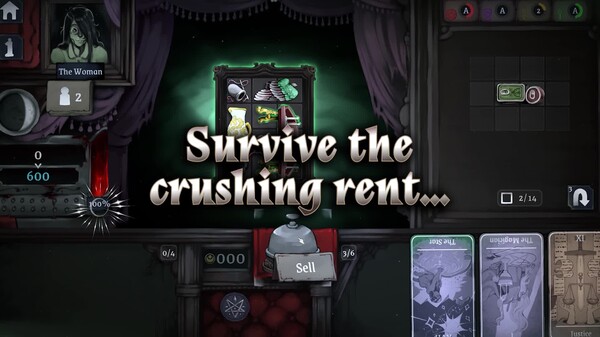
A gothic roguelike shopkeeping game where you sell antiques, read the tarot, and manage your inventory to survive crushing rent increases. Match strange customers with the relics they crave, unlock powerful cards, and gamble your way out of debt, one deal at a time.
Modeled estimate, not a reported figure. How we estimate →
Media

About
Welcome to Fortune Seller, a darkly weird roguelike about running an antique shop in a world where every deal could be your last and your days are numbered.
You’ve inherited a dusty little storefront and a mountain of debt. The landlord? Unforgiving. The rent? Rising every single week. Your only hope? Sell the right treasures to the right customers, and let the cards decide the rest.
Hands-on Inventory Management
Arrange your antiques Tetris-style to make the most of your limited storage space. Every slot matters, the wrong layout could cost you your life.
Sell What They Crave
Read your customers, match their tastes, and score huge payouts. The better the match, the bigger your profit.
Tarot-Based Upgrades
Draw cards between days to gain powerful new abilities. Choose wisely, the deck can bless or betray you.
Spiral into debt
Weekly rent hikes keep the pressure high. Miss a payment, and your shops days are numbered.
Roguelike Replayability
Unlock new tarot cards, unique powers, and eccentric playable characters to change your approach with every run.
Genres
Stats
All-time low is the lowest price we've recorded for this game since we started tracking it.
English, Spanish - Spain, French, German, Japanese, Korean, Russian, Simplified Chinese, Swedish, Portuguese - Brazil, Traditional Chinese
Engagement
Hours played at review time, across 46 reviews with recorded playtime.
Reviews
Themes across 46 recent reviews and how positive each mention is. A keyword signal, not full sentiment analysis.
positive critical· bar length = how often the theme comes up
Reviews
[h1]Not As Good As Balatro, But It's Still A Good Time.[/h1] Yes, this game is basically Balatro with a different coat of paint and with the gimmick of inventory management, and no, it's not as mesmerizingly addictive as the former. Still, Fortune Seller offers you a decent amount of fun time chasing the big number and arranging the perfect boxes. [h2]Things I Like About Fortune Seller:[/h2] [list] [*][b]Arranging Items For Sale:[/b] Instead of playing poker hands, you need to sell the customers all sort of weird trinkets and baubles and make a profit to clear your debt. The premise is simple. You put as many items as you can inside customers' boxes. Try your best to rotate and restock the perfect item combination. The fuller the boxes are, the better the deal becomes. It's a very straightforward arranging process, and the gameplay captures the satisfaction of inventory management very well. [*][b]Size Matters:[/b] Very similar to Dungeon Clawler, Fortune Seller also presents a different kind of "deck-builder". Items come in various shapes and sizes. Bigger items are more profitable but inflexible when it comes to weird box sizes or inconvenient negative modifiers; smaller items are perfect fillers for fill bonuses but earn way less than the debt demands. Sizes affect special effects as well. Each special effect grants an aura to the affected item (Charge/around the item, Wave/horizontal lines, Ignite/vertical lines). You need to think carefully before applying special effects to an item. It's the same deal with value-size ratio. Take its size into consideration, and try to cover as many slots as possible to earn the most profit. [/list] [h2]Thing I Like And Dislike About Fortune Seller:[/h2] [list] [*][b]Simpler Format:[/b] I think Fortune Seller's take on Balatro's number-generating thrill is a rather basic "keep adding more things." Tarot cards, spells, contracts—everything in the game is designed to just earn you more points in a slightly different way. That's it. There are no rule-breaking variants like Shortcut or Four Fingers. Of course, this is not necessarily a bad thing. Sometimes you just want to see the number go up without being too strategical and worrying too much about the synergy. Yet, doing so also sacrifices the potential depth the game could have. Fortune Seller has this dilemma. The runs are still fun, but they soon boil down to the same loop of "just adding more stuff." [/list] [h2]Things I Dislike About Fortune Seller:[/h2] (These two are more of suggestions rather than complaints.) [list] [*][b]Type-specific Property Maybe:[/b] I think each item type could use some changes to spice up the deck-building aspect of the game. Besides the minor arcana bonuses, different item types could possess unique passives that could alter your play style. Anomalous is a good example of this: it counts as all types, it is highly valuable, and it is also very inflexible in terms of placement. I wish other types would follow the steps. For example, Heriloom items gain double value if this is your last customer; Organic items slowly grow in size, and you can put them in the unsuitable slots to cut them into small pieces, etc. [*][b]Dialogue Variety:[/b] After Hades 2 and Slay The Spire 2, I desperately want more roguelike/lite to add small story fragments to not only add another incentive for replayability but also to integrate the intriguing world-building into the gameplay. Fortune Seller is already halfway there thanks to the weird portraits of the customers. The game needs just a little more small chitchat to help us understand their backgrounds and personalities. Like, why does The Person's eye look like that, and why is he hungry all the time? Why do Daughter and Grandma have flowers growing on them? Why does The Devotee start stripping when I fulfill his request? These are the burning questions I am eager to find out the answers to. [/list] [b]中文小簡評[/b] 雖然玩法及成癮性不到《小丑牌》那般極致,《命運販賣者》仍然是款不錯的刷分roguelike,不錯的黑奇幻畫風及簡單有趣的背包整理系統還是值得一玩。 [b]喜歡的點[/b] [list] [*]玩法簡單直白,把各式各樣稀奇古怪的小玩意兒塞進客人帶來的箱子裡賣掉即可。玩過《惡靈古堡4》的肯定很熟悉這般操作,旋轉、拼湊、組合,盡可能地將所有欄位塞滿,塞的越滿賺的錢越多,充分呈現背包整理完整後的滿足感。 [*]商品選擇的思考方式跟《抓抓地牢》雷同,除了考慮單件物品的價位外,還需要額外留意商品的尺寸大小及形狀。客人的箱子往往會有多個指定商品種類的增減益格,放對可以賺大錢,放錯直接功虧一簣,大尺寸商品容易造成排列上的困難,小尺寸商品雖好牌但難以獲利。此外,商品也能透過法術附魔來強化鄰近商品的附加價值,這點又直接與商品尺寸成正比,因此在這款roguelike的「牌組構築」上需要審慎評估可行性。 [/list] [b]又愛又恨的點[/b] [list] [*]老實說,《命運販賣者》的流派其實比《小丑牌》要來的少很多,兩者雖然大方向一致,但前者更加精簡遊戲的複雜度,變得只要不斷的累加東西就好,不必太講究牌組規劃及其他組合效果也就能輕鬆過關。當然這未必是件壞事,有時候就是想放空心思地看著數字不斷往上跳(這也是為何我喜歡玩戰甲的原因),但如此設計也容易讓玩法缺乏深度。 [/list] [b]不喜歡的點[/b] (與其說是不喜歡的點倒不如說是希望能加入的要素。) [list] [*]我覺得商品的「分門別類」可以多一些獨特的被動技能來讓構築要素豐富些,至少在添購物資時能多一分思考的點,「異常物件」就是個很棒的例子:單價極高、等同所有類型、常常是非常難搞的大面積商品,希望其他類別也能跟進。 [*]這點大概是深受《黑帝斯2》與《殺戮尖塔2》影響,越來越喜歡roguelike/lite在遊戲中添加一些故事要素或簡單世界觀。《命運販賣者》就只差那麼一點,只要讓各個古怪的顧客再多一點有趣的對話內容,讓我們能稍微了解其背景與個性即可。 [/list] [quote=author]If you like what I write, please consider a follow to [url=https://store.steampowered.com/curator/45738167/]my curator[/url] page, thanks! 如果你喜歡我寫的東西,可以追蹤[url=https://store.steampowered.com/curator/45738167/]我的鑑賞家[/url]喔![/quote]
It's a game about maximizing layered addition and multiplication. ✔ no-nonsense min-maxing - the game ✘ after playing nearly 4 hours the counting rules are absolutely unfathomable to me. I thought I understood and then my big item scored 10x worse than some literal garbage I threw in to fill space, so I clearly do not. The game doesn't show how it counts. It doesn't provide any estimates on how well you will score. Sure, I could go into online deep-dive how it's supposed to work. But without any estimates it's uncountable anyway, so I won't ✘ so much randomness in a game about optimizations with essentially instant run failures ✘ on top of all that at some point you get special events where you lose your [i] re-rolling [/i] capabilities. Suddenly no re-rolling in RNG heavy game. [i] Even if your build relies on getting specific items out of your inventory [/i] ✘ extremely repetitive - fails as a roguelike, since runs are essentially the same ⓘ Playable on Steam Deck, but somewhat better with mouse. This experience allowed me to create a hypothesis though. A lot of people like this kind of gameplay because it merges [i] min-maxing [/i] with [i] lootboxes[/i]. Yes, lootboxes serve essentially the same function as scoring in this game. You do not know what you will get, but you hope for the best. It's addictive to many. And personally? [i] I hate it. [/i]
RIDICULOUSLY addictive game. Loving the theme, the easy-to-play, Hard-to-master and even the random aspect (the score calculations are potentially so complex that it becomes "I hope this works" There is nothing I don't recommend about the gameplay. Plays very well on Steam Deck, though some things that would work better with a mouse are slightly clunky, though its hard to see any way they could be improved!
good game loop but game is hard. not recommended jusat yet as it might need some updates before rec
Didn't care for it, feels like after the first week you've seen the bulk of what it has to offer, pretty much everything in this game is just a multiplier tied to x and the gameplay loop just doesn't feel very engaging. I just though it was kinda boring.
Balatro + Backpack Battles. Pretty fun, but not engaging enough to keep me playing after the first run. Pretty well made and polished though.
Fortune Seller is a darkly atmospheric roguelike management game that blends shopkeeping, inventory organization, tarot mechanics, and economic survival into an unexpectedly addictive strategy experience. Developed by Kiwick, the game places players inside a struggling antique shop drowning in debt, where survival depends on carefully buying, arranging, and selling strange cursed relics while manipulating powerful tarot effects and item synergies to maximize profits. Although the premise sounds relatively simple at first glance, the game quickly reveals an impressive amount of strategic depth beneath its gothic presentation, creating a gameplay loop that becomes difficult to stop once its systems fully begin interacting. The foundation of the game revolves around managing a mysterious antique store while attempting to stay ahead of rising rent costs and financial pressure. Every run places players in increasingly desperate economic situations where success depends on understanding how relics, contracts, tarot cards, and modifiers interact with one another. Rather than simply selling expensive items for profit, players are constantly encouraged to experiment with positioning, combinations, and layered bonuses in order to generate absurdly high-value sales through carefully optimized inventory setups. One of the game’s most satisfying mechanics is its inventory management system. Every item occupies physical space inside a limited grid, forcing players to think carefully about placement and organization. Relics contain unique effects that influence surrounding items, create combo opportunities, or trigger additional bonuses when arranged correctly. This turns inventory management into a strategic puzzle where positioning becomes just as important as item value itself. Building efficient layouts capable of triggering massive profit chains becomes deeply rewarding, especially once more advanced relics and modifiers start interacting in increasingly complex ways. The tarot card system adds another layer of strategy that significantly expands the game’s depth. Throughout runs, players unlock and collect powerful tarot cards capable of altering item behavior, modifying scoring systems, or amplifying certain relic combinations. Some tarot effects can completely reshape how a run functions, encouraging players to shift strategies depending on the cards they acquire. The excitement of discovering new synergies between tarot cards and inventory layouts becomes one of the game’s strongest hooks because successful combinations can create enormous profit explosions that feel incredibly satisfying. What makes Fortune Seller especially compelling is how naturally it merges multiple genres together. At times the game feels like an inventory management puzzle, while other moments resemble a deckbuilding roguelike or a high-risk economic simulator driven by gambling mechanics and escalating pressure. This constant overlap between systems keeps the gameplay fresh because every decision influences several layers of progression simultaneously. Choosing which relics to buy, which cards to activate, and which risks to take all become interconnected parts of survival. The roguelike structure works extremely well because no two runs evolve exactly the same way. Randomized relics, customer demands, modifiers, contracts, and tarot combinations constantly force players to adapt their strategies rather than relying on repetitive solutions. Some runs reward aggressive risk-taking and gambling on powerful combinations, while others encourage cautious inventory optimization and steady financial management. This unpredictability creates strong replay value and encourages constant experimentation. Progression is handled effectively throughout the experience. New relics, cards, mechanics, contracts, and modifiers gradually unlock over time, steadily expanding the game’s complexity without overwhelming players too early. The pacing of these unlocks helps maintain long-term engagement because there is always another powerful combination or unusual strategy waiting to be discovered. Even after multiple runs, the game consistently creates the feeling that more efficient or more ridiculous builds remain possible. The gothic atmosphere is another major strength. Fortune Seller embraces occult imagery, cursed relics, mysterious customers, and tarot symbolism to create a dark but strangely cozy mood throughout the experience. The antique shop setting, combined with the themes of debt, temptation, and dangerous fortune-seeking, gives the game a distinctive identity compared to many other roguelike strategy titles. The atmosphere constantly reinforces the idea that players are participating in something risky and slightly supernatural rather than simply managing a normal store. Visually, the game succeeds through style and clarity rather than technical complexity. The interface remains readable even as inventories become increasingly crowded with relics and effects, while item designs are varied enough to keep inventory management visually engaging. The gothic color palette, animated effects, and satisfying scoring visuals all help reinforce the game’s dark fantasy identity. The audio design also contributes heavily to the experience. Ambient music supports the eerie atmosphere without becoming repetitive during longer sessions, while sound effects tied to sales, card activations, and combo chains provide rewarding feedback that makes successful turns feel impactful. The game understands the importance of audiovisual reinforcement in combo-driven strategy games, and the satisfying sounds attached to large profit chains make optimization feel consistently rewarding. Another impressive aspect is the game’s accessibility despite its hidden complexity. The basic premise of buying and selling relics is easy to understand almost immediately, but the deeper strategic systems involving modifiers, contracts, tarot combinations, and inventory synergies gradually unfold over time. This layered design creates a strong balance between casual accessibility and long-term mastery. However, Fortune Seller is not without flaws. One of the biggest issues is repetition during very long sessions. Although the randomized systems provide considerable variety, the gameplay remains heavily centered around inventory optimization and combo-building. Players who do not enjoy micromanagement or efficiency-focused gameplay may eventually feel the repetition more strongly than dedicated roguelike fans. Balancing can also feel inconsistent at times. Certain tarot cards and relic combinations appear noticeably more powerful than others, leading to situations where some builds become dramatically more effective once discovered. This occasionally reduces strategic diversity because certain combinations dominate successful runs too reliably. The interface, while generally clean, can also become overwhelming later in the game when inventories fill with layered modifiers, triggered effects, and overlapping bonuses. Newer players may struggle to fully understand why certain combinations succeed so dramatically while others fail, especially once advanced mechanics begin stacking together. For players who enjoy roguelike strategy games, inventory management systems, deckbuilding mechanics, or optimization-heavy indie experiences with strong replay value, Fortune Seller delivers a deeply satisfying and highly creative experience. Its combination of occult atmosphere, addictive combo-building, and risk-driven progression makes it one of the more memorable indie roguelites currently available on Steam. Rating: 8/10
Saw one of the security guards in Gamble With Your Friends playing this and I had friends help me identify it. Now I'm addicted to two different games.
Fortune Seller delivers exactly what it promises: a combo-based non-timed spatial puzzle game with a mini-economy and lots of overlapping powers. The basic gameplay is about packing funny-shaped items worth points into a funny-shaped area and trying to maximize the points scored, in order to hit successive scoring targets. This area may contain bonus and malus squares that trigger on the item category; the items can have an “alteration” that affects their scoring, as well a special effect that scores other shapes placed in particular positions relative to them. Between rounds you can buy more items, single-use “spells”, “tarot cards” that give scoring bonuses, and “contracts” that have a significant positive and a significant negative. In the “campaign” you have four weeks of five scoring targets, increasing steadily and jumping on the last week of the month. Each week you have a limited number of “clients” (areas to pack) and try to hit that day’s target before running out of them. The better you do, the more currency you earn, so having a single blowout day has a capped benefit. The game combines strategic refinement of your stock of items, tarot cards, and contracts over rounds, with tactical spatial placement, spell-use, and rerolling inventory. It’s low stress and doesn’t require uninterrupted concentration, perfect to play as a secondary activity.
Try the demo(it's harder than the base game)! A fun, cheap game with amazing art and a lot of replayability. I beat the game after a couple attempts so the 'hard' review feels a bit disingenuous, Also while this is clearly a inspired by balatro, I think it has a very strong identity and has an incredibly well designed deck system, which is not something a lot of these gambling roguelikes have. I was also pleasantly surprised by how many unlock challenges there are. Really keeps you engaged, and you can tell a ton of work was put into the final product.
Related
Related
Trends
Concurrent players on Steam, sampled daily since tracking started.
Momentum
Pace estimated from the game's recent review growth (our daily snapshots) at its own sales-per-review ratio — a momentum signal, not booked sales.
Audience
Estimated from the language of this game's reviews — a proxy for where players are, not official Steam demographics.
Related
| Omoide Ni Kawaru Kimi Memories Off | $14.9K | 92 | 78% | $9.99 |
| Nelo | $14.9K | 148 | 70% | $4.99 |
| PROZE: Enlightenment | $14.9K | 121 | 69% | $5.99 |
| Pine Hearts | $14.9K | 118 | 97% | $7.79 |
| Riptale | $14.9K | 111 | 86% | $5.99 |
| Shadow Bug | $14.9K | 111 | 95% | $5.99 |