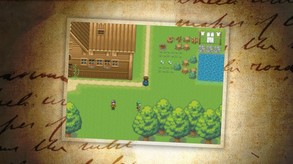
Angels of Fasaria was originally released in 2005. With thousands of downloads and over 48 thousand active users in the browser based game, Angels of Fasaria maintained a loyal following and support base. After the release of "Fasaria World" and later the "Ancients of Fasaria" mmorpg.
Modeled estimate, not a reported figure. How we estimate →
Media

About
Stats
All-time low is the lowest price we've recorded for this game since we started tracking it.
Languages: English**languages with full audio support
Engagement
Hours played at review time, across 43 reviews with recorded playtime.
Reviews
Themes across 43 recent reviews and how positive each mention is. A keyword signal, not full sentiment analysis.
positive critical· bar length = how often the theme comes up
Reviews
this game is pretty bad. it's bog standard RPGMaker junk with a cliched story and stock assets. the first thing you do is wake up in a castle and have to go talk to the king in order to start your quest. i HATE games that start this way. when you do go outside the castle you get attacked by enemies that are already hitting for 100s of points worth of damage. you can actually die on your first encounter in this game, and if you don't find healing before your second you're virtually guaranteed to die. it's insane to design a game this way!!! unfortunately, i think covid my have also killed the developers. RIP
Игра качественно сделана как для RPGмейкера, очень приятная музыка, хотелось бы отметить что тут в меньшке нельзя посмотреть активные квесты, а так-же узнать об опастности монстров, набил третий уровень, зашел в дерево - здох от монстров которые с удала снимали пол столба НР(
너무 단조로운 게임이군요. 편의성도 너무 떨어지고. 무엇보다, 업적 달성하려면 스크린샷 보내라는게 제일 맘에 안드는 요소입니다.
我就来做个评测任务
I immediately picked up on the grindy aspect of this game and was hoping that it would get better or maybe the story would improve. If the other reviews indicate anything this is not the case. Not even sure how I got this game but if I paid for it I am greatly disappointed
💋
A Surprising Gem. As someone who considers themselves a religious person, I typically don’t gravitate toward games with overt religious themes. My favourite game, KeeperRL, is quite the opposite, it’s a dungeon-keeper rogue-like where you role-play as a Dark Lord, establishing a sinister domain filled with demon worship, moral corruption, and even atrocities like torture. It’s dark, strategic, and deeply engaging, with a higher market price reflecting its refined gameplay. So, I was surprised to find myself falling in love with this game, which takes a very different approach. Here, you play as a protagonist aligned with what seems to be a moral or religious framework inspired by real-world traditions. While KeeperRL uses similar themes with a more cynical, satirical lens - such as the possibility of corrupting a church, to the point of demon worship, this game instead embraces a tone that’s sweet, whimsical, and even charming. Of course, the game isn’t without its quirks. For example, where does the nun character go when your party rests in your bed? I’m not sure I want to overthink that one! And losing the game for completing a quest but forgetting to equip your sword and armour feels like an odd design choice - maybe even a bug? Despite these unanswered questions and minor frustrations, there’s something irresistibly endearing about this game. I haven’t played it all the way through yet, but from what I’ve experienced so far, it feels like an innocent and heartwarming adventure. I do enjoy surprise plot twists, and if this game takes a darker turn later on, I’ll be genuinely shocked (and might just have to eat my hat!). For now, I wholeheartedly recommend this adorable game to anyone who appreciates a lighthearted, thoughtful experience. It’s a refreshing change of pace from the darker tones of KeeperRL and a lovely reminder that games can inspire positivity and joy and a kind of childish purity, perhaps you once knew.
++
Angels of Fasaria: Version 2.0, developed and published by Fasaria World, is a curious relic in the modern gaming landscape—an independently revived classic RPG that embraces its old-school roots with a sense of nostalgic sincerity. Originally part of an older browser-based RPG series dating back to the mid-2000s, the game was rebuilt and re-released on Steam to preserve what its creators considered the foundation of the Fasaria universe. This reimagined version seeks to combine the familiar mechanics of retro role-playing adventures with the accessibility of modern PC distribution. While the result is a modest but heartfelt effort, its charm and simplicity are balanced by technical limitations, minimal polish, and a dated design philosophy that may not appeal to players accustomed to contemporary RPG standards. From the very beginning, Angels of Fasaria establishes itself as a throwback to the formative era of 2D role-playing games. Its world is presented through classic sprite-based visuals, tile maps, and turn-based combat reminiscent of the early Final Fantasy and Dragon Quest titles. The narrative follows a traditional structure built around celestial forces, divine conflict, and the restoration of balance in a fantasy realm. Players step into the role of a chosen hero guided by higher powers and driven to confront the growing corruption that threatens the land. The story unfolds in a linear but earnest way, using dialogue boxes and static character portraits to convey emotion and plot. Its simplicity gives it an almost timeless quality—there is no irony or self-awareness, just the unembellished storytelling of a bygone age. The gameplay loop revolves around exploration, combat, and incremental progression. Towns serve as safe havens for healing and restocking, while fields and dungeons contain enemies, treasures, and secrets to uncover. Battles are menu-driven and turn-based, focusing on basic commands like attacking, defending, casting spells, and using items. The game emphasizes resource management—deciding when to expend magic points or conserve healing supplies—over flashy abilities or complex mechanics. While it lacks the intricate systems of modern tactical RPGs, its straightforward approach rewards patience and planning. Leveling up grants incremental stat increases and access to stronger skills, creating a steady sense of growth. There are no deep skill trees or branching builds, but the progression feels consistent, offering the satisfaction of slowly overcoming stronger enemies through experience and preparation. What gives Angels of Fasaria its unique identity is its dedication to the atmosphere of retro fantasy. The pixelated environments, simple animations, and looping musical themes create a nostalgic sense of adventure that will be familiar to anyone who grew up during the early days of PC or console RPGs. The soundtrack leans heavily on melodic repetition, matching the minimalist visuals with a soothing if somewhat limited audio palette. The towns, forests, and temples are constructed with a handcrafted charm that reflects the earnestness of an independent project. It is clear that Fasaria World’s developers poured genuine affection into recreating the feeling of classic role-playing, focusing on evoking emotion through simplicity rather than technical spectacle. Despite its sincerity, the game is not without flaws. Angels of Fasaria: Version 2.0 shows its age both in design and execution. The interface feels clunky by modern standards, and certain technical hiccups—ranging from launch errors to resolution inconsistencies—can disrupt the experience. Players have reported occasional compatibility issues, such as runtime errors that prevent the game from loading on some systems, as well as a lack of updates addressing these problems since its initial Steam release. The re-release does include quality-of-life features like cloud saving and achievements, but these modern touches only partially offset the overall dated feel of the game. Its simplicity, while charming, can also become a drawback during long play sessions. The limited enemy variety and repetitive combat encounters begin to reveal the game’s shallow mechanical depth, and progression can feel more like routine maintenance than genuine discovery. Content-wise, the adventure is relatively brief. Most players can complete the main storyline within several hours, and there are few optional side quests or hidden challenges to encourage replayability. The small scale works in its favor for those seeking a light, digestible RPG experience, but for players expecting a deep and expansive world, the brevity can be disappointing. The linear structure also means that player choice plays little role in shaping the outcome of the story, which unfolds in a predetermined fashion. While this straightforward design harkens back to the simplicity of older RPGs, it also limits player engagement in an era where choice-driven narratives and dynamic systems have become genre staples. Still, there is something undeniably endearing about Angels of Fasaria: Version 2.0. Its lack of pretension and focus on pure, nostalgic role-playing give it an identity that feels genuine. The game does not attempt to disguise its modest production values or compete with larger titles—it knows what it is and makes no apologies for it. For players who grew up with RPGs from the 8- or 16-bit eras, there is comfort in its familiar rhythm and aesthetic. Even its flaws, from its rough edges to its minimal animations, contribute to its old-fashioned charm. It recalls a time when RPGs were smaller, more personal experiences crafted by passionate individuals rather than large development teams. Ultimately, Angels of Fasaria: Version 2.0 is a passion project that succeeds more as a nostalgic homage than as a polished modern RPG. Its strengths lie in its sincerity, simplicity, and respect for classic design, while its weaknesses stem from its technical limitations, short length, and lack of depth. It offers an experience that feels like rediscovering a long-lost cartridge from a forgotten console—familiar, flawed, and strangely comforting. For players seeking a brief return to the roots of fantasy role-playing, it serves as a small but genuine reminder of where the genre began. For everyone else, it remains a quaint curiosity—a humble echo from a different time, lovingly preserved for those who still believe that the simplest adventures can hold the greatest charm. Rating: 6/10
还可以,比较杀时间
Related
Related
Trends
Modeled estimate over time, reconstructed from Steam's monthly review histogram.
Momentum
Pace estimated from the game's recent review growth (our daily snapshots) at its own sales-per-review ratio — a momentum signal, not booked sales.
Audience
Estimated from the language of this game's reviews — a proxy for where players are, not official Steam demographics.
Related
| Into the Void | $3.5K | 67 | 48% | $1.99 |
| Recollection | $3.5K | 127 | 98% | $0.69 |
| Duckpocalypse | $3.5K | 52 | 88% | $2.99 |
| Battle Simulator | $3.5K | 169 | 54% | $0.69 |
| Sherlock Holmes Consulting Detective: The Case of the Tin Soldier | $3.5K | 52 | 69% | $3.99 |
| Starsphere | $3.5K | 52 | 85% | $3.99 |
Related
| 7 Days to Die | $425.3M | 403.6K | 87% | $44.99 |
| Mount & Blade II: Bannerlord | $309.8M | 294K | 88% | $49.99 |
| Don't Starve Together | $164.7M | 539.5K | 95% | $14.99 |
| Mount & Blade: Warband | $101.9M | 171.6K | 98% | $19.99 |
| The Scroll of Taiwu : Beyond The Dome | $62.3M | 69.6K | 66% | $29.99 |
| The Isle | $60.1M | 116.7K | 80% | $19.99 |