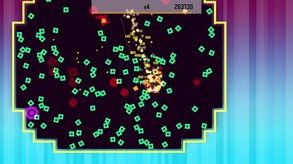
Trigonarium is a hardcore twin-stick shooter for fans of challenging arcade gaming. Fight your way through multitudes of enemy formations in constantly shifting battle arenas to face the colossal level bosses.
Modeled estimate, not a reported figure. How we estimate →
Media

About
Genres
Stats
All-time low is the lowest price we've recorded for this game since we started tracking it.
Languages: English, Finnish
Engagement
Hours played at review time, across 40 reviews with recorded playtime.
Reviews
⠀
I know what you're thinking, it's less than a dollar, how good can it be? Trigonarium is a good example of don't judge a book by its cover (or price). I have very picky taste and analyze games on a more scrutinizing level, but I was pleasantry surprised with this 50 cent twin stick. Despite the 50 cent look of the game and lack of reviews, this dev seems to really know what he's doing gameplay wise. And no surprise, apparently this is made by an ex-Housemarque (Returnal) dev! PLUSES: -The game avoids many common issues for twin sticks like geometry wars, where the game eventually devolves into a bomb spam life farming loop. The game holds up at more advanced level play and plays more like a quicker robotron than geometry wars. There are more static enemies than in geometry wars, and combined with the more complex enemy patterns, the player can't just circle strafe around enemy waves but is forced to adapt and move in more compex and skillful patterns. -The dash mechanic is not just defensive but attacks enemies and then gives the player a beefy amount of invulnerable frames at the end of it, affording the player strong enough base power to allow the enemy patterns to be juiced up more without feeling unfair. The movement feels adequate enough to dodge things as well as adapt on the fly; many other games in this genre don't give the player enough movement speed which forces the player either to predict where enemies will be or get locked into checkmate losing scenarios. This game focuses more on pure twin stick skill of dodging and shooting. -The arena constantly changes and it's done well. -Even though shooting power starts off a bit weak in the default mode (pea shooter syndrome) there is an "ultimate" campaign that juices the game up and starts the player off with a stronger starting shot speed for those who want a more fast paced "japanese" type gameplay and skip right to the intense gameplay. Similarly, some modes like "challenge classic" consist of being on a very large arena, and the dev intelligently gives the player a fast and strong triple shot on it at the start to accommodate the large play space, which again shows the dev is attentive to these little details that are important, where many other devs would not even think to do such. Your gun can also be upgraded through collecting the orbs in a typical fashion, and your shot power remains until you lose, another good choice. -There are also a healthy amount of additional modes to keep you going. They shake up the gameplay in intelligent ways which is not always the case with additional modes in arcade games. -The arcade mode lasts just the right amount of time. No 3+ hour campaign here, it's over quickly which inspires replaying runs which is what an arcade game should do. After beating a level, you jump immediately to the next; no menus breaking up the flow. The dev understands arcade design and has avoided most of the common issues with modern arcade games. CRITICISMS: -The visuals need to change more from level to level; it has been researched that arcade players actually feel a stronger sense of progression in an arcade game when the graphics and or colors change more from stage to stage as opposed to actual gameplay changes. The stages do offer new enemy types, but the lack of visual change does diminish psychologically the overall sense of progression. -The bosses are undercooked. They aren't poorly designed, just too easy. Also some of them kind of repeat in design concept too much. CONCLUSION: This isn't just a good game for the 50 cents, it's a good game regardless of its cost. I really look forward to Sektori, because it seems to be more of the same but the visuals/sound are beefed up for a better audiovisual experience. With random 50 cent games like this, you don't buy it really expecting to be more than a 50 cent experience, and it certainly doesn't look like it will be much from the cheap visuals, but it just shows that there are these devs out there tied to prestigious companies like Housemarque doing there own thing, showing off their talent, meanwhile getting overlooked. It's not a masterpiece, but it's certainly worth more than 50 cents and demonstrates better game design talent than other similar games.
Trigonarium is a simple twin stick shooter inspired by Geometry Wars and originally developed for iOS which may explain the basic art style. It has scripted levels and dynamically changing level layouts. You can choose between two campaign mode and four short challenge modes. The levels of each campaign mode can be played individually. You can play by yourself or through local coop (supports Remote Play Together). Besides your regular shot you can strike (dash). After each strike it takes a couple seconds to recharge. Killed enemies leave glimmer. Once you've collected enough one of three tokens can appear. By chaining enemy kills you build up a score multiplier to a max of 100 which resets to 1 when your chain breaks. The game can be played with dual stick controller, keyboard + mouse/tablet or (one handed) controller + mouse/tablet. The last option is my preferred method for playing twin stick shooters. I'm using a PS3 Move Nav Controller in combination with a Wacom tablet. Great score chaser with quite a bit of replayability because of the leaderboards. https://youtu.be/itcK-KXviRI
this is MUCH better than Sektori more clear visuals and no stupid roguelike elements
💋
sonsuz shoot em up sevenlere iyi gibi
W twin stick shooter
Trigonarium, developed by Kimmo Lahtinen and published by Kimmo Factor Oy, is a fast-paced, twin-stick arcade shooter that delivers a visually striking and challenging experience for fans of the genre. Released in 2015, the game emphasizes precision, quick reflexes, and strategic maneuvering as players navigate dynamic arenas filled with waves of enemies. Its design focuses on high-intensity action paired with minimalist yet vibrant visuals, creating an experience that is both demanding and visually captivating. The core gameplay of Trigonarium revolves around controlling a small ship with twin-stick mechanics, allowing for independent movement and shooting in different directions. Players face continuously spawning enemies in arenas that frequently shift shape, requiring constant adaptation and tactical thinking. The game offers multiple modes to accommodate varying skill levels: a three-world arcade campaign provides a structured progression for newcomers, while a five-world “Ultimate” campaign challenges even seasoned players with more complex patterns and faster enemy behavior. Additionally, challenge modes and local two-player cooperative play expand the game’s versatility, giving players numerous ways to test their skills either solo or alongside a friend. Visually, Trigonarium adopts a bold, abstract aesthetic dominated by neon-colored enemies, geometric shapes, and dark, contrasting backgrounds. The shifting arenas and vibrant particle effects amplify the intensity of gameplay, making each encounter visually engaging and sometimes unpredictable. The dynamic visual design not only complements the fast-paced action but also assists players in tracking enemies and anticipating threats amidst the chaos. The soundtrack, composed by Tommy Baynen, features electronic music that synchronizes effectively with the gameplay, heightening the sense of urgency and immersion throughout each session. A key strength of Trigonarium lies in its tight, responsive controls and the way they complement the demanding enemy patterns. Success depends on maintaining precision in movement while maximizing offensive output, especially during combo chains and high-score runs. This scoring system encourages mastery, rewarding players who can sustain consecutive kills without taking damage. While the difficulty curve can be steep, particularly in later levels and challenge modes, it contributes to the sense of accomplishment when players overcome these rigorous tests of skill. Despite its intensity, Trigonarium remains accessible to those willing to invest time in learning its mechanics. Its appeal lies in the balance between challenge and reward, as each session is designed to push players to refine their reflexes and strategy. The cooperative mode adds an additional layer of depth, allowing players to coordinate tactics and share the thrill of navigating chaotic arenas together. Overall, Trigonarium is a standout title within the twin-stick shooter genre, combining fast-paced, skill-based gameplay with striking visuals and an energetic soundtrack. Its multiple modes, escalating difficulty, and replayability make it engaging for both casual and hardcore arcade enthusiasts. For players seeking a visually dynamic, challenging, and highly rewarding shooter experience, Trigonarium offers a compelling and memorable journey that demands precision, strategy, and quick reflexes at every turn. Rating: 9/10
Related
Related
Trends
Concurrent players on Steam, sampled daily since tracking started.
Audience
Estimated from the language of this game's reviews — a proxy for where players are, not official Steam demographics.
Related
| PHAT PHROG | $1.8K | 78 | 62% | $0.99 |
| Streamer Simulator | $1.8K | 52 | 23% | $0.99 |
| Zombie Solitaire 2 Chapter 2 | $1.8K | 74 | 88% | $1.07 |
| Guild of Ascension | $1.8K | 60 | 75% | $1.49 |
| Galactic Battles | $1.8K | 126 | 37% | $0.69 |
| Forgotten Land | $1.8K | 116 | 36% | $0.99 |