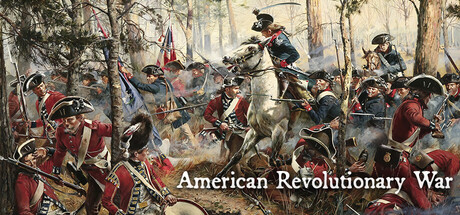
Fight through the American War of Independence in a tactical wargame of field battles, frontier warfare, fortified positions, and campaigns for control of the colonies. Command American, British, Loyalist, German, Native allied, and French forces across 148 scenarios and four campaigns.
Modeled estimate, not a reported figure. How we estimate →
Media

About
American Revolutionary War
Fight across the battlefields of the American War of Independence in American Revolutionary War, a detailed tactical wargame covering major campaigns, battles, and skirmishes of the conflict between Britain, the American colonies, and their allies.
From Lexington and Concord to Bunker Hill, Saratoga, Camden, Cowpens, and Yorktown, American Revolutionary War places you in command of the forces that fought for control of the colonies. What began as a political crisis inside the British Empire became a continent-wide war involving regular armies, militia, Loyalists, German auxiliaries, Native allies, French forces, and frontier fighters.
Take command in American Revolutionary War, where detailed tactical maps and historically grounded orders of battle place you in control of armies fighting across cities, farms, forests, rivers, forts, and frontier settlements. Every battle is shaped by the realities of the age: militia reliability, disciplined regulars, light infantry tactics, mounted raids, fatigue, supply, command, and the constant challenge of holding ground in difficult terrain.
Recreate the major campaigns of the American Revolutionary War from either side of the conflict.
Lead the American forces, including:
Continental infantry
State troops
Local militia
Minutemen
Riflemen
Light infantry
Light dragoons
Frontier and partisan forces
Or take command of Britain and its allies, including:
British regulars
Loyalist provincial troops
Highland regiments
German auxiliaries
Jägers
Light Infantry
Grenadiers
Native allied forces
As the war expands, French forces also enter the fight, bringing professional troops, naval support, and new operational possibilities.
The historically accurate Order of Battle reflects the many forces that fought across the war. American forces range from trained militia to reformed Continental troops, while British, Loyalist, German, Native, and French units each bring their own battlefield strengths and limitations.
American Revolutionary War covers the full scope of the conflict across its major theaters.
Fight in the northern theater, where the struggle for Boston, New York, Canada, and the Hudson Valley shaped the early war and led to the decisive American victory at Saratoga.
Battle across the frontier, where forts, raids, settlements, river routes, and Native alliances made the war harsher, less formal, and deeply tied to control of the continent’s interior.
Command forces in the southern theater, where British hopes for Loyalist support led to a brutal war of maneuver, raids, and attrition across Georgia and the Carolinas.
The American Revolution was fought across difficult and varied terrain. Dense woods, fences, rivers, towns, roads, and broken ground forced armies to adapt.
Fight across battlefields where:
Open order and close order formations matter
Woods and rough terrain shape movement and combat
Militia may stand firm or collapse under pressure
Regulars bring discipline, firepower, and staying power
Light infantry, riflemen, Jägers, and Native allied forces excel in challenging terrain for broken ground
Cavalry and mounted troops can scout, raid, and exploit openings
The game models the differences between early-war militia, Continental regulars, British professionals, Loyalist formations, German auxiliaries, Highland troops, Native allied forces, and French expeditionary troops.
American Revolutionary War includes 148 standalone scenarios covering engagements of all sizes, including:
Three tutorial scenarios
Major historical battles
Smaller skirmishes and frontier actions
Variant scenarios
Specialized versions for both head-to-head play and play against the AI
The game covers famous and lesser-known actions from across the war, including:
Concord
Lexington
Bunker Hill
Ninety Six
Quebec
Long Island
Harlem Heights
White Plains
Trenton
Princeton
Bennington
Brandywine
Germantown
Freeman’s Farm
Bemis Heights
Monmouth
Savannah
Ramseur’s Mill
Camden
Kings Mountain
Cowpens
Hobkirk’s Hill
And many more.
Four dedicated campaigns containing 37 additional scenarios allow players to make strategic decisions to shape the tactical battles and impact the flow of the campaigns or follow the war through connected operations and strategic decisions.
Experience the conflict as more than isolated battles, with choices and battle outcomes having repercussions throughout the campaign.
A range of historically accurate maps are included, covering the significant locations fought over during the war along with many lesser-known battlefields. Most maps are larger than the historic battlefields, allowing players to explore and create their own scenarios.
The game also includes extensive 3D unit graphics representing the major armies involved, including American, British, Loyalist, German, Native allied, and French forces.
Design notes, campaign notes, and a bibliography provide additional historical background on the production of the game and the sources used by the design team.
Customize and expand your experience with a full suite of editors, including:
Campaign editor
Scenario editor
Sub-map editor
Use these tools to modify existing content, create new engagements, or subdivide larger maps into smaller battlefield segments for custom scenario design.
Multiple play options include:
Play against the computer AI
Play-By-Email
LAN and live Internet play
Two-player Hot Seat mode
Genres
Stats
All-time low is the lowest price we've recorded for this game since we started tracking it.
Languages: English
Engagement
Hours played at review time, across 20 reviews with recorded playtime.
Reviews
There are not a lot of wargames with this level of detail and playability. Well recommended!
Awesome game so far! I love these games, having also played Bulge '44, and a lot of the John Tiller's campaign series games. I don't think there is another game that portrays the American Revolution in such detail. And, I was pleasantly surprised to see the Penobscot Expedition scenario, which I think is the only wargame scenario I have ever played that took place in my home state of Maine. Great stuff!
Outstanding in every way. The attention to unit detail and the gorgeous map make it my favorite of the series.
No better way to celebrate the 250th! Very fun game.
I finished the Saratoga 1777 (full) campaign for the Americans - I already own several WDS games, so I knew what I was getting into - I'm willing to forgive some of the flaws of these games (why? - these games are unique and can be a real challenge, they're fun and historically accurate) - I enjoyed the campaign, even though it all took place on one map and it was just different scenarios of the same - AI is decent, actually quite good - maybe slower unit grouping (careful approach), it has some bugs (it allowed me to capture Burgoyne), but it's significantly better than I would expect from similar games - maybe it made a slightly human mistake that the AI sent infantry from the northeastern fortified position to help in the side part behind the forest and I occupied 3 artillery positions and a flag from the other side - a pretty human mistake, or another rare flag without protection (for 500 points) - what would I like? --- 1.) please, something like achievements, or something that records that I have already played a given campaign/scenario and with what result. WDS has many games, and I am too lazy to make statistics myself for such a large number of games. 2.) Maybe a tournament under the WDS banner - (similar to what Slitherine does) - I know that the developers are still updating the engine, so more things will come over time and minor shortcomings will disappear over time The game is really good, I recommend it.
Wargame Design Studios American Revolutionary War is a fantastic strategy hex game with outstanding historical accuracy. The learning curve is not as steep as you might think. I jumped into the Battle of Quebec on December 31, 1775, and I couldn’t have been more pleased. Playing as the British hunkered in the Quebec citadel, I sweated as American militia appeared gradually, from one direction to another. Poor accuracy from my muskets made it difficult to slow their advance. Although I was able to repel the Montgomery force, Arnold’s force breached the east gate late game, and entered the citadel. Guns and British militia slowed their advance. Just as all felt lost as the Americans captured victory locations inside the citadel, a few well placed guns past the Notre Dame Basilica-Cathedral near City Hall stymied the rebels and halted their advance. It was a minor defeat for the Americans, but better than their historical performance. Infantry casualties were fairly close to historic (although more Brits died under my command). In summary, the map design and scale, unit types and sizes, weapon performance, and casualty rates are all incredibly historically accurate, and AI performance challenging and adjustable. Highly recommended for military history fans and grognards.
This was my first experience with WDS games, and complex hex and counter games overall, and so far only played the copy I bought from their website using their launcher. I got my free steam key after it released here so figured Id leave a review. The interface takes a bit to get used to, but its intuitive, especially working through the tutorial scenario, and it did not take long to understand basics in movements, formations, firing, map filters, etc. The hardest part for me is keeping units organized within their command structure and not mixing them together to keep order and within command range, but being able to highlight a unit's organization on the map and also taking the time to view the full in game OOB has begun to make things easier. Recently found a wargaming discord group and have been playing some PBEM matches, which has been tons of fun and engaging. All the WDS games seem like such a deep labor of love, and you can see it first hand in this games included design notes and full bibliography of sources used. I bought a few of the books from the recommended reading and it has been fun to read about battles and then play them. Makes for a more engaging experience, especially for battles that you might not know much about. Highly recommend this game and to also check out their website for their other titles not yet on Steam as they have games covering many different time periods and scales.
Understanding how WDS games are developed can be important in terms of understanding roles in how their titles get built. The engines, and by extension, their series are not all being created by the same scenario designers (essentially a game engine is going to be developed by programming, whereas scenario designers fit into the borader team as being delegated as a subject matter expert.). The point being here is that different scenario designers' approaches are going to produce differing expereinces, even within any of their given series (to be fair, it has been like that even well before WDS took on the JTS catalog). The Musket and Pike series engine can be very flexible, although like anything, it can be a matter of give and take; it does a lot of things that can never be done as a practical matter on paper/cardboard -such as scale, however at other times, due to programming, the engine can be surprising less versatile than board wargames (and again, this is not anything that is WDS' issue- but rather, it is the material and media that they are working with; so not a negative, but rather see it as an operating parameter). WDS has a reputation for continually developing their products, even after release (maybe supporting it might be a more accurate term); and engine changes have been applied, as they get developed for other titles within the scope of their series (which is also how JTS applied them in the past as well). In the interests of transparency, I had a lot of experience with Musket and Pike, in terms of project development in the past, but not so much in the past several years, so I have been getting reacquainted with things (slowly); there have been some new concepts introduced, as well as differenmt styles of coding. I feel like I want to get more of a firmer handle of the series as it stands now, as to how it was several years before, plus since I was working within my own ideas (seeing where the engine could or might go), it can be a little different thing to talk to how other designers have done the same thing. That being said, I have known the designer of this title for some years, and knew of his longstanding interest in the topic (not many people haul off and design scenarios, even for fun, and I know Mike did that even in the old 1776 title, and made some major changes in a battle compared to the stock scenario in that older product -translation: here's a guy who wanted to see what could be done, and was mainly interested in challenging himself, based upon his own research and understanding of a situation. That was pretty impressive (doubt I told him at the time -but it did influence my approach in my own time in projects). I spent most of my time in this title with the demo - mainly because I was always going to be paying attention to Rhode Island even if it hadn't been in the demo, because I felt I probably knew that best. The OOB was pretty impressive (meaning the file because more units are there than are in the scenario). If I have to make 1 'complaint' - it is Tillinghast -- 2x l's ;) - but to be fair, there is a character limit before things start bleeding off the edge of the defined spaces that actually show this detail in game. The M&P engine (and by extension the S&S engine) allow for 15 faction slots divided by 2 sides. Personally I prefer it if a scenario designer uses more, rather than less of these slots, because it allows anyone wanting to -really- get into scenario designing, the opportunity to explore building bigger, and more complex Order of Battle files, and that might be something WDS can consider going forward in the sense that just providing generic slots would be of value, in the sense that as far as I am aware these slots are hard coded into the engine within a title (in other words they need to have some name assigned to them in order to function; and of course you'd have to manually add in graphics and all of that (which happens to be doable; sure it's additional work - but that is sort of the point when you are doing this as a hobby ... work is not 'work' in that sense). Anyways -it isn't possible right now, and it would be nice if that could happen (within the series' in a broader sense), and to be fair, I think ARW has enough to work with, but that isn't really the case with all of the titles within the broader Musket & Pike or Sword & Siege engines. Maps - I am purposefully avoiding the lack of a map editor, as I am well aware of the stance, and the point of view of why there isn't one provided, and that hasn't been anything new as JTS was of a similar mind; sure it'd be great to have one, but barring that- it would be pretty cool if every now and then there could be some generic maps added to titles, preferably some big ones; as there are sub-map editors so that you as the end user are able to carve them up and use them in scenario building. That might be a useful compromise that allows WDS to fully control their proprietorial map editor. Ok on to ARW, it is impressive with the broad range of material presented. The designer notes are well put together, and outline the scope that the scenario designer hoped to achieve. Personally, I think he did this, and did it pretty comprehensively. The list of reference material is pretty impressive- just using McBurney's Rhode Island book said a lot; that's basically the most comprehensive work on that region through 1778, and shows a real attention to detail; I'd read it several years ago while doing family history research. I do want to eventually put together some composite map images. I'm sure there might be more I can say in time, but as it stands I got about 7 fairly different WDS titles all within a pretty short space of time, some are more related than others. Is it a good title to spend your money on? Yeh you bet - there really isn't anything like this out there, that is this comprehensive of a treatmenton the American War of Independence. WDS titles, are essentially turn based hex and counter type games which aim to play to computers' strong suits - the machine does the counting for you, and can apply limited intelligence situations that board games that are not double blind set ups can struggle with. The machine also takes care of paperwork- so no tracking step losses, or ammo expenditure on a sheet of paper. And size ... well, yes you can have some really massive maps in this medium that you cannot really have in a paper map unless you have several gymnasiums handy. However that might not be news for many people, given this is on Steam, I wouldn't necessarily take that as a given.
I published a depth review of this game on this website here. https://strategyandwargaming.com/2026/04/20/american-revolutionary-war-review-a-game-or-a-historical-simulation/ I cover in depth the military tactics used in this game and how close to history this game is. Don't let my steam hours fool you, I been playing a early version of this game since last year and I put at least 20 hours into this game on the WDS website version. The game is a game for history lovers and is WDS best offering so far.
Outstanding hex and counter wargame that covers the American Revolution from it's beginning to it's end. Fantastic maps and counters while also being historically accurate. Wargame Design Studio continues to improve their product with each new game release. Highly recommended.
Related
Related
Trends
Concurrent players on Steam, sampled daily since tracking started.
Momentum
Pace estimated from the game's recent review growth (our daily snapshots) at its own sales-per-review ratio — a momentum signal, not booked sales.
Audience
Estimated from the language of this game's reviews — a proxy for where players are, not official Steam demographics.
Related
| Sid Meier’s Civilization® VI | $580.3M | 376.5K | 86% | $59.99 |
| Hearts of Iron IV | $478.6M | 372.6K | 90% | $49.99 |
| 7 Days to Die | $425.3M | 403.6K | 87% | $44.99 |
| Mount & Blade II: Bannerlord | $309.8M | 294K | 88% | $49.99 |
| Stellaris | $277.8M | 196.1K | 86% | $49.99 |
| Arma 3 | $237.7M | 294.2K | 90% | $29.99 |
Related
| Momoiro Closet | $30.8K | 61 | 90% | $29.99 |
| I Wanna Fuck my Mom's Best Friend | $30.8K | 120 | 68% | $14.99 |
| Idle Land of Exile | $30.8K | 289 | 73% | $4.99 |
| DeathOmen | $30.8K | 116 | 80% | $6.99 |
| Robowars | $30.8K | 291 | 46% | $3.99 |
| Lust Poker Club | $30.8K | 100 | 81% | $7.99 |