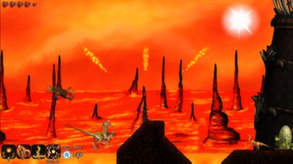
A modern take on the 16-bit era, A Valley Without Wind 2 blends a variety of mechanics across multiple genres, seamlessly bringing together the best qualities of old-school platform-shooters and turn-based strategy games.
Modeled estimate, not a reported figure. How we estimate →
Media

About
Stats
All-time low is the lowest price we've recorded for this game since we started tracking it.
Languages: English**languages with full audio support
Engagement
Hours played at review time, across 40 reviews with recorded playtime.
Reviews
Themes across 40 recent reviews and how positive each mention is. A keyword signal, not full sentiment analysis.
positive critical· bar length = how often the theme comes up
Reviews
I'm not a platform fan, but I really wanted to at least try this after disliking AVWW1 given the comments that it has more focused gameplay than the first. I liked the controls way less than AVWW1, but I liked the immediacy of the plot and the strategy screen. Again, I feel way out of my depth with this game, which if anything has more love and care in it than the first game, but I'm just not a fan of platforming. I really enjoyed the filler texts for items and spells and such, and if you liked AVWW1, you'd probably like the gameplay twists for AVWW2. The graphics seem "more realistic" in that reality has a lot of brown dirt and debris. I like the different direction, but it is a bit harder for me to pick out relevant details like monster vs. colorful debris, but that would probably get better if I played a lot. I like this game's potential more than the first, but it is less accessible to me, a platformer-disliker, especially since they don't want you to use a mouse and (though they still let you use it) they designed the game around not using a mouse for aiming and they tell you this up front.
Hum... The mixed reviews for this game are right cause this is a mixed bag. The game is many things, lots of things and way too many. It's a platformer, strategic, turn-based, RPG, management, rogue-like, procedural, adventure game. Sounds like fun? Yeah, but not for long. It's like a pizza with all the toppings or a 99 flavor ice-cream. They just put all the things they thought would be cool and it turned up to be a collage of ideas and mechanics that are not blended too well. No bugs or crashes. Runs fine on Win 7. You can't deny the developers put love into the making of this. The music is pretty good. The graphics are nice to look at. The story is simple but not that bad. Plenty replayability. But, as a game, it falls short in everything. As a platformer is uninspired, as strategic is too random and chaotic, as turn-based is way too simple, as an RPG is too basic... you get it, it's a jack of all trades and master of none. If you're really patient you might be willing to sink a decent amount of hours reading a lot of explanations that might get you even more confused. Once you're losing there's no way to overcome it. The outcome of the game depends too much on your initial turns and the randomness of the maps can doom your efforts even before you take your first move. Overall, it's a very niche game. I wouldn't say is a terrible game but the design flaws are many. It's just too ambitious for its own good. I recommend it only if you get it for cheap and only if you're very lenient with indie experiments. I will give it a thumbs up but only for the effort and nothing else.
Very weird game. Got it for 3$ (sales <3) so I can finally play it and test it out myself. It has more cons than pros for me, and I also give it a negative review as in "I don't recommend it to almost anyone", but [b]unlike[/b] most other games nowadays, it did make me enjoy or even hooked for a while, so I kinda feel bad for reviewing this negatively, but there are too many flaws to ignore. Pros: [list] [*][b]Exclusively Skillshot-based combat[/b] Your abilities are also very bizzare abilities (imagine shooting at a straight line) [spoiler]You must enable the mouse targetting at settings, because it is not default... And I see it as mandatory to play this. I legit cannot imagine anyone enjoying playing this without mouse since you can shoot only in 3 directions and everything is so mobile and fast[/spoiler] [*][b]A dazzling amount of areas/levels[/b] [*][b]Turn-Based Strategy done [u]right[/u].[/b] The Strategic layer is the thing that sets it apart. It is a metroidvania but with a strategy map where you command your [strike]minions[/strike]recruits. So, you explore and expand the map by going to places yourself, and your recruits do everything else. Resource management exists (food as an upkeep for recruits/scrap to build buildings/morale for effectiveness of recruits) and by building and assigning each one to a tile/building, you improve these. However, this is not some "pull someone into a farm to make food".... There is combat too. Nothing fancy (which is good, being complex isn't good), but monsters spawn around certain locations, and you must defend them with your recruits. Eventually (when early-game ends), big bad boss spawns, and chases to kill everyone. That means, if you built everything onto a few adjacent tiles, then you are about to lose, since the big bad boss is invulnerable and never dies. It prevents camping/turtling. So, you expand on the explored area of yours, with those recruits building stuff left and right, while the boss perma-kills them. This makes the strategic map dynamic with the monsters too, instead of building and snowballing the game with boredom. So, the biggest pro in this game, and what gets me playing is that it got right what matters: "[b][u]Just One More Turn[/u][/b]". You see where you want to explore/tiles to unlock for your recruits, you get in, you kill everything, then onto the world map, you build stuff and move your recruits appropriately. Repeat. Super satisfying gameplay loop not gonna lie, and its short on top of that <3 [/list] Neutral: [list] [*][b]The Artstyle[/b] There are 3~5 different artstyles from what I noticed in the game, and it shows. However, I find it refreshing to see tbh, however, sometimes the artstyle clashes too harshly. So, most people will dislike it for sure, since it is not consistent and high-quality, however I like it, hence the neutral category. [*][b]The Music[/b] The main theme is 100% [b]HYPE[/b], legit feels like you are about to play an incredible game you will never forget. But aside of that, the rest of the music is ambience. But its not bad, since it sets the mood right most of the times. Hence the neutral here, because you may dislike ambience music (ofc, you can turn it off and blast your playlist in the background) [*][b]The Multiplayer[/b] Haven't played it, can't judge. But I do appreciate that the developers support full multiplayer in this game, I will definitely get into this if I find replayability to the game, aka I finish it and want to replay it. [*][b]Procedurally Generated World[/b] You may not like this, because it is not hand-crafted. Though, I didn't notice, until I read it on the store page, so that means they must have done a good job with this. Adds a lot of replayability, for those who want to replay it. [/list] Cons: [list] [*][b]The Camera[/b] Perhaps the worse camera in any 2D game. Ever gotten damaged by off-screen enemies? Yeah, happens all the time. It never zooms in or out, it just moves a little to the left or right depending on your movement. So even if it moved properly, the zoom is really really bad, its un-needed sometimes because this is a skillshot game, and I cannot see how far away my enemies are... [*][b]The Movement[/b] You feel like you play a crippled mario. You move left and right, with an meh speed, and you can jump. That's all there is to it. No high jumping, no wall-jumping, no momentum feel, no high speeds ever. The platforming legit feels worse than the original mario... [*][b]The Balancing[/b] Not gonna mention the enemies, since I did dropped difficulty a lot because I hate meat-sponges (20 seconds of hitting a fodder enemy to kill it smh wtf) The balancing, means the player class' progression. There are 5 tiers of classes in-game. That's a lot, since at least 5 classes per tier. However, I am at tier 2, and there is a certain tier 1 class, that is extremely better, than any tier 2 class... That is sad. Because when I mean tiers, I don't mean levels. 5 tiers is the endgame, and tier 2 is early to midgame... [*][b]The Sound Effects[/b] Not horrible by any means, but just meh. Incredly forgettable/generic and unsatisfying. But at least they deliver the proper sound cue or effect, and I'm glad they at least exist in this kind of game. [*][b]The Animations[/b] Horrible, bad bad bad. The enemies' is even worse, if they even have one aside of walking/running lmao. But the player's is really bad tbh. Kinda sad, but whatever, it's not a deal-breaker to me at all, since I barely see my character when im trying to focus on enemies and skillshots. [*][b]The Bossfights[/b] At least they are not boring lel. Like, they dont have invulnerable phases, where you have to wait a million years for them to be vulnerable again. No bs moves either. They just walk on a platform shooting ♥♥♥♥ at you, while fodder are trying to get you. Pretty easy and predictable tbh. Then when they lose X of their life, they teleport deeper into the dungeon. The fighting area has Y depth, unlike some tunnel-levels in the game, and the enemies attack you a lot. But it just sucks, because the bosses are weak af with predictable/slow projectiles and the monsters arent infinite, so you can just slowly kill the enemies, then focus on the boss, which is an absolute weakling everytime. And ofc, every bossfight is essentially the same, but like I said, at least its not boring because you can go at your own pace guns blazing, or turtling to victory safely. And it also refreshes the pace since its a different kind of gameplay than killing enemies and advancing in a level, or doing strategy map stuff. [*][b]The Polishing[/b] It really feels like there is a lot of content in this game, and a lot of effort was spent making it. But the game lacks polish for sure. A lot is needed. [/list] If you still want to play the game after having read all of this, [b]ENABLE THE MOUSE SETTINGS[/b], because otherwise, you will be playing with some botched d-pad control settings, where every enemy is super mobile, and you can only shoot 0/45/90 degrees... I legit cannot believe the default control settings are keyboard-exclusive... Eight-Way aiming in 2019... Every enemy that doesnt move in a straight line is highly mobile, so it is impossible to hit without mouse! If I had to take a guess, you will like this, only if you are looking to play a unique platformer/metroidvania, since no other platformer or metroidvania game, has incorporated proper/fun strategic elements like this. But if you do, with all the replayability value onto this game(multiplayer + so many different classes + procedurally generated world that is actually good), you are bound to spend a lot of time with it (20 hours+) Even if you dont plan on replaying the game (like me as of now), having experienced all the flaws above as you have seen, I still like this game, and enjoyed my time with it thus far, but I legit wouldn't recommend it to almost anyone.
Still as janky as the first one. You can screw yourself in the strategy section pretty easily. He added mouse aiming but it doesn't add much. Multiplayer isn't great but with coordination you can really make something happen. Its not pretty at all, but no true roguelike is. I personally find it fun to just endlessly plow through areas so I was not disappointed at all.
This is a confused 2D retro pixel "16 bit" action platformer with "strategy" elements where you jump around a lot of platforms and collect stuff and fight stuff, then play a metagame which is a kind of lame town building strategy thing, I don't know. The implementation here is just rubbish. 2D platformers died not long after Donkey Kong introduced them in 1981. Arcen games plunged on regardless, making a game that kind of runs on modern PCs but with no display scaling, so you get tiny, unreadable text accompanying clunky, terrible platformer gameplay. This is the sequel to an earlier game with all the same problems, but it's worse. Like, the Highlander 2 of "A Valley Without Wind", if "A Valley Without Wind" was a good product.
My Personal Game Score: 3 / 10 -Confusing game. -The first game is a little better than this. -Sub-standard game of the first version.
This game keeps trying to lure me in with some good looking ideas but they are full of constant bad design choices. Enemies are NOT fun to fight and are not rewarding enough to make it worth your while. Bosses are boring and the overworld is unbalanced as hell. Avoid like the plague.
Умер мужик. Друзья стоят у гроба: — А он неплохо выглядит. — Ещё бы, три дня не пьёт.
A Valley Without Wind 2 is an unconventional hybrid of action platforming and strategic gameplay developed and published by Arcen Games. Released in 2013, the game was designed as a complete reimagining of its predecessor rather than a traditional sequel. While the original A Valley Without Wind leaned heavily into procedural exploration and sandbox-style mechanics, the second installment rebuilds the concept around a clearer structure and a more focused campaign. The result is a game that blends multiple genres together, combining turn-based strategic management with real-time side-scrolling combat in a fantasy setting filled with magical battles and tactical decision-making. The story centers on a powerful tyrant named Demonaica, a nearly immortal ruler who has conquered the world and established an oppressive regime that dominates every remaining civilization. Players take on the role of a mage who infiltrates Demonaica’s ranks and manages to obtain the same immortality that protects the villain. With this newfound power, the protagonist becomes one of the few individuals capable of challenging Demonaica’s reign. The player then leads a growing resistance movement dedicated to stripping the tyrant and his generals of their immortality before confronting them in a final battle. The narrative unfolds gradually throughout the campaign, providing context for the player’s strategic objectives while maintaining a dark fantasy tone that reflects the devastated world under Demonaica’s control. One of the most distinctive aspects of the game is its dual-layer gameplay system. The experience alternates between a strategic overworld map and individual side-scrolling action missions. On the overworld map, players manage the resistance army in a turn-based format. They move units across a grid-like battlefield, gather resources, construct buildings, and recruit new allies to strengthen their forces. Enemy armies constantly move across the map as well, attempting to capture territory and threaten the player’s settlements. This layer of gameplay emphasizes planning and positioning, as players must carefully manage their resources and anticipate enemy movements to maintain control of the battlefield. Whenever two opposing forces meet or a specific location is explored, the game transitions into a side-scrolling action stage. In these segments, players directly control a mage character who must defeat enemies and navigate through platforming challenges. Combat revolves around magical attacks and abilities that can be customized through various upgrades and perks. Players dodge enemy projectiles, unleash spells, and move through hazardous environments while trying to clear each area of hostile creatures. Although the platforming mechanics are relatively simple compared to dedicated action games, they provide an engaging contrast to the slower pace of the strategic layer. Character progression plays a significant role in shaping the player’s combat effectiveness. Throughout the campaign, players unlock different mage classes and abilities that influence how the character performs in battle. Some builds emphasize raw magical power, allowing players to unleash powerful attacks capable of eliminating enemies quickly. Others focus on defensive abilities that improve survivability during difficult encounters. Because players can adjust their character’s abilities between missions, the game encourages experimentation with different combinations of skills and equipment to find strategies that suit individual playstyles. The strategic layer also includes a progression system tied to expanding the resistance movement. As players capture territories and complete objectives, they gain access to additional resources and structures that strengthen their army. New units can be recruited to defend key locations, and buildings can be constructed to support the growing resistance network. These elements add a sense of long-term development to the campaign, as the player gradually transforms a small insurgent force into a powerful faction capable of challenging Demonaica’s empire. Procedural generation plays an important role in the game’s design. Many of the environments and encounters are generated dynamically, ensuring that each playthrough unfolds differently. The placement of enemies, terrain features, and certain objectives can vary between missions, creating a sense of unpredictability throughout the campaign. This system helps prevent the gameplay from becoming overly repetitive, although it can sometimes result in levels that feel less carefully designed than those found in fully handcrafted games. Visually, A Valley Without Wind 2 adopts a retro-inspired 2D art style that draws inspiration from classic platformers of earlier gaming eras. Characters and environments are presented using colorful pixel art, giving the game a nostalgic appearance while maintaining clarity during combat. The various regions of the world feature distinct visual themes, ranging from ruined cities and haunted landscapes to magical forests and ancient structures. While the graphical style is relatively simple compared to modern high-budget titles, it effectively supports the game’s fantasy atmosphere and gameplay mechanics. The audio design complements the visuals with a soundtrack that blends atmospheric melodies and energetic battle themes. Exploration sequences on the strategic map are often accompanied by calmer music that reinforces the contemplative nature of planning moves and managing resources. When players enter combat stages, the music shifts toward more intense compositions that heighten the sense of urgency. Sound effects for spells, enemy attacks, and environmental interactions provide clear feedback during action sequences, ensuring that players can react quickly during chaotic battles. One of the most interesting aspects of the game is its willingness to experiment with genre combinations. By merging turn-based strategy with real-time action platforming, the developers attempted to create a gameplay loop that requires both tactical planning and reflex-based combat skills. This design allows players to experience two different styles of gameplay within a single campaign. Strategic decisions made on the overworld map influence the challenges faced during platforming missions, creating a sense of interconnected systems that shape the overall progression. However, the game’s ambitious design also leads to some noticeable shortcomings. The transition between the strategic and action layers can sometimes feel abrupt, as the two systems operate quite differently. While the strategy component provides a sense of scale and long-term planning, it does not reach the depth of dedicated strategy games. Similarly, the platforming segments are enjoyable but relatively simple compared to specialized action titles. As a result, the hybrid approach may leave some players wishing that one of the two gameplay styles had been developed further. Overall, A Valley Without Wind 2 is an ambitious and experimental game that attempts to combine multiple genres into a single cohesive experience. While its hybrid design may not appeal to everyone, it demonstrates a creative approach to gameplay that few other titles attempt. Players who enjoy strategy games, action platformers, or unusual genre blends may find the game particularly intriguing. Although the execution is occasionally uneven, the game’s innovative ideas and distinctive structure make it a memorable entry in the world of indie gaming. Rating: 6/10
Bon mix de stratégie et de plateforme !
Related
Related
Trends
Modeled estimate over time, reconstructed from Steam's monthly review histogram.
Momentum
Pace estimated from the game's recent review growth (our daily snapshots) at its own sales-per-review ratio — a momentum signal, not booked sales.
Audience
Estimated from the language of this game's reviews — a proxy for where players are, not official Steam demographics.
Related
| The Message from Deep Space | $111.5K | 602 | 98% | $9.99 |
| Dino Crisis | $111.5K | 965 | 80% | $4.99 |
| Kakuriyo Village ~Moratorium of Adolescence~ | $111.5K | 206 | 82% | $24.99 |
| MorphVOX Pro 5 - Voice Changer | $111.4K | 191 | 47% | $39.99 |
| Dynamite Jack | $111.5K | 423 | 86% | $9.99 |
| SIMULACRA 3 | $111.6K | 360 | 59% | $9.99 |