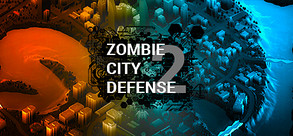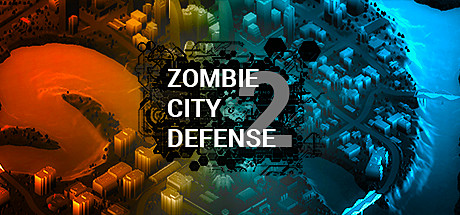
In a near future, the world has been devastated by a virus turning humanity into zombies. You are Iron Corps, the last defense of civilization traveling the world to find resources, help people and find answers. Will you survive long enough?
Modeled estimate, not a reported figure. How we estimate →
Media
About


Genres
Stats
All-time low is the lowest price we've recorded for this game since we started tracking it.
Languages: English*, Russian*languages with full audio support
Engagement
Hours played at review time, across 40 reviews with recorded playtime.
Reviews
Хороша в своей нише
Zombie City Defense 2, developed and published by Mozg Labs, is a strategy-driven zombie survival game that blends elements of real-time tactics and tower defense into a single, demanding experience. Rather than focusing on moment-to-moment action or direct control, the game places players in a command role, overseeing military operations against an overwhelming undead outbreak. Set in a bleak near-future world, the game frames its conflict around the Iron Corps, a last-resort military force tasked with holding back the apocalypse while investigating the origins of the infection. The result is a game that emphasizes planning, resource efficiency, and adaptability over spectacle. At the heart of the experience is a mission-based structure where players must defend strategic locations against waves of zombies using a limited pool of tactical resources. Before each mission begins, you are given a set number of tactical points that determine what units, defenses, and abilities you can deploy. These points must be spent carefully on infantry squads, armored vehicles, stationary defenses, and powerful but costly abilities such as airstrikes. This system immediately establishes a sense of tension, as poor preparation can doom a mission before it even begins, while smart allocation can make seemingly impossible scenarios manageable. Gameplay unfolds in real time, but the pace is measured rather than frantic. Units are represented by icons rather than detailed models, and combat is abstracted to focus on positioning, coverage, and timing. Infantry can be deployed to defend choke points, scavenge for resources, or support structures, while vehicles and turrets provide sustained firepower against incoming hordes. One of the game’s more distinctive features is the ability to alter the environment itself, such as destroying bridges to redirect zombie flows or abandoning certain areas to fortify others. These decisions give the battlefield a dynamic quality and reinforce the idea that survival often depends on sacrifice and strategic retreat. Environmental conditions play a meaningful role in shaping each mission. Weather effects such as fog, rain, snow, and extreme heat influence visibility and unit effectiveness, while night cycles increase zombie aggression and resilience. This forces players to adapt their strategies rather than rely on a single optimal setup. A unit composition that performs well in daylight may struggle at night, and certain defenses become less effective under adverse conditions. These variables add depth to the gameplay loop, encouraging experimentation and careful observation. The game’s difficulty curve is one of its defining traits. Early missions introduce mechanics gradually, but the challenge ramps up steadily, and later stages demand near-perfect planning and execution. Tactical points remain limited throughout, meaning that progression is not about overpowering the enemy but about learning how to counter them more efficiently. This can be deeply satisfying for players who enjoy strategic problem-solving, but it can also feel unforgiving. Some missions require replaying earlier scenarios to unlock additional options or refine strategies, which may frustrate players who prefer smoother progression. Visually, Zombie City Defense 2 adopts a minimalist, map-like presentation. Cities, landscapes, and units are depicted in a stylized, almost board-game-like manner. While this approach keeps performance smooth and information density high, it can also make the action feel distant and, at times, hard to read. During intense moments, tracking individual unit positions or understanding why a defense failed may require close attention. The interface is functional but not especially intuitive, and the learning curve can feel steep due to limited in-game guidance. Narratively, the game takes a restrained approach. Story elements are delivered through brief mission descriptions and contextual text rather than cinematic sequences or character-driven storytelling. This minimalist narrative design supports the strategic focus, but it also means the emotional weight of the apocalypse is felt more through gameplay pressure than through plot development. Players invested in lore may find the world intriguing but underdeveloped, while others may appreciate the lack of distractions. Replayability comes from experimentation rather than randomness. Different unit compositions, difficulty settings, and optional modes encourage players to revisit missions and test alternative strategies. However, mission objectives and layouts remain largely fixed, which can lead to a sense of repetition once optimal solutions are discovered. The game rewards mastery and efficiency more than creativity, reinforcing its identity as a tactical puzzle rather than an open-ended sandbox. Ultimately, Zombie City Defense 2 is a niche but thoughtful entry in the zombie genre. It prioritizes strategic depth, tough decision-making, and long-term planning over visual flair or action-heavy gameplay. Its strengths lie in its challenging mechanics and dynamic battlefield management, while its weaknesses stem from presentation limitations and a steep learning curve. For players who enjoy methodical strategy games and are willing to embrace trial, error, and repetition, it offers a tense and rewarding take on zombie survival. For those seeking cinematic immersion or fast-paced combat, it may feel austere and demanding, but on its own terms, it delivers a solid and distinctive strategic experience. Rating: 6/10
오랜만에 다시 할려니까 왜안되노 비추드렸습니노~
One of the best games I ever played, to be honest, I haven't seen anything quite similar like this.
Juego muy dificil, tienes que echar muchas horas para conseguir buenas armas, pero te mantiene pegado, y ademas son partidas cortas, por lo que no se hace pesado. Hasta que no lo termine no paro :).
Awesome game
Obscenely difficult, can't beat level 1 even years later. Game is abandoned by devs.
后悔买了
If you like this, then Infected Free Zone is definitely another zombie game for you.
Related
Related
Trends
Concurrent players on Steam, sampled daily since tracking started.
Momentum
Pace estimated from the game's recent review growth (our daily snapshots) at its own sales-per-review ratio — a momentum signal, not booked sales.
Audience
Estimated from the language of this game's reviews — a proxy for where players are, not official Steam demographics.
Related
| Mister Versatile: A Gay Superhero Visual Novel | $79.1K | 141 | 89% | $19.99 |
| Beach Invasion 1945 - Pacific | $79.2K | 271 | 80% | $9.99 |
| Feed The Pit | $79.1K | 308 | 98% | $9.99 |
| RuneQuest: Warlords | $79.2K | 95 | 74% | $29.99 |
| 云端之约 | $79.1K | 529 | 93% | $7.99 |
| Minotaur | $79.2K | 342 | 95% | $14.99 |
Related
| 7 Days to Die | $425.3M | 403.6K | 87% | $44.99 |
| Mount & Blade II: Bannerlord | $309.8M | 294K | 88% | $49.99 |
| Squad | $167.2M | 178.2K | 83% | $39.99 |
| Don't Starve Together | $164.7M | 539.5K | 95% | $14.99 |
| Schedule I | $144.4M | 308.5K | 98% | $19.99 |
| Raft | $144M | 375.8K | 93% | $19.99 |