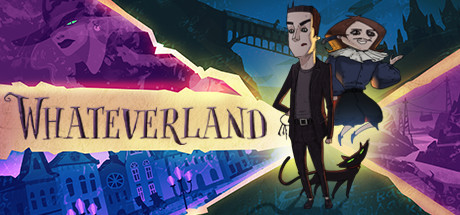
Find your way out of a magical prison in this non-linear point'n'click adventure full of mini games and challenges. Get to meet the charismatic Whateverlanders, steal and deceive or be a good boy to discover all the different endings of Vincent's story.
Modeled estimate, not a reported figure. How we estimate →
Media

About


Genres
Stats
All-time low is the lowest price we've recorded for this game since we started tracking it.
Languages: English*, French, Italian, German, Spanish - Spain, Japanese, Korean, Russian, Simplified Chinese, Traditional Chinese, Ukrainian, Turkish*languages with full audio support
Engagement
Hours played at review time, across 40 reviews with recorded playtime.
Reviews
Themes across 40 recent reviews and how positive each mention is. A keyword signal, not full sentiment analysis.
positive critical· bar length = how often the theme comes up
Reviews
很幽默很古怪的游戏
8/10
Классная игра с милым сюжетом. Идеально для спокойного вечера
Ihan hauska point & click peli, mutta juoni oli ehkä hieman suoraviivainen ja tylsähkö. Ei tarjonnut jännitystä mutta ihan mukava pelattava.
Whateverland is a narrative-driven point-and-click adventure game developed by Caligari Games and co-published with WhisperGames. It tells the story of Vincent, a skilled but unlucky thief who attempts to steal a necklace from an old woman, only to discover she is a powerful witch named Beatrice. As punishment, she exiles him to Whateverland, a surreal and strange limbo inhabited by a cast of oddball characters—each also trapped by their past mistakes. The setting serves not only as a fantastical prison but also as a mirror for the choices players make throughout the journey, as Vincent attempts to gather the pieces of a spell to escape. The core gameplay unfolds through exploration, conversation, light puzzle-solving, and a number of optional mini-games. One of the game’s defining strengths lies in its non-linear structure. Unlike many traditional adventure games that funnel players down a single path, Whateverland gives you the freedom to tackle challenges in different ways—be it through deception, theft, diplomacy, or empathy. The decisions you make impact character relationships and the overall narrative outcome, leading to multiple endings. This choice-driven design means that not everything can be seen or done in a single playthrough, and replaying the game with a different approach reveals new layers to both the characters and the world. Vincent is not alone in his quest. He is accompanied by Nick, a ghostly companion with his own personality and opinions, often commenting on your choices or offering hints. Their dynamic adds a layer of humor and tension, balancing the game’s often eerie or surreal atmosphere with lighter moments. Dialogue is fully voiced, and the characters are brought to life with expressive performances that fit well within the game’s quirky and offbeat tone. Each resident of Whateverland has a backstory, and your interactions with them—whether helpful or exploitative—shape your journey and theirs. Visually, the game is striking. Everything is hand-drawn with a distinctive art style that blends dark whimsy with dreamlike surrealism. There are clear influences from artists like Tim Burton, though the game maintains its own identity. The environments are filled with strange details: architecture that bends the rules of reality, grotesque-yet-endearing character designs, and a palette that shifts with mood and story. The visual design reinforces the feeling that this is a place out of time, disconnected from logic but deeply rooted in emotion and consequence. Sound design plays a crucial role in reinforcing the game’s mood. The original soundtrack features live instrumentation, including a chamber sextet that adds texture and authenticity to the audio landscape. The music shifts with tone—sometimes eerie and mysterious, sometimes upbeat and whimsical—and works in tandem with ambient effects to create an immersive world. While the production values may not rival big-budget titles, the sound design fits the scale and artistic intent of the game perfectly. In addition to its narrative and exploration elements, Whateverland features a number of mini-games that vary in type and complexity. One of the most notable is “Bell and Bones,” a turn-based strategy mini-game reminiscent of football played on a hexagonal grid. These diversions are often tied to character quests or serve as alternative ways to progress. While they add variety, some players may find them hit-or-miss. A few mini-games can feel under-explained or awkwardly integrated, leading to pacing issues when they interrupt the flow of story-driven gameplay. There are some technical rough edges as well. The user interface can occasionally feel clunky, particularly when identifying interactive objects within the environment. Navigating certain screens or dialogue trees may require more clicks than necessary, and some puzzles lack clarity in design. These issues aren’t game-breaking, but they can momentarily break immersion, especially during more complex or time-sensitive tasks. Despite these minor flaws, Whateverland delivers a genuinely original and thoughtful experience. It doesn’t rely on conventional storytelling or gameplay tropes, instead offering players a world where personal choice and consequence matter, both mechanically and thematically. The surreal visuals, branching narrative, and mix of humor and melancholy combine to create a memorable adventure that stands out within the point-and-click genre. For players who enjoy morally flexible characters, experimental storytelling, and handcrafted art styles, Whateverland is well worth exploring—especially for those willing to embrace the weird and reflect on what redemption might look like in a world that refuses to forget. Rating: 8/10
Eu diria que é um jogo mediano: não é ruim, mas também não é sensacional.
It would have been better without Bell & Bones.
牛一点,画风很有特色但是我不太喜欢,但是配音真不错
I do not recommend this to point and click enthusiasts. This game is mostly this "Turn-based strategy sport simulator" which is really repetitive. Once you figure out how it works all levels are really easy to beat. The lock picking minigame was quite fun, but some objects were impossible to see. Would have loved a zoom function for those. For the minigames and the "overworld" in general it was often a chore to figure out the controls. Sometimes clicking didn't seem to do anything in the satellite minigame. The sidekick Nick often blocked exits etc. In general the "difficulty" of the puzzles was more about finding the one thing blending into the background that was interactable. I also got softlocked during minigames a few times and had to reload a save. I tried doing the same for a puzzle near the end of the game and my autosave got overwritten. I still recommend it. I had a nice time. The game often goes on sale for 90%, so for 1,50€ it's definitely a nice time waster.
Это замечательная игра, я просто расплакалась от концовки, как это прекрасно. Игра навсегда осталась в моем сердце ❤️
Related
Related
Trends
Modeled estimate over time, reconstructed from Steam's monthly review histogram.
Momentum
Pace estimated from the game's recent review growth (our daily snapshots) at its own sales-per-review ratio — a momentum signal, not booked sales.
Audience
Estimated from the language of this game's reviews — a proxy for where players are, not official Steam demographics.
Related
| Kenshō | $3.5K | 58 | 90% | $3.99 |
| The Wolf's Bite | $3.5K | 58 | 88% | $3.99 |
| Extreme Roads USA | $3.5K | 69 | 12% | $1.49 |
| Pleasure Puzzle:Workshop 趣拼拼:拼图工坊 | $3.5K | 236 | 89% | $0.49 |
| The Pillage | $3.5K | 58 | 86% | $2.99 |
| Lonely in the Winter | $3.5K | 58 | 91% | $2.99 |
Related
| Euro Truck Simulator 2 | $421.6M | 932.6K | 97% | $19.99 |
| Human Fall Flat | $109.3M | 225.6K | 95% | $19.99 |
| American Truck Simulator | $103.7M | 194.2K | 97% | $19.99 |
| Slime Rancher | $73.9M | 155.5K | 98% |
| $19.99 |
| DAVE THE DIVER | $67.1M | 158.9K | 97% | $19.99 |
| House Flipper | $65.8M | 110.8K | 94% | $24.99 |