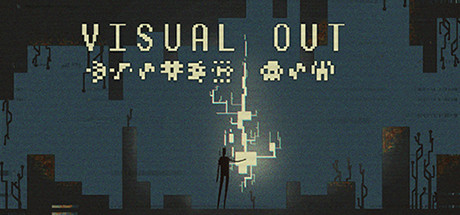
An explorative platformer inside a dying computer
Modeled estimate, not a reported figure. How we estimate →
Media

About
Stats
All-time low is the lowest price we've recorded for this game since we started tracking it.
Languages: English
Reviews
Visual Out is one of the purest Metroidvanias I have ever played. Right from the get-go, MadameBerry provides the player with just enough of a story to intrigue them, but not so much that deciphering the plot is a chore all on its own. The rest of the story is laid out as needed through short data-logs and the occassional monologue. After the opening cutscene, the player is quickly (but not abruptly) thrown into the world and given the freedom to figure out the intuitive mechanics of the game for themselves. The flow and pacing of the game is consistent throughout, and is structured according to the player's own choices regarding exploration. Remarkably, the world itself is at once both maze-like and open in design. Some rooms feel claustrophobic, others are massive, expansive, and awe-inspiring. One particular room with a giant fan (though taxing on the crappy processor of my 6-year old laptop) really demonstrated the technical, graphical, and atmospheric quality of the game. Regarding graphics, Visual Out is a game heavy on the effects. While I am normally opposed to this in games, in Visual Out I actually found the effects to be ingeniously well done. Unlike in most games, where the special effects add little more than an unnecessary amount of bloom and particles, the effects in Visual Out actually make the game [i]better[/i]. And the effects look good. [i]Really[/i] good. Numerous games through the years have used the "ye olde CRT monitor" aesthetic, but rarely (in my opinion) to terribly good effect. In Visual Out, the aesthetic is handled brilliantly. Not once in the game did I ever feel like the effects got in the way or obscured my ability to play the game. Not even once. In fact, they made the boss fights a joy, because the whole world seemed to react to my every move and attack. Yet, for how much the effects improve the experience of playing Visual Out, the great thing is, the game still doesn't look too bad without them. It's still entirely playable, and wholely enjoyable. So if you have a crappy old HP laptop like me, fret not! All are welcome! Bring your old CRT if you want and make your own effects! ;) Beyond the effects and the story, the greatness of Visual Out lies in its total focus on player exploration--which, might I add, is rarely ever hampered. A fair amount of the world is open to the player right from the get-go, and within the first couple hours of gameplay, most players will have already unlocked enough abilities to explore much of the rest. Taking an approach to exploration that has the player explore the periphery of the world before finishing things off in the map's center (a la Hero Core), Visual Out keeps the end-game constantly within the sights of the player, and (a la Super Metroid) leaves the doorway to the game's proverbial Tourian a fairly easy one to remember--a good thing, when the player spends so much time traversing from one half of the map over to the other. This necessarily means that the player passes the gateway several times over the course of a typical playthrough, leaving no room for confusion when the time finally comes to go beat up Mother Br-I mean, the bad guy. The ribbon that ties this quintessential Metroidvania package together is the excellent atmospheric music. It is simple, but pleasing to the ears, and conveys just the right amount of loneliness, mystery, and subtextual fear to make the player really feel like they're walking through an empty, abandoned, infected computer. Think the Underwater Maridia theme from Super Metroid--it sounds and feels exactly like that, and I [i]love[/i] it. All in all, Visual Out is a remarkably good game, and a nigh flawless Metroidvania. I had an absolute blast playing it, and can see myself delving back into its circuits many, many more times. Thanks for the excellent game, Berry. :)
Related
Related
Trends
Concurrent players on Steam, sampled daily since tracking started.
[h1] The Metroidvania Review[/h1] [url=https://metroidvaniareview.com/2018/11/24/visual-out/] Scored Summary[/url] | | [url=http://store.steampowered.com/curator/30503887/] Subscribe to our Curator [/url] [b]How Metroidvania is it?[/b] Medium Fit – While the level structure and progression is exactly what you’d want from a Metroidvania, “combat” is handled in a very unusual way. [url= https://steamcommunity.com/groups/MetroidvaniaReview/discussions/1/1744478429684685223/] Want to hear a different opinion, or want to share your own review? Check out our Forum here.[/url] [h1]Full Review[/h1] [i]Visual Out[/i] is very weird and hard to describe – though I’m going to make my best attempt at doing so. It’s pretty easy to recommend to anyone looking for something completely new. On that same token though it had me questioning whether or not “weird” equated to “fun”. Eventually novelty fades away for just about everything, and while [i]Visual Out[/i] might be the gaming equivalent of an abstract painting, it still uses the same shapes that make up everything else. The most novel thing about [i]Visual Out[/i] is that it avoids traditional combat entirely, opting instead for the sort of puzzle fights you’d expect from a typical [i]Zelda[/i] game. Your first power – the “Current” – is this line that extends from your stick figure’s hand just slowly enough that I can’t call it a whip. If the line connects with a compatible object you can move the object anywhere you can see on the screen. Objects function exactly as normal, so if you “plug-in” to an enemy, it will still shoot at you or drop its bombs – or whatever it normally does. So early on in the game your task is to passive-aggressively shove enemies into innocuous locations so you can get where you want without taking damage. This unusual approach to enemy encounters gets built upon nicely as you progress. You get this “Jammer” power that creates a negative space in your immediate area, and enemies that enter this negative space start functioning differently. Often when “jammed”, they do the opposite thing from what they were doing before. Enemies that would create large pixels on the screen will start removing them, letting you pass through blocked corridors. Poison bottles will start producing items that give you energy. It’s very similar to the “glitch gun” from [i]Axiom Verge[/i] in the sense that every enemy has two states you can deal with, except as mentioned before your goal isn’t really to eliminate your foes, just to avoid them or use them to your advantage. Bosses of course are the exception to this idea of passive-aggressive combat. Each one is a puzzle that requires you to use the powers you’ve found to take them apart. Most of them are pretty straight forward, but two in particular might have you stumped for a few deaths. Generally the bosses are satisfying to figure out; even if once you’ve solved the puzzle it might feel like some drag on a bit. While the Current power and the Jammer power are the core of the gameplay, there are traditional Metroidvania movement powers as well – such as the obligatory double jump and a dash ability. All of these come together to create a very well-constructed Metroidvania world to explore, which is definitely the best and most memorable part of [i]Visual Out[/i]. In fact, I’d say that it’s the game’s core challenge. The voice that constantly talks to your avatar and the data logs around the computer space give this sense of mystery that drives you to keep moving forward – and it’s that kind of mystery that is fun to discuss on forums about what it all really means. [i]Visual Out’s[/i] also uses a power supply accessed through on/off switches in the world to change your route through the game world. This combined with your weird ability to manipulate enemies provides a smart and well-designed Metroidvania space. I believe that keeping exploration challenging is why Madameberry Games decided to not show your position on the game’s map by default. At save points you’re given a miniature map that shows where you are, but when you’re actually navigating the world your more complete start menu map just shows the layout without telling you which room you’re in. If you’ve played [i]Hollow Knight[/i] and tried to navigate the world without wearing the Compass Charm, you’ll know what this is like. However unlike [i]Hollow Knight[/i] where the friendly humming cartographer gives you a map full of environmental markers you can use to orient yourself, [i]Visual Out’s[/i] map is more like [i]Super Metroid’s[/i] where you’re [i]only[/i] given squares to represent the rooms. This means if you really want to keep track of where you’ve been, you may want to screenshot the in-game map and paste it into MS Paint so you can draw your position any time you make a screen transition. I remain neutral on this design decision, because I think it can be fun to test your memory – and even use paper – but some might argue that the game would be better if it just did this for you. Generally the world layout is good enough that I didn’t feel like I needed the map for a non 100% playthrough. However, in the late game they require you to explore the whole world in order to progress which made this design slightly frustrating. The final “puzzle” you need to solve requires you to enter 3 symbols into this screen, and the only way to know which symbols to use is to enter one of six rooms which [i]might[/i] have a symbol. I suspect it’s all random making it impossible to use a guide, and since there are so many options for symbols, it’s unreasonable to solve it through brute force. I hesitate to call this a “puzzle” since it really equates to a scavenger hunt – and honestly I think that’s fine for a game where exploration is the focus. It’s just that aforementioned less-than-useful map that made it a bit of a pain. I personally stumbled across two symbols and had wandered more than I was willing to tolerate, so I guessed the final symbol through a trial and error process of trying the 24 remaining symbols one at a time (I ended up trying 22 of them before getting the right one.) Thus, when trying to answer the question of whether [i]Visual Out’s[/i] brand of “Weird” equates to “Fun”, stuff like this makes me hesitate to give it the highest score. I also feel like the puzzles are not clever enough to recommend it to those looking for the kind of intellectual challenge that something like [i]La-Mulana[/i] could provide. With that said, [i]Visual Out[/i] is for the most part fun to traverse. In terms of atmosphere, there’s nothing quite like it. I think that if you liked the cryptic nature of the narrative in games like [i]Axiom Verge[/i], [i]Hollow Knight[/i], or the From Software Souls games, and would like to see a game centered around only that story-telling aspect, you might find [i]Visual Out[/i] appealing. Even if you just want to see something completely different, I give [i]Visual Out[/i] a recommendation. 3 out of 5
Having just finished this game (95% item completion, but c'mon gimme a break) I can say that I certainly would recommend it to the right sort of person. To tell if you will enjoy Visual Out, you need only complete these simple questions: 1. Do you enjoy Metroidvanias? 2. [This question intentionally left blank]? Now, I do enjoy Metroidvanias despite being horrible at them. I found myself stumped a few times throughout my playthrough, but I'll chalk this up to me being dumb rather than bad game design. I feel that a more seasoned veteran of Metroidvanias will have an easier time with this than myself. For the less seasoned, I'd consider this to be a 'guide game'. In terms of the visuals and music, simply fantastic. The art is beautiful and the animations are smooth. The soundtrack is very atmospheric and fits the derelict tone very well. Overall, I thoroughly enjoyed my time with Visual Out. Beautiful visuals and music along with fun and challenging gameplay make for a highly enjoyable experience. Recommended!
haven't played much cause of unrelated computer issues but so far it's a fun game with a cool look
[quote][b]This review was made possible by[url=https://store.steampowered.com/curator/6095538/] Yolo Army Reviews. [/url] [/b] [i]I received a reviewing copy of this game for free. However, my review is honest.[/i] [/quote] [i]Skip to the bottom for my Final Thoughts[/i] Visual Out is a great atmospheric Metroidvania centered around a program in a dying computer. [h1]Graphics[/h1] Visual Out is, quite honestly, one of the best looking indie games I've seen so far in 2018. The graphics are mostly minimalistic, however there is a nostalgic (for some, I'm wayyyy after that era) CRT-monitor feeling that is very nicely done. The level design is very similar to that of Risk of Rain, and that's not a bad thing at all. The game focuses heavily on the visual effects so if you're epilectic then I'd recommend you stay away or play in moderation, but for everyone else I find the visual effects to be very nicely done and didn't cause me any headaches whatsoever. [h1]Audio & Soundtrack[/h1] The music in Visual Out really helps tie in the atmosphere of the game. The main menu music alone is incredibly well done and sets the tone for the dark theme ahead of you when you run the game for the first time. The music at the beginning of the game is very dark and makes the game feel a lot like a horror (which it isn't) and really reinforces the overall atmosphere of the game. Like the graphics, the music is really reminiscent of older retro games and fits in really nicely with the rest of the game. If you want to give the soundtrack a listen ahead of time, you can find samples of the entire album on Amazon. [h1]Gameplay[/h1] The gameplay is, for me at least, the weakest part of Visual Out but not by much. When I first started playing the game (the first hour/hour and a half), I found myself getting lost quite often with no real direction or guidance of where I was supposed to go. I eventually found my way via trial and error but for the first little bit I found myself getting a little bit frustrated, whether that be by my own incompetance or the game is up to you. One could argue that the game is an exploration game and they'd be right, however right from the get go (the beginning cutscene) you are given no direction whatsover; no quest, no goals, nothin', which I think the developers could touch up on a little bit. I really like the character progression which is entirely ability based. The player is given complete control of how they want to build their character which allows for tons of replayability and options for you to choose from. [h1]Storyline[/h1] The story for Visual Out is one of the stronger parts of the game. Without spoiling the story, you play as a program stuck inside a dying computer. You spend the entirety of the game exploring (like I mentioned earlier) and discovering more and more about the world you reside in. Visual Out's story is something I'd recommend you purchase the game for alone, so if you're itching for a good story that unveils itself to you at just the right pace then I'd highly recommend Visual Out. [h1]Final Thoughts[/h1] Overall Visual Out is probably one of the better indie games I've played thus far in 2018. The graphics, audio and storyline are all really well done, and the gameplay, although a little bit weak here and there, is still pretty good and is didn't ruin or hinder my experience at all. If you enjoy Metroidvanias, games with good stories or some nostalgic CRT-monitor style graphics then you should check out Visual Out. Rating: Graphics: 9.0/10 Audio: 8.5/10 Gameplay: 7.0/10 Storyline: 9.5/10 Overall: 8.4/10 [quote]Like the review? Consider checking out and following[b][url=http://store.steampowered.com/curator/31837076/] My Curator Page [/url][/b] for more! [/quote]
As a fan of Metroidvanias, I appreciate games where you are free to explore and do what you can. VisualOut is not that. Though its presentation brings to mind many other indie darlings with similar quirkiness (Pony Island and You Have To Win The Game are immediate comparisons), its gameplay lacks direction or motivation. While most games in this genre are like this, VisualOut is absolutely a game of "cannots". Here's a jump you cannot make; a boss you cannot kill; a powerup you cannot access; a wall you cannot break. Now, most MetroidVanias encourage you to explore, find alternate routes, get secrets, read logs. VisualOut is not that sort of game. Eventually, you run out of routes to run, out of items to find, and at that point it's up to the game to provide a little direction. I'm not saying the game has to play everything for you, but...well, look how the Metroid games did it. Eventually, I got stuck at the first "boss" enemy (featured in the trailer) with no clear way to damage it, no further powerups available to me, and no way out of the room. After a few tries, I couldn't even make my way back to the boss. VisualOut prioritizes its (admittedly very nice) artistic ideas over the traditions of exploration gameplay, and it suffers. The game becomes player unfriendly. Did I mention that you have to turn on "map assist" and the GUI in the options menu? Those aren't defaults, they're "accessibility options". Overall, I can't recommend this game. I was excited to play it -- as I am with anything in this genre, considering we're probably never getting an official 2D Metroid or Castlevania release again, but also, because of my interest in glitch art and retro computing. This game fails to scratch any of those itches, though, and honestly, I don't even think a walkthrough would make this game worth it.
I love how atmospheric this game is. The art and attention to detail is on point. I ran into a few issues getting the game running for the first time, but nothing major. Really enjoying the exploration and the smart use of puzzles and abilities. It seems there are a lot of places to explore that I can't reach yet, which is the perfect way to handle Metroidvanias. The music is great too, but I'm a little biased because I wrote it :P
This game is rad so far. It's like a Metroidvania where the environment is unfamiliar and alienating, so you're having to experiment a lot with the way different objects interact with one another. It reminds me of the feeling I had when I first played Super Metroid, where everything felt unknown and mysterious, and anything could happen. I don't get that feeling much anymore with most games so I love feeling it again. Also has a killer visual style and soundtrack.
I haven't really put too much time into thise title yet, however it looks very promising and I absolutely love the art and concept.
A very unique metroidvania type of game. You'll spend a lot of time backtracking but the strange art style and wonderful music will make it somewhere between bearable and enjoyable. If you're looking to try something weird and techy then you'll love this, but the lacking and pretentious story that we have no real stake in won't hold it up narratively for you.
Related
| Tide—1927— | $3.4K | 51 | 86% | $2.99 |
| Cyber Tower 2048 | $3.4K | 99 | 87% | $1.49 |
| Beyond the Sunset 斜阳下的彼岸 | $3.4K | 168 | 93% | $0.99 |
| 祛魅·教化(祛魅1) | $3.4K | 93 | 71% | $1.79 |
| The Cameron Files: The Secret at Loch Ness | $3.4K | 66 | 70% | $2.99 |
| My Bones | $3.4K | 402 | 46% | $0.49 |