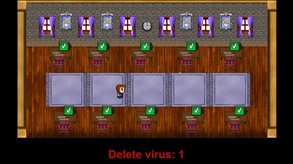
Virus Petya - a simulator of the system administrator. In this game you need to run from one computer to another, to remove from the computer a terrible virus "PETYA". But it's not easy, because with each attempt of the virus to infect the computer, the virus gets closer to the end of his successful work
Modeled estimate, not a reported figure. How we estimate →
Media

About
Genres
Stats
All-time low is the lowest price we've recorded for this game since we started tracking it.
Languages: English*, Russian**languages with full audio support
Engagement
Hours played at review time, across 39 reviews with recorded playtime.
Reviews
ТАК КОРОЧЕ ♥♥♥♥♥ ♥♥♥♥♥♥ CAPSLOCK/// вроде все. так о чем это я а ♥♥♥ как бы че я xотел сказать игра ебнутая блятт нероботает неxуя 15 рублей лучше ♥♥♥♥♥ купить чупик и сасать чем вирус ♥♥♥♥♥♥ неxуя ♥♥♥♥♥ не стоит своиx денег короче xерня не бирите ♥♥♥♥♥
[quote][b][url=https://en.wikipedia.org/wiki/Asset_flip]Warning: Asset Flip![/url][/b] Virus Petya is an asset flip, or what Valve calls a "Fake Game". The "developer" paid for/pirated someone else's example/template/tutorial game, changed the name/reskinned a couple of things, and submitted it to Valve as if it was their own game.[/quote] Virus Petya is a basic Unity asset flip, some stock pixel assets slapped on a basic JRPB engine, but Laush was too lazy when doing his asset flip to make a JRPG out of other people's assets so this is just a platespinner where you run between computers to "fix" them with a button click. It's a shallow and pointless game made to scam gamers out of a few roubles through review manipulation, a standard MO for this Russian "developer". Laush Dmitriy Sergeevich/Laush Studio have a known history of trying to scam people into paying them money for someone else's work, through this account or through closely linked/alt accounts. An example of Laush Dmitriy Sergeevich/Laush Studio doing this is [url=https://store.steampowered.com/app/894070]Unmanned helicopter[/url], which is really "[url=https://assetstore.unity.com/packages/3d/environments/urban/simple-town-pack-91947]Simple Town Pack[/url]", written by the actual developers, MyxerMan. Also, [url=https://store.steampowered.com/app/794190]Football Russian 20!8[/url], which is really "[url=https://www.youtube.com/watch?v=BNoCLwRvLHs]Goalkeeper Animation: How to Make a Penalty Shoot Game in Unity[/url]", developed by Grafik Ganes. Taking this shovelware seriously as if it was a genuine attempt to make a game, it doesn't meet basic minimum requirements that most PC gamers expect as standard. A choice was made to use obsolete, decades old retro pixel "art" as a substitute for contemporary PC graphics. It's unclear if this is due to lack of budget or talent, regardless, the overall visual quality of the game is extremely low as a result. There's no option to change the resolution and no useful graphics tweaks. There's no way to ensure this is running at the native resolution of your display. There's no guarantee this game will look right on any PC as a result of this hamfisted design decision. The controls can't be customised, which will be an annoyance for many, but it can also render the game unplayable for differently-abled gamers, left handed gamers or gamers using AZERTY or other international keyboard layouts. These technical defects push this game below acceptable standards for any modern PC game. The poor quality of this game is reflected by how many people spent time with it. At the time of this review, SteamDB shows the all-time peak player number was only 3 players, and the worst part is these weren't genuine players, these were the Russian fake review accounts that the developer paid to make the fake reviews. Since the fake reviews are all done, now the only player activity occurs once or twice a month, presumably someone loading it up to see what it is then quickly uninstalling it. Considering there's over 120 million gamers on Steam and well over 130,000 games for gamers to choose from, the overwhelming lack of interest in this low quality game is to be expected. It's also important to note the "developer" here has connections to a number of shady Russian asset flippers and review manipulators who show an organised pattern to scam and defraud gamers with fake reviews and asset flipping the work of others for profit. While reviews are about the games, gamers should be informed when developers act unethically. Whether these connections are the same developer using multiple accounts, or just working closely with other unethical developers, gamers should be warned about the harm to gamers by this developer and their associates. Buying games from unethical developers puts your money at risk. [quote][b][url=https://www.ftc.gov/legal-library/browse/federal-register-notices/16-cfr-part-465-trade-regulation-rule-use-consumer-reviews-testimonials-final-rule]Warning: Review Manipulation![/url][/b] This game features a number of fake positive reviews from accounts known to be in the business of review manipulation/paid reviews. They're all written in either Russian, broken English or ChatGPT AI slop, appear at almost exactly the same time, very shortly after the game launched on Steam, all have a direct Steam purchase of the game, and the accounts are used consistently to write fake reviews for asset flips and other cash grabs/scams. The "Positive" review score on this game should be disregarded due to this blatant, unethical review manipulation. This is done to deceive and scam gamers into paying for a bad product. Due to the 2024 FTC ruling (16 CFR Part 465), these fake reviews are a violation of US Federal Law.[/quote] This kind of asset flipping isn't harmless. It makes it harder for gamers to find genuinely made games from ethical developers. It makes it harder for genuine indie developers, who put hard work into trying to make real games, to find an audience for their products. It gives indie developers a bad name. So, should you buy this asset flip? Is this better than any of the 130,000+ genuinely made games on Steam? Of course not! Virus Petya has the preposterous price of $11 USD, for which you could easily get any number of older AAA games. Given the defects and quality issues with the game, coupled with the unrealistic price, and the questionable ethical nature of the developer and/or their associates (as outlined above), this is impossible to recommend. For comparison, the $11 asking price for this game could get you games like "Hunt: Showdown", "Valheim" or "Phantasmophobia". No pixelcrap is worth $11. If developers want to get paid the same kind of money as real game developers who know how to do graphics properly, they need to learn how to do graphics properly.
Virus Petya is a small-scale indie experiment developed by Laush Dmitriy Sergeevich and published by Laush Studio that transforms the concept of a computer virus into a light, arcade-style gameplay loop. Rather than attempting a realistic or technical depiction of cybersecurity, the game approaches its subject with a deliberately simple and almost playful tone, using the idea of digital infection as the backdrop for a fast, repetitive challenge focused on reaction, movement, and basic decision-making. Its scope is modest, and its ambitions are clearly centered on novelty rather than depth. The central premise places the player in a confined environment filled with computers that are gradually being infected by a fictionalized version of the Petya virus. Your task is to move between these machines and remove the virus before it completely takes control. Each attempt to clean a computer advances the overall infection state, meaning that the player is constantly racing against an invisible clock. Victory conditions are minimal: as long as at least one computer remains uninfected, you succeed. This structure creates a mild sense of urgency without ever becoming truly stressful, positioning the game as a casual time-management challenge rather than a high-pressure simulation. Gameplay mechanics are intentionally straightforward. Movement between computers and interacting with them to remove the virus make up nearly the entire experience. There are no complex systems to learn, no branching strategies, and very little variation in how situations unfold. This simplicity makes the game easy to understand within minutes, but it also defines its limitations. After a few rounds, players will have seen everything the game has to offer, and success becomes more about repetition and familiarity than adaptation or mastery. The audiovisual presentation reflects the game’s small scale. Graphics are basic and functional, relying on simple 2D visuals that resemble early indie or casual browser games. Environments are sparse, and visual feedback is minimal, which can sometimes make interactions feel unclear or imprecise. Clicking or positioning yourself correctly to interact with a computer is not always intuitive, and this lack of polish can introduce moments of frustration that feel unnecessary given the simplicity of the task. Sound design and music are understated, contributing more to atmosphere than to tension or excitement. What gives Virus Petya its identity is less its mechanics and more its concept. The idea of “fighting” a computer virus by physically running between machines is inherently absurd, and the game seems aware of this. It leans into a slightly meme-like tone, treating the subject matter with humor rather than seriousness. For some players, this quirky framing is enough to make the experience amusing, especially in short sessions where expectations are kept low. Replayability is limited. While Steam achievements and repeated attempts to optimize your performance offer a small incentive to keep playing, there are no new mechanics, modes, or escalating challenges to significantly extend the experience. Once the novelty wears off, the loop becomes predictable, and continued play relies entirely on the player’s tolerance for repetition. This makes the game best suited for brief play sessions rather than extended engagement. Community reception reflects this divide. Players who approach Virus Petya as a short, tongue-in-cheek indie curiosity often find it mildly entertaining and easy to recommend at a low price. Those expecting a deeper simulation, more varied gameplay, or polished controls tend to be disappointed by how little the experience evolves over time. The game does not pretend to be something it is not, but that honesty also limits its appeal. Overall, Virus Petya is a niche indie title that lives or dies on its premise. It offers a simple, almost arcade-like interpretation of battling a computer virus, wrapped in a minimal presentation and a repetitive loop. It is not a meaningful exploration of cybersecurity, nor is it designed to provide long-term depth. Instead, it functions as a brief curiosity—something to try, understand, and move on from. For players who enjoy oddball indie games with unusual themes and very low complexity, it can be a harmless diversion, but those looking for substance or lasting challenge will likely find it too thin to hold their interest for long. Rating: 5/10
[h1]Virus Petya[/h1] Na minha opinião só vale pelo desafio mesmo de pegar as conquistas que se vc conseguir de primeira pega quase todas em poucos minutos, tirando isso não perca seu tempo pois o fator desafio acaba depois disso ai.
10 tane pc var ekranda virüs çıkıyor gidip pc nin yanına virüsü sil diyoruz siliyor ne saçma bi iş mk simülasyon demişler bide
Man, back in 2018, I would not have recommended this game. Getting 50+ viruses in one run was extremely hard for me and I honestly didn't have any fun playing. However, the dev did recently change how the game works and so the difficulty dropped and it's much easier to get multiple viruses in one run. However, there still really isn't much to the game. It's extremely simple. You go from computer to computer and delete viruses until you game over. Because of that, there isn't much replay value. It can get boring very quickly. It would be nice to have in-game sound options because the music is loud and gets annoying after a bit. Overall, I do recommend this for someone who is looking for an easy and quick game to do. If you're looking for a fun game with replay value, dodge this. But I give kudos to the dev for not forgetting or ignoring an older game of theirs!
Жизненный и доступный для понимания платформер: нужно бегать между пк'ами и удалять вирусы. Интересно, как долго продержится местный сисадмин? Прикольнуло, что есть ачивки даже за неправильные действия. Детальная графика и динамичный геймплей.
A Dangerous VIRUS entered Several SERVERS, this virus is known by the name of PETYA. Don´t be frightened this is a game for ALL Players. Disable the virus (delected) on All Computers and FINISH YOUR WORK. WARNING: This virus can be reappeared on a single computer, if it reaches 100% the computer will become useless. Download and PLAY.
Well, that's five minutes of my life I can't get back. The game gives you no clear directives on how to do anything. Also, the fact that this game is $10.99 is mind blowing because this is one of the worst "games" I've seen on Steam. 0/10
Install then Delete Virus Petya = World is SAVED xD
Related
Related
Trends
Concurrent players on Steam, sampled daily since tracking started.
Audience
Estimated from the language of this game's reviews — a proxy for where players are, not official Steam demographics.
Related
| Monopoly Madness | $14.4K | 99 | 41% | $7.49 |
| Exodemon | $14.4K | 54 | 94% | $12.99 |
| The Sin | $14.4K | 229 | 86% | $4.99 |
| Kredolis | $14.5K | 93 | 56% | $9.99 |
| Time on Frog Island | $14.4K | 367 | 69% | $2.99 |
| Deadtime Defenders | $14.4K | 57 | 81% | $9.99 |
Related
| 7 Days to Die | $425.3M | 403.6K | 87% | $44.99 |
| Euro Truck Simulator 2 | $421.6M | 932.3K | 97% | $19.99 |
| Mount & Blade II: Bannerlord | $309.8M | 294K | 88% | $49.99 |
| The Forest | $254.8M | 678.6K | 96% | $19.99 |
| Project Zomboid | $239.1M | 461K | 94% | $19.99 |
| No Man's Sky | $230.9M | 412.2K | 85% | $23.99 |