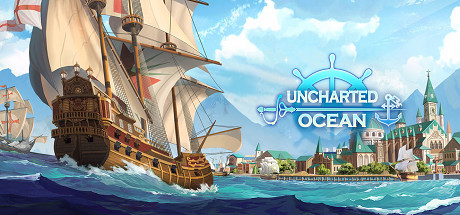
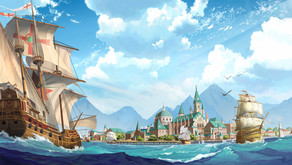
Uncharted Ocean, developed and published by HiRabbitgame, is an open-ended nautical role-playing game that draws heavily from classic seafaring adventures, placing freedom, trade, and long-term progression at the center of its design. Set during a loosely interpreted Age of Discovery, the game invites players to step into the role of a captain seeking fortune and influence across vast oceans dotted with ports, islands, and hidden dangers. From its opening moments, Uncharted Ocean makes it clear that it is less concerned with scripted storytelling and more focused on emergent journeys shaped by player choice, patience, and strategic planning.
The foundation of the experience lies in sailing and economic simulation. Players begin with a modest ship and limited resources, gradually learning the rhythms of maritime trade by buying goods in one port and selling them for profit in another. Each city has its own supply and demand, encouraging careful route planning and experimentation to uncover lucrative trade loops. Over time, this trading system becomes the primary driver of growth, funding ship upgrades, crew recruitment, and fleet expansion. The satisfaction comes not from instant rewards, but from watching a humble operation evolve into a thriving maritime enterprise through smart decisions and persistence.
Exploration plays a significant role in shaping the game’s sense of scale and adventure. The oceans feel vast, and long voyages between ports emphasize distance and risk. Along the way, players can discover uncharted islands, hidden treasures, and mysterious ruins that break up the routine of commerce and add a sense of wonder to the journey. These discoveries often come with danger, whether from hostile ships, unpredictable weather, or limited supplies, reinforcing the idea that exploration is an investment with uncertain outcomes. This balance between risk and reward gives the world a sense of weight and authenticity.
Naval combat and fleet management add another strategic layer to the experience. Encounters with pirates, rival factions, and hostile forces are inevitable, and success depends on preparation rather than reflexes. Ship durability, crew composition, morale, and equipment all influence combat outcomes, encouraging players to think ahead rather than charge blindly into battle. As fleets grow, managing multiple ships with different roles becomes essential, transforming the game from a solo sailing adventure into a broader strategic exercise in coordination and resource allocation.
One of the game’s more distinctive features is its use of national affiliations. Choosing a nationality at the start influences diplomatic relationships, economic advantages, and access to certain regions or opportunities. These affiliations subtly shape the flow of the game, affecting how ports respond to you and where tensions or alliances may arise. While not deeply simulated, this system adds flavor and replay value, encouraging players to approach the game differently across multiple playthroughs.
Despite its ambition, Uncharted Ocean shows clear signs of roughness in execution. The interface can feel unintuitive, with menus and controls that sometimes struggle to communicate information clearly. Localization issues occasionally surface in item descriptions and quest text, creating confusion where clarity is essential. Progression can also feel grind-heavy, especially for players unfamiliar with trade-focused games, as advancement often requires long stretches of repetitive sailing and incremental profit-making before meaningful upgrades become available.
The game’s presentation is serviceable rather than striking. Visuals favor functionality over spectacle, with simple ship models, modest environmental detail, and limited animation. While this approach keeps performance stable and information readable, it does little to elevate immersion. Similarly, sound design is minimal, reinforcing the utilitarian feel of the experience. For some players, this understated presentation will feel appropriate for a systems-driven game; for others, it may make the world feel less alive than its scope suggests.
Another factor influencing perception is the game’s development trajectory. While the core experience offers substantial content, some players note that updates and expansions have been uneven, leading to a sense that certain systems could have been refined further. This contributes to the impression of a game with strong ideas that are not always fully polished, leaving gaps between ambition and execution.
Ultimately, Uncharted Ocean is a game that rewards a specific mindset. It is best suited for players who enjoy slow-burn progression, economic optimization, and the freedom to chart their own course without constant guidance. Those seeking fast-paced action, cinematic storytelling, or heavy hand-holding may find it tedious or opaque. However, for fans of classic sailing RPGs and open-ended simulations, it offers a deep and absorbing maritime sandbox where success is earned through planning, endurance, and a willingness to embrace the long voyage.
Rating: 7/10