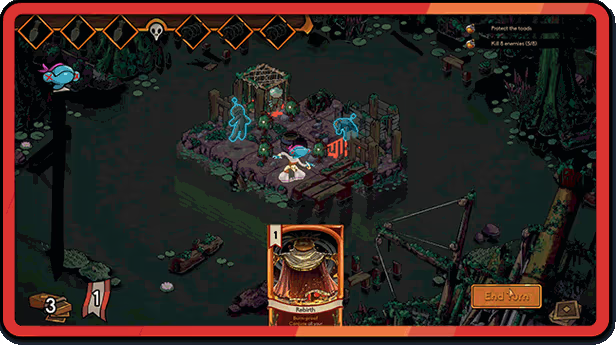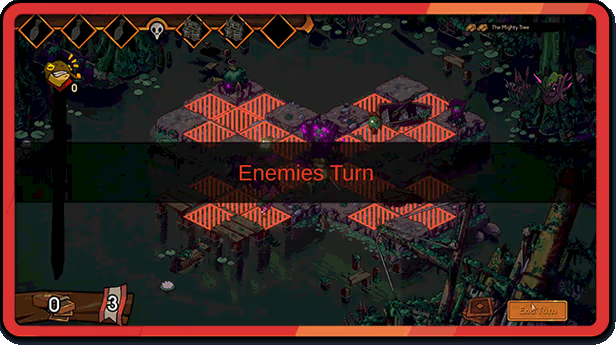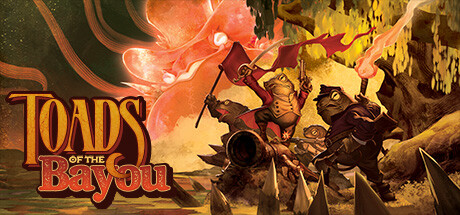
Lead a group of toads as they fight against Baron Samedi’s evil forces in a challenging mix of turn-based tactics and roguelike deckbuilding. Synergise card effects, gain the aid of powerful allies and engage in strategic combat to thrive in the cursed bayou.
Modeled estimate, not a reported figure. How we estimate →
Media

About
Baron Samedi, a spirit of the dead, has tricked you and your group of wandering toads who were looking for a place to settle and thrive, by trapping them in the cursed bayou and forcing them to face the evil that inhabits it. Determined to overcome the dreadful Baron Samedi, the toads must band together to defeat his waves of minions and cleanse the corruption.


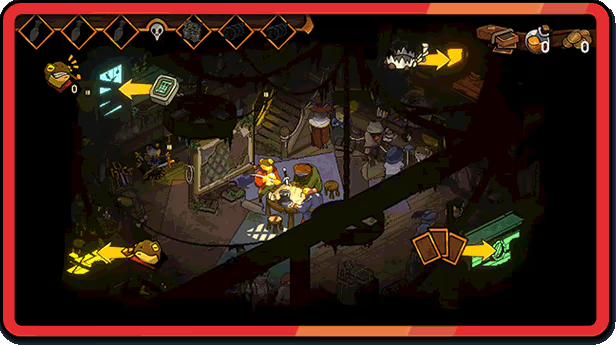
Upgrade and restore the Tavern that will be inhabited by allies who will grant you unique abilities and join you on your journey, powerful cards to add to your deck, traps for strategic combat and Veves to harness vodou powers.


Choose between 3 different Toads each with their own traits, bonuses and weaknesses in grid-based combat. Each run is unique through three different islands, combat encounters and permadeath granting you upgrades at the end of each run.


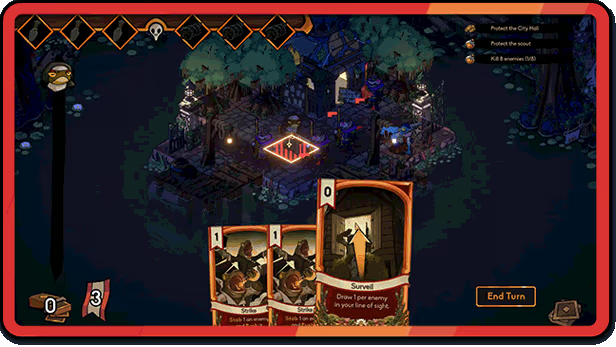
Combine a variety of tactical movement cards with powerful combat cards to create the strongest deck you can in order to effectively defeat the Baron’s forces.
- 50+ Cards
- 3 Playable Toads each with different abilities and traits
- 20 Support Toads
- 22 Traps
- 10 Bosses
- Original Soundtrack

Stats
All-time low is the lowest price we've recorded for this game since we started tracking it.
Languages: English, French, German, Spanish - Spain
Engagement
Hours played at review time, across 40 reviews with recorded playtime.
Reviews
Themes across 40 recent reviews and how positive each mention is. A keyword signal, not full sentiment analysis.
positive critical· bar length = how often the theme comes up
Reviews
Toads of the Bayou is a well-crafted tactical roguelite with a charming universe and some interesting ideas, but it’s very hard to recommend in its current state. The game appears to have been abandoned since December 2024 and lacks essential quality-of-life updates, bug fixes, and post-launch support. The presentation is easily its strongest point. The pixel art is beautiful and full of character, and the Louisiana and New Orleans–inspired universe is genuinely intriguing. The soundtrack and sound design complement the experience well, and for a tactical roguelite there’s a decent amount of variation and randomness, even if that randomness often works against the game rather than in its favor. Playing the game, however, can be frustrating. Steam Deck support is particularly rough despite claims of being controller-friendly. The game frequently loses focus, menus are awkward to navigate, and grid movement can lead to input errors. Some design decisions are baffling, like being unable to back out after paying to remove a card from your deck. The game uses two currency systems, one tied to meta progression and rerolls and another earned during runs. The run-based currency (oil) is broken, as you rarely know how much you’ve earned or why because the numbers aren’t representative, which undermines decision-making. While there are some neat mechanics, many are locked behind specific characters, giving the illusion of choice early on. Each character has a rigid playstyle, some clearly stronger than others, and the heavy reliance on RNG means runs can swing wildly between effortless and frustratingly unwinnable. You can brute-force wins by endlessly rerolling, but that’s hardly satisfying and forces you to farm to get enough money. In the end, Toads of the Bayou has strong artistic direction but is held back by unclear mechanics (the Bombardier card being a prime example), questionable design choices, long load times and freezes, and numerous bugs. Combined with what looks like an abandoned state, it’s difficult to recommend unless bought at a deep discount and you’re willing to overlook shallow build variety for style and atmosphere.
Still very very buggy. Not worth this.
I want to like this game, I have played it alot... but it is unfinished, abandoned, and very much unbalanced.
The game is fun I very much enjoyed my time with it but it needed some qol updates and some new content but sadly the game was abandoned years ago.
[h1] SURTOUT N'ACHETEZ PAS CE JEU ! [/h1] Malgré ses 75% d'avis positifs et le fait que j'ai moi-même apprécié mes premières 3h30 de jeu, voici la réalité : Le jeu avait du potentiel... ou plutôt, aurait pu en avoir, mais il a clairement été abandonné. BEAUCOUP DE BUGS !!! Exemple : - Bugs visuels (ennemis pratiquement invisibles derrière certains décors). - Missions qui calculent mal les ressources que tu dois sauver et ou ramasser. - Bugs liés aux decks (avoir la possibilité de vendre pour descendre en dessous de 4 cartes te donne un tour infini, car tu peux rejouer tes trois cartes sans fin). AUCUN SUIVI : - Le jeu est sorti dans cet état, et vu le très faible nombre de ventes, il n'a jamais reçu de correctifs, mises à jour ou même une seule réponse officielle des devs sur leur forum. Les problèmes reportés en quantités restent ignorés. Résultat tôt ou tard, tu vas être bloqué par un bug frustrant qui va ruiner ton expérience. Note finale 3 / 10, il y avait pourtant de très bonnes idées qui, avec du travail, auraient pu en faire un jeu solide. Avec un vrai suivi des devs, il mériterait facilement un 6,5 à 7 / 10. Mais dans son état actuel, passez votre chemin.
I really want to like this game, but it's a buggy & poorly designed mess. Your allies constantly attack both you and the buildings you are trying to protect. It's impossible to see the grid and what is going on. Damage comes from random places you have no way of knowing about, or the game glitches and you can't see where the attacks are. Great idea, piss poor execution.
I recommend it on the fact that there are good gameplay elements here. The art is also really nice, both for the cards and all of the pixel-art animations. The game feels really good too, it's quick and crisp with the right sounds for actions taken. I also picked it up on sale so for the cheap price, it was worth it. Reasons why I don't recommend it however: - Some bugs and game design choices. When completing a mission the game gives you the incorrect amount of oil (currency). If you fail an objective, you get a negative card added to your deck. Removing the card costs 6 oil. Buying new cards and squadmates costs 10+ oil. You get 10-11 from a successful mission so failing 1 objective just sucks. And the negative cards just stack. You can also fail objectives by friendly fire, like pushing an enemy deals damage to structures behind them too. With some bug fixes and balancing updates this could be a top tier amazing turn-based game, but the game hasn't gotten an update in a year (or any developer replies in steam discussions) so unfortunately it doesn't seem likely.
I really wanted to like this game because the theme and art style are great, but it just isn’t enjoyable to play. The difficulty feels random rather than challenging, resources are either scarce or pointless, and there’s very little sense of reward or personalisation in your runs. It’s not a bad game, just not fun for me, and I don’t feel motivated to keep playing.
Needs updates. Do not by.
Toads of the Bayou is a cute little game about swampy amphibians fighting back against occult occupation. It is easy to pick up, fun to play, and satisfying to beat. Unfortunately, there are more than a few things that keep it from being a very good game. Art: 7/10. The art is perfectly fine, the pixel-art animations are smooth and the background music is pleasant. The early American motifs put through a toad-y filter makes the visuals interesting but not fantastic. No real notes here. Game Design: 5/10. I can't remember seeing another isometric turn-based combat deckbuilder so it was fun to see what the designers came up with. One toad is good at stabbing enemies and pushing them into walls for extra damage, another is a crack shot with a rifle but gets swarmed easily, and I haven't unlocked the third character but I'm sure they have similarly unique gameplay patterns. Where the design fails, though, is in some of its systems. -First of all, there are two currencies: oil and gold. Oil is earned throughout a run by passing levels and completing secondary objectives, then spent between fights to add or remove cards to your deck, hire support toads, buy veves (potions), and purchase traps. Gold is sometimes earned during a run but mostly awarded once a run has ended. This would be fine, but on your first run the four shops are all locked and require a one-time gold payment to open. Then, once you open them, some slots in the shop are locked and require a one-time gold payment to unlock. Then, once those are unlocked, re-rolling the shop costs gold, not oil. This creates an unsatisfying and backwards incentive of playing non-serious runs just to earn gold that you can spend re-rolling shops for the best upgrades on your next serious run rather than starting each run with the mindset of 'this could be the god run'. -Each shop has its own issues. ----Cards can either be default version or 'upgraded' with extra effects or reduced cost, but the upgraded cards seem to occur around 10% of the time and there is no way to upgrade cards you already have in your deck. This means that often the shop will have mediocre cards that probably won't make your deck better. Removing basic cards that don't fit your style is usually the most effective way to improve your deck, which feels bad. ----Support toads are expensive and powerful additions to your run, but the shop will offer you toads that are already in your party that you cannot buy, making 1/3 or more of the shop useless and encouraging you to spend your extremely limited gold to reroll the shop once again encouraging farming runs. ----Half of the veves are, I wouldn't say useless, but extremely niche and unusable in all but the most specific situations. Many of them let you jump over an enemy which sounds thematic to the toad experience but requires you to be next to them (dangerous) and that there is an empty space behind them (unusual) which may put you in an even more dangerous position. The better ones simply provide card draw or extra damage which are powerful but somewhat boring. ----The trap shop is full of mildly useful but very cheap single-use traps, but the default character makes his own traps and draws cards when those traps are destroyed. Often you either don't have any free slots to buy traps or have to discard your own to buy new ones. This isn't a big issue but it still feels like the game is designed against itself. -There are some mechanics in the game designed around taking damage, but when your max HP is 4 (or less!) the risk of dying is far greater than the advantage you get from, say, drawing 2 and discarding 1. -The maps and objectives are procedurally generated which keeps things fresh, but sometimes lead to impossible objectives. More than once I have had to protect a toad scout but on turn 1 an enemy arrives on the single inaccessible tile behind them and immediately attacks and there is nothing I can do to protect him. -During the tutorial the game tells you that enemies do not act on the turn that they spawn so that you can keep up the advantage between turns. I thought, great! Then later on in the run enemies spawned and immediately moved to my objective and threatened to destroy it. When I inspected the enemy it had a buff saying 'can move and act immediately'. Why tell me in the tutorial that they wait a turn when, late during the run, none of them do? -There is a movement card in your hand every turn that lets you move 3 squares, but that number goes down by 1 for each card you play before it. However, when you kill an enemy, if it's not in your hand, you draw it at full strength again. This means that it is very often optimal to waste your movement card moving away from your target and killing something else just to get the card back at 3 movement and go where you actually want to be. In other words you can move 3 then attack but you can't attack then move 3. I'd love to know why they made this choice. -The deckbuilding is dynamic, but with most decks sitting around 8 or 10 cards at all times they can get very powerful and consistent very quickly (based on shop luck). Sometimes the shop shows me terrible un-upgraded cards and I lose, then sometimes it gives me exactly what I want and I am killing bosses on turn 1. This is even more incentive to waste time farming gold before trying a serious run with plenty of re-rolls. UI: 3/10. This game's UI is functional but constantly confusing and occasionally gratingly annoying. -More than once the map generated two adjacent tiles that were visually identical but one was a 'ground' tile that I could stand on and the other was a 'wall' tile that was impassable and would damage me if I was knocked into it. There is no way to check the functionality of each tile through the UI. -Sometimes a small enemy would be on a tile behind an object that is closer to the camera which causes a red outline to appear so I can keep track of it. Great! Sometimes the opposite would happen and a large enemy would block my view of the entire tile behind him (especially the big fish in act 3). I found it impossible to tell if that tile was wall or ground, or if it was about to be shot by a far-away enemy. One of my runs was ended by this. Not great! -Some of the clickable buttons in the game are not representative of their visual location. Navigating through the tavern to the different shops between fights looks like it should be easy but it feels like the arrows/glyphs that move you do not register half the times you click on them. The world map is especially bad, with the next zone happily bouncing from the anticipation of being clicked while I try to navigate my cursor to the tiny section of the button that will actually move me to the next zone. -Some of the menus overlay on top of each other. In the card shop you enter by clicking on the shopkeeper which brings up the shop interface with a small back-arrow in the bottom right to close it (why the bottom right anyway?). You can then remove a card which brings up another interface of your deck with the same back-arrow in the same spot as before. This would be fine except that half the time clicking the arrow takes me back to the shop interface and the other half it seems to click both and I have to click on the shopkeeper again. -You can move the camera during battles to get a better view on things (though you can't rotate it), even though the maps are small enough that they should fit entirely on the screen (at least on my 2560x1440 monitor). Frustratingly, at the very start of each battle when you choose which tile to start on, you cannot move the camera. Sometimes when choosing where to start I couldn't see several tiles at the front or back. I enjoyed beating the game once but some confusing design and UI issues keep me from enjoying it any longer. Overall 6/10. Would recommend to any roguelike enthusiasts or toad-obsessed nieces and nephews. For me, though, it's back to Slay The Spire.
Related
Related
Trends
Modeled estimate over time, reconstructed from Steam's monthly review histogram.
Momentum
Pace estimated from the game's recent review growth (our daily snapshots) at its own sales-per-review ratio — a momentum signal, not booked sales.
Audience
Estimated from the language of this game's reviews — a proxy for where players are, not official Steam demographics.
Related
| The Castle Doctrine | $40.1K | 379 | 49% | $3.99 |
| Sex & Gun VR | $40.1K | 78 | 45% | $24.99 |
| Vilde | $40.1K | 100 | 77% | $15.99 |
| Guard Duty | $40.1K | 260 | 92% | $9.99 |
| The Inner World | $40.1K | 1.5K | 89% | $1.49 |
| Freedom Fall | $40.1K | 159 | 89% | $9.99 |