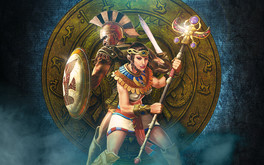
For its 10 year anniversary, Titan Quest will shine in new splendour. This Anniversary Edition combines both Titan Quest and Titan Quest Immortal Throne in one game, and has been given a massive overhaul for the ultimate ARPG experience.
Modeled estimate, not a reported figure. How we estimate →
Prices
The United States storefront in every case, so this compares stores and not countries.
Prices
Each in the currency that store quoted — not converted: the gap between two rows is the publisher's pricing, not an exchange rate.
Every market we collect.
Discounts
Every price cut of more than 20% we have observed, in each market that quoted one, with this game's chart position on either side of it. These are episodes, not a model: a sale is one event, and one event cannot tell you what the next one will do.
Reviews, worldwide (the counter carries no country): 2.43/day in the week to Aug 8 → 4.71/day in the week after.
For scale, across Steam · Top Sellers · Brazil over the last 30 days: the 26 chart moves that followed a price cut of more than 20% went a median of 7 places towards #1, and the 2,400 moves with no price cut behind them went 2 away. One store, one chart, one country — it is the only place we have enough observations to say even that.
Prices outside the United States have been collected since 6 August 2026 and chart positions since 19 July 2026, so a cut older than that has no market to compare and a market that joined later has no history yet. Nothing here is converted between currencies.
About
Add-ons
Each DLC is estimated with the same model as a game, then summed — a modeled figure, not reported DLC sales.
Sums Steam only; Xbox publishes no volume signal, so the true total is higher by an unknown amount.
| Store | Price | Audience | Score | Chart | Est. revenue |
|---|---|---|---|---|---|
SteamYou are here | $19.99 | 38Kreviews | 90% | — | $15.7M |
| $19.99 | 190ratings | 76% | — | not modelled |
Matched by title — a reused name can pair the wrong games. * is a critic aggregate. Prices and positions are each store's United States storefront; Epic charts worldwide. Audience and Score too, except Steam's, which is worldwide.
Updates
Build ids and update times come straight from Steam's PICS — the same source SteamDB reads. Patch history grows as we record new builds.
Engagement
Reviews
Themes across 967 recent reviews and how positive each mention is. A keyword signal, not full sentiment analysis.
Reviews
Occasional crashes and very often crashes during Ragnarok dlc, not very responsive controller input and the need to complete the game twice to unlock the last dlc (being an adult with responsibilities i became a casual gamer so that kind of gaming block just makes my life harder). Also, very rare actually useful item drop so most of the time you run with the same old skill set. Some synergies would be nice or an incentive to change the attack pattern from time to time. Rather old fashion game in the genre.
Titan Quest is originally a 20-year-old game (2006) with some distance from the original Diablo (1996). It’s quite a trip down memory lane thinking about what else released in 2006: Neverwinter Nights 2, FFXII, and on the movie side Casino Royale, Pirates 2, X-Men 3. A couple of achievements reference the animated Disney Mulan and The Scorpion King (mercifully lost to time). Titan Quest’s lineage of dual-classing and components (items that attach to equipment and modify them) is very clear in Grim Dawn, released a decade later (2016) just before Titan Quest received its own Anniversary Edition (2016). Unsurprisingly, Titan Quest has dated graphics, but as indicated by the existence of Grim Dawn, its game systems are pretty solid. (Here there are no Devotion Constellations and Recipes aren’t something you learn, they’re ingredients in the formula.) However I played the entire game without an artifact; this system wasn’t explained well and I never seemed to find the ingredients for any recipe. The distinctive aspect of Titan Quest is its bright quasi-historical/mythological settings - this isn’t about grimdark demon-plagued medieval countryside, or post-apocalyptic steampunk, this is the sunny Mediterranean, sunnier Egypt, the Silk Road, and not sunny Northern Europe (I didn’t play Eternal Embers). There’s a bit of a kick talking to ancient historical and mythological NPCs, and fighting dinosaurs and Neanderthals in regions with ancient names for Tibet and Iran. The Greek setting was relatively fresh (though that dropped off returning to it multiple times later), I did not enjoy Egypt, the mandatory ARPG desert second act (please stop copying Diablo 2, it’s been over a quarter of a century), and the journeys through the Silk Road, and Celtic settlements in modern Germany to Scandinavia were fun. The voice acting is pretty bad, with lots of “pretend old man” and “pretend old man with fake accent”. On the actual gameplay, there were several factors that hurt the pacing of the game quite badly. The maps were far too large and finicky (running down narrow staircases in dungeons was particularly bad), and without objective markers, finding your destination was frequently a chore, repeated many, many times across the 6-act campaign. There are far too many multi-level dungeons, and huge wilderness areas, and the enormous Labyrinth where the minimap didn’t match the actual terrain was a particular nadir. There are waypoints only in major cities; the rebirth fountains in between are poor substitutes. Through a combination of attack-speed, and damage/health ratios, enemies became tedious to exterminate, many of them automatically moved just in time to dodge my dash-strike skill. I ran through many, many maps, avoiding monsters, occasionally turning around to AoE the gathered groups that were still following me. Then there was the irritating tendency for enemies to aggro from offscreen long after a fight while I was going through my inventory. Early in the game, enemy champions and certain bosses were far too strong (one boss absorbed my top two damage types) and stalled out my progress. I had frequent freezes and a few crashes on my machine, even after making all the recommended changes to fix them. Occasionally during combat my character froze or stopped receiving input (maybe I got stunned but this wasn’t clear), and especially in later maps overhanging foliage or tall foreground terrain obscured enemies and fights behind them. I had to restart a couple of times after teleporting inside walls, and there were a couple of bugs where quests (including main quests) weren’t ticked off correctly. Overall Titan Quest is better appreciated as a piece of history in the ARPG genre, and an ARPG with a less common tone and setting. Grim Dawn uses the same mechanics within a more polished game.
Media

Related
Related
Price dynamics, follower growth, revenue and sales trajectories with interactive tooltips
This and every other Pro feature is free until October 20, 2026. A free account is all it takes.
Genres
Stats
All-time low is the lowest price we've recorded for this game since we started tracking it.
Languages: English*, French*, Italian, German*, Spanish - Spain, Czech, Polish, Russian*, Japanese, Korean, Simplified Chinese, Ukrainian*languages with full audio support
Hours played at review time, across 972 reviews with recorded playtime.
positive critical· bar length = how often the theme comes up
疯狂闪退
I have been playing this game for YEARS. A family friend gave me their titan quest disc when I was 7, and I have THOUSANDS of hours before I ever bought it on steam. I used to steal my dads work laptop and hide under my bed, and play this game for hours each night. I'm so obsessed with this world that defined my childhood, that I have multiple sentimental copies of the physical game. Firstly, this game inspired my love of mythology and history that has followed me to this day. The story telling, music, voice acting, and design, is flawless. This will always be my favourite game from the Golden Age RPG genre, if not every genre. The slower pace, the impactful and flavourful masteries and choices, and the worldbuilding just hits in this game like no other. I tried TItan quest 2, and like other top-down RPGs (POE, DIABLO 4) I found it to be a bit of a overstimulating bullet hell. And, for some reason, despite everyone in titan quest 1 having a normal ancient greek accent, everyone in titan quest 2 is cockney british, which really put me off the second game... If you miss old RPGs, like dragon age origins, you'll love this. Titan quest has a flavour, a relaxed style, and a story driven world that is incredibly approachable- and yet, mechanics and game classes that are so intentional and just the right amount of restricting. Masteries give your character meaningful challenges, flavour, and strengths/weaknesses (unlike titan quest 2). When the 2nd game came out, I was truly hoping it would be this game, but bigger and better. But still, I find myself crawling back to my first love with a box of chocolates and an apology. I'm yours forever titan quest 1.
Sim o jogo está datado [i] (se você não sabe o jogo original foi lançado em 2006 e essa versão de aniversário foi lançada em 2016)[/i], não espere mecânicas modernas, profundidade, skills bonitas e impressionantes, tudo aqui é simples, básico do básico mas mesmo assim é divertido jogar, da para passar o tempo e se divertir. As quests também são bem genéricas. É aquele clássico: vai ali, mata uns bichos, pega um item, volta, conversa com o NPC e pronto. Depois de algumas horas você já está fazendo tudo no automático. Titan Quest é um jogo de outra época e está bastante datado em vários aspectos. Mas justamente por ser simples, direto e sem querer reinventar a roda, ele funciona muito bem pra quem quer passar o tempo, farmar uns itens e sair matando hordas de inimigos.
Очень прикольная игра. Геймплей устраивает. Сюжетка хорошая. Очень нравиться музыка из игры. А вообще у каждого свое мнение и вкус. Мне очень понравилась в свое время.
Ну это просто ЛЕГЕНДА + НОСТАЛЬГИЯ!
[h1]Titan Quest Anniversary Edition – A Classic Mythological ARPG That Still Holds Up[/h1] [i]Most of my experience comes from the original physical disc release, which is the version I am currently playing. I later noticed that I also own the Anniversary Edition on Steam, where I have 6.5 hours recorded. I am not going to replay the whole game only to repeat an adventure I already know, so this review focuses mainly on the shared core game while separating that from the Anniversary Edition improvements.[/i] [hr][/hr] I have been gaming since the 1980s and grew up through the 1990s. I have played thousands of games across many genres. Titan Quest comes from a different era. It is a traditional loot-driven action RPG that lets you create a character, explore a large handcrafted world and progress at your own pace. The obvious comparison is Diablo II, but Titan Quest has a strong identity of its own. Instead of placing almost everything inside dark gothic ruins and demonic landscapes, it takes you through Greek countryside, Egyptian deserts, Babylon, China and the Underworld. You fight satyrs, centaurs, harpies, gorgons, skeletons, jackal warriors, demons and many other creatures drawn from ancient mythology. That setting remains the game’s greatest strength. You travel through farms, villages, forests, temples, caves, tombs, deserts, mountain passes and ancient cities. The regions change their architecture, enemies, equipment and atmosphere as you move between cultures. The graphics are clearly old, but the art direction still gives the world character. [h2]Combat and character building[/h2] The gameplay follows the classic action-RPG loop: kill monsters, complete quests, gain levels, find equipment and improve your build. Instead of choosing one fixed class, you select a Mastery and later combine it with a second one. This allows warriors, archers, spellcasters, summoners, defensive tanks and many hybrids. A character can mix physical combat with elemental magic, hunting abilities, pets or defensive skills rather than being locked into one narrow role. This dual-Mastery system is one of the main reasons Titan Quest has so much replay value. Different combinations change how you fight, what equipment matters and which statistics you need. It is also possible to build a weak character if you spread points without a plan. Older RPGs were often more willing to let players make mistakes and learn the systems. Combat can feel slower and less fluid than newer games such as Grim Dawn, Torchlight II or modern Diablo titles. Early characters have few abilities, movement is somewhat stiff and many builds rely heavily on basic attacks and passive bonuses. It improves once more skills and faster equipment become available, but the opening hours can feel slow. [h2]Loot and progression[/h2] Titan Quest contains a huge amount of equipment. Enemies often carry the weapons and armour they will drop, which is a detail I still appreciate. When an enemy attacks with a dangerous glowing weapon, there is a chance that the same weapon will be lying on the ground after the fight. Relics and charms can be attached to suitable equipment, while rarer items and sets encourage particular builds. Finding a meaningful upgrade can be satisfying, especially when it completes part of a character you have been planning. The system also has problems. The ground can become covered with low-quality equipment that stopped being useful hours earlier. Filters hide some of it, but they do not solve the clutter. Loot progression can also be inconsistent, and you may play for a long time without finding anything better than what you already use. Storage is another weakness for anyone who collects sets, relics and equipment for future characters. Anniversary Edition improves storage compared with the original, but collectors may still end up using extra characters or external tools. [h2]Story, quests and pacing[/h2] The story gives you a reason to cross the ancient world, but this is not a deeply cinematic or character-driven RPG. Most NPCs stand in place and explain quests through voiced dialogue. Many missions involve killing monsters, rescuing someone or retrieving an item. The mythology makes those familiar tasks more interesting, but repetition is unavoidable. The campaign is long, and higher difficulties require running through it again for stronger enemies and better loot. Players who enjoy builds and farming may like that structure. Players who want a tightly paced story may feel that it lasts too long. The beginning deserves a warning. Your character starts with limited skills, basic equipment and a lot of walking between small groups of enemies. It becomes more interesting as the world opens, but it does not deliver instant spectacle. [h2]What Anniversary Edition changes[/h2] Anniversary Edition combines Titan Quest and Immortal Throne into one installation and adds a large collection of updates. The later Ragnarök, Atlantis and Eternal Embers expansions are separate purchases, and I am not judging them here. These include modern resolution support, a scalable interface, greater camera distance, improved performance and stability, balance changes, many bug fixes, better enemy and pet AI, restored multiplayer features, Steam achievements, Workshop integration and quality-of-life improvements. Those include higher item-stack limits, quicker collection of some items, a larger stash and an adjustable game-speed option. Long-time players often highlight the speed setting, smoother scrolling, modern display support and revived multiplayer as important improvements. Some players still report crashes, network problems, however. I have not tested every Anniversary Edition feature or the current multiplayer deeply enough to judge all of it, so I will not pretend otherwise. [h2]What still works[/h2] Titan Quest still succeeds because it feels like an actual journey. You begin as an unknown traveller helping a village and gradually cross countries, mythological realms and increasingly dangerous battlefields. Your simple character slowly becomes capable of fighting legendary monsters and gods. It also has a calmer atmosphere than many action RPGs. The music and scenery often make exploration feel relaxed between battles. The game does not constantly interrupt you with battle passes, premium currency, daily objectives or pressure to remain online. You can play alone, stop when you choose and return later. After decades of gaming, I do not need every game to be endlessly updated or designed around keeping me logged in. Sometimes I want a complete adventure on my own terms, and Titan Quest still provides that. [h2]Final verdict[/h2] Titan Quest is dated in several ways. The opening is slow, movement can feel stiff, combat can become repetitive, loot creates too much clutter, storage is limited and the story presentation is basic by modern standards. Despite those flaws, it remains one of the stronger traditional action RPGs. Its mythology gives it a personality many competitors lack, the dual-Mastery system supports a wide range of builds, and the handcrafted world creates a convincing sense of travelling on an epic quest. Anniversary Edition is the most practical modern package because it combines the original game and Immortal Throne while adding display support, balance work, bug fixes, multiplayer restoration, Workshop support and useful quality-of-life features. [b]Recommended.[/b] My recommendation is based mainly on extensive experience with the original physical release and the shared core game, not on pretending that 6.5 Steam hours represent a complete test of every Anniversary Edition change. For players who enjoy Diablo-style combat, mythology, loot and character building, Titan Quest is still worth playing. https://www.youtube.com/watch?v=LaGW67bf9Mw&t=900s
Very nice "get away" from D2R and other flashy action RPGs. This is old school at its finest. items are rare to see & upgrades feel meaningfull ! I recommend it if you just want to kill monsters and chill.
es gibt keine aktuellen ubdates weswegen das spiel bei bestimmten monstern abstürtz
Active players
Estimated daily and monthly active players (DAU/MAU) modeled from peak concurrency.
Players by region
Where this game's players are, estimated from review languages.
Players also reviewed
The games this title's players most often review too — audience affinity.
Related
| Game | Estimated lifetime revenue | Reviews | Review score | Price |
|---|---|---|---|---|
| $985.9K | 4K | 85% | $9.99 | |
| $787.3K | 4.3K | 82% | $6.99 | |
| $7.5M | 13.7K | 82% | $29.99 | |
| $40.6K | 104 | 57% | $19.99 | |
| $5.3K | 27 | 74% | $9.99 | |
| $0 | 0 | — | Free |
Related
| Game | Estimated lifetime revenue | Reviews | Review score | Price |
|---|---|---|---|---|
| $15.7M | 13.3K | 98% | $29.99 | |
| $15.7M | 48.3K | 86% | $12.99 | |
| $15.7M | 28.8K | 92% | $39.99 | |
| $15.7M | 13.4K | 68% | $39.99 | |
| $15.7M | 15.9K | 77% | $39.99 | |
| $15.8M | 22.3K | 94% | $12.49 |