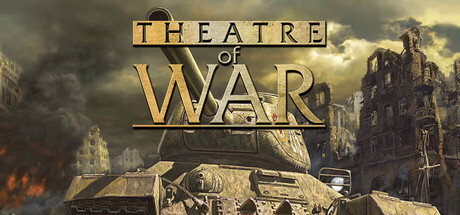
Theatre of War is a deeply simulation-focused World War II tactical strategy title that places realism and historical accuracy far above accessibility or spectacle. Developed by 1C and released on Steam under Fulqrum Publishing, the game is designed less as a traditional real-time strategy experience and more as a battlefield command simulator, where every unit, order, and positional decision carries real consequences. Rather than empowering players with endless reinforcements or abstract resource systems, Theatre of War challenges them to work with limited, historically grounded forces and succeed through planning, discipline, and tactical restraint.
The structure of the game is built around a large collection of standalone missions inspired by real engagements across the European theater. Players take command of forces representing multiple nations, including German, Soviet, Allied, and other European units, each equipped with historically accurate vehicles, weapons, and formations. Every mission feels like a puzzle rooted in real military constraints: terrain must be read carefully, fields of fire established deliberately, and advances planned with an understanding of armor penetration, line of sight, and cover. There is little room for improvisation once a battle is underway, which reinforces the importance of preparation and situational awareness.
Combat unfolds in real time but at a deliberately measured pace. Infantry squads behave like real soldiers rather than disposable units, taking cover, becoming suppressed, retreating under heavy fire, or breaking entirely if morale collapses. Tanks are powerful but vulnerable when mishandled, requiring proper angling, support from infantry, and protection from anti-tank weapons. Artillery and air support are devastating tools, but they are limited and must be timed precisely, as careless use can just as easily decimate your own forces. This emphasis on realism makes even small engagements tense and demanding, as a single misjudgment can cascade into mission failure.
One of Theatre of War’s defining features is its unit persistence and progression. Soldiers and vehicle crews can gain experience over the course of campaigns, becoming more effective and reliable in combat. This system adds emotional weight to engagements, as preserving veteran units becomes a priority rather than an afterthought. Losing an experienced tank crew or infantry squad is not just a numerical setback but a strategic loss that can make subsequent missions significantly harder. This reinforces cautious play and rewards commanders who value positioning and patience over aggression.
The game’s dedication to historical detail is evident in nearly every system. Vehicles are modeled according to real specifications, including armor thickness, weapon caliber, and mobility limitations. Infantry equipment varies by faction and era, and even subtle differences can affect battlefield performance. Maps are based on authentic terrain layouts, with villages, forests, roads, and elevation changes that influence tactics in meaningful ways. For players with an interest in military history, this level of fidelity is one of the game’s strongest appeals, transforming each scenario into a study of how real battles might have unfolded under different command decisions.
However, this commitment to realism also defines the game’s most significant drawbacks. Theatre of War is unapologetically demanding, with an interface and control scheme that feel dated and often cumbersome. Issuing precise orders can require multiple steps, and unit responsiveness is not always intuitive, reflecting the friction of command rather than smooth player control. The learning curve is steep, and the game provides minimal guidance, expecting players to learn through trial, error, and external research. For newcomers to tactical wargames, this can feel punishing rather than challenging.
Visually, the game is functional rather than impressive. Unit models, terrain, and effects convey necessary information clearly, but they lack the polish or cinematic flair of more modern strategy titles. Explosions, weapon fire, and animations are subdued, reinforcing the grounded tone but occasionally making battles feel visually flat. Sound design follows a similar philosophy, favoring authenticity over drama, with weapon reports and ambient battlefield noise contributing to immersion without overwhelming the player.
Multiplayer extends the same design philosophy into competitive and cooperative scenarios, allowing players to test their tactical skills against human opponents. With no economic layer to fall back on, multiplayer matches emphasize maneuvering, coordination, and timing, often rewarding slower, more deliberate play. While the online community is niche, those who engage with it tend to appreciate the purity of the tactical challenge, where victory is earned through superior command rather than mechanical efficiency.
Ultimately, Theatre of War is a game that knows exactly who it is for. It does not seek to entertain through constant action or flashy presentation, nor does it attempt to simplify the realities of mid-20th-century warfare for casual consumption. Instead, it offers a demanding, often unforgiving simulation of battlefield command that rewards careful thought, historical awareness, and patience. For players who enjoy deeply tactical experiences and are willing to wrestle with complex systems in exchange for authenticity, Theatre of War remains a compelling and uncompromising entry in the World War II strategy genre.
Rating: 6/10