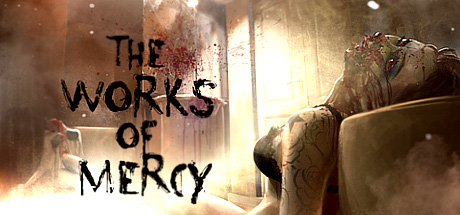
The Works of Mercy is a short, narrative-focused psychological horror experience developed and published by Pentacle that places its emphasis not on survival mechanics or traditional scares, but on moral discomfort and emotional unease. Rather than casting the player as a helpless victim fleeing an unseen threat, the game deliberately subverts expectations by forcing the player into the role of someone compelled to commit terrible acts under extreme pressure. Its ambition lies in exploring guilt, coercion, and responsibility, framing horror as something internal and ethical rather than purely external or supernatural.
The story revolves around an unnamed protagonist whose wife and child have been abducted. A mysterious figure named Eugen contacts him and issues a horrifying ultimatum: carry out a series of murders, or his family will die. From this point forward, the game becomes a grim psychological descent, asking the player to witness and participate in acts they may find deeply uncomfortable. The narrative attempts to challenge the player’s sense of agency, constantly blurring the line between choice and inevitability, and questioning whether actions taken under duress absolve one of moral responsibility.
Most of the game unfolds within the confines of a small, unremarkable apartment, which serves as both a physical and psychological prison. This limited setting reinforces the feeling of isolation and helplessness, as the player repeatedly paces familiar rooms while awaiting instructions or consequences. Progression is largely driven by scripted events, phone conversations, and short sequences that transport the player into disturbing scenarios. Rather than building fear through unpredictability or threat, the game relies on anticipation and dread, letting the player sit with the weight of what they are being asked to do.
Gameplay mechanics are deliberately minimal. There are no complex puzzles, combat systems, or traditional fail states. Interaction is limited to movement, examining objects, and making occasional dialogue choices. These choices, however, rarely alter the outcome in a meaningful way, reinforcing the game’s central theme of powerlessness. While this design supports the narrative intent, it also means that the experience often feels closer to an interactive short story than a conventional game, which can leave players craving deeper engagement or mechanical variety.
The horror in The Works of Mercy is psychological rather than visceral, though it does not shy away from dark subject matter. Much of the tension comes from implication and context rather than overt scares. Unfortunately, the execution of these ideas is uneven. Dialogue can feel blunt and overly explicit, undermining subtlety, and voice acting quality varies, sometimes pulling the player out of the intended mood. Moments that aim for emotional impact can instead feel awkward or unintentionally flat, which weakens the game’s ability to fully realize its disturbing premise.
Visually, the game is modest and functional. The apartment environment is sparse and repetitive, reinforcing the bleak tone but offering little visual variety. Occasional surreal or dreamlike sequences attempt to inject atmosphere and symbolism, but they are brief and lack the polish needed to leave a lasting impression. Lighting and sound design do some heavy lifting, using darkness, silence, and ambient noise to establish mood, though these elements are not always consistent enough to sustain tension throughout the runtime.
Thematically, The Works of Mercy reaches for heavy ideas—sacrifice, family, guilt, and moral compromise—but often presents them in a straightforward, almost literal manner. Rather than allowing players to wrestle with ambiguity, the narrative frequently spells out its intentions, which diminishes the psychological impact. As a result, the game feels more like a provocative concept piece than a fully developed exploration of its themes. The brevity of the experience further limits how deeply these ideas can be examined, as there is little time for escalation or emotional buildup.
Player reception reflects this mixed execution. Some appreciate the willingness to tackle uncomfortable topics and the inversion of typical horror roles, finding value in its bleak tone and unsettling premise. Others criticize the lack of meaningful interactivity, predictable storytelling, and uneven presentation, arguing that the game’s ambition exceeds its execution. Its short length and limited replay value also contribute to the sense that it feels underdeveloped rather than concise.
Taken as a whole, The Works of Mercy is an experimental psychological horror title that prioritizes concept over craftsmanship. It offers a disturbing premise and a perspective rarely explored in games, but struggles to translate those ideas into a compelling interactive experience. For players interested in narrative experiments and moral horror, it may be worth experiencing as a curiosity. However, those seeking a polished horror game with strong gameplay systems or nuanced storytelling may find its impact fleeting, its discomfort more theoretical than deeply felt, and its ambition only partially realized.
Rating: 5/10