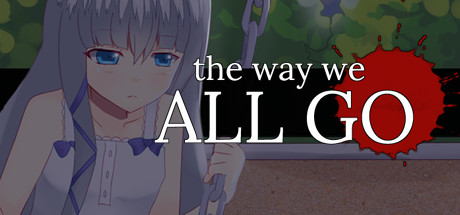
The Way We All Go (2015), developed and published by ebi-hime, is a brief yet emotionally intense visual novel that prioritizes raw human vulnerability over traditional storytelling satisfaction. Rather than guiding players through a neatly structured narrative with clear resolutions, it presents a series of uncomfortable, intimate moments that revolve around flawed characters and the fragile connections between them. It’s not designed to entertain in a conventional sense—instead, it invites the player to sit with difficult emotions and observe how they unfold without interference.
The story centers on a small group of individuals whose lives intersect through strained relationships and unresolved personal issues. Instead of building toward a dramatic climax, the narrative is composed of quiet, often unsettling interactions that reveal deeper layers of insecurity, dependence, and emotional instability. The writing feels grounded in realism, capturing the awkwardness and tension of conversations where people struggle to express themselves or unintentionally hurt one another. There is a deliberate lack of exaggeration, which makes the characters feel believable, even when their behavior becomes frustrating or distressing.
One of the game’s most striking qualities is its refusal to impose judgment or provide clear moral direction. The characters are not framed as heroes or villains, and their actions are not neatly categorized as right or wrong. This ambiguity allows the story to feel more authentic, but it also makes it more challenging to engage with on an emotional level. Players are left to interpret the characters’ motivations and consequences on their own, which can lead to a more personal but also more uncomfortable experience.
Interactivity is minimal, even compared to most visual novels. Choices are rare and have little impact on the overall direction of the story, reinforcing a sense of inevitability. This lack of agency can feel limiting, but it also aligns with the themes of the game. The characters themselves often seem trapped by their circumstances and emotions, and the player’s inability to change events mirrors that lack of control. It shifts the experience from one of participation to one of observation, where the focus is on understanding rather than influencing.
Visually, the game adopts a simple anime-inspired style that emphasizes character expressions and subtle emotional cues. The artwork is not elaborate, but it is effective in conveying the tone of each scene. Small changes in posture or facial expression carry significant weight, helping to communicate feelings that are not always explicitly stated in the dialogue. The soundtrack complements this approach with subdued, melancholic tracks that reinforce the game’s somber atmosphere without overwhelming it.
The pacing is tightly controlled, with the entire experience unfolding over a relatively short period. There is little in the way of filler content, and each scene contributes to the overall emotional impact. However, the brevity also means that certain elements are left underdeveloped. While the characters are compelling, the limited runtime restricts how deeply their backgrounds and relationships can be explored. This can leave the story feeling incomplete, though it also adds to the sense of ambiguity that defines the game.
What ultimately sets The Way We All Go apart is its willingness to embrace discomfort. It does not offer easy resolutions or moments of relief, and it does not attempt to soften the consequences of its characters’ actions. Instead, it presents a snapshot of emotional struggle and leaves the player to process it independently. This approach can be difficult to engage with, especially for those expecting a more traditional narrative structure, but it also gives the game a distinct identity.
In the end, The Way We All Go (2015) is a deeply personal and introspective experience that prioritizes emotional honesty over conventional storytelling. It is not a game that aims to satisfy or entertain in the usual sense, but one that lingers through its tone and themes. For players willing to engage with its heavy subject matter and understated presentation, it offers a thought-provoking journey that stands out for its sincerity and restraint.
Rating: 8/10