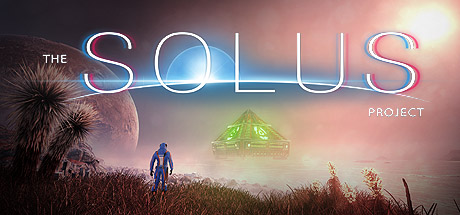
The Solus Project is a first-person science-fiction adventure that places exploration, isolation, and environmental survival at the center of its experience. Developed by Hourences and Grip Games and published by Teotl Studios, the game presents a structured single-player journey rather than an endlessly open survival sandbox. Its strongest quality is the way it makes an alien planet feel genuinely unfamiliar and dangerous, using weather, temperature, underground ruins, environmental puzzles, and limited resources to maintain tension without depending on constant combat.
The story begins after Earth has been destroyed, leaving the remnants of humanity aboard a small fleet near Pluto. The player is part of a mission sent to investigate Gliese-6143-C as a possible new home, but the expedition ends disastrously when the spacecraft is destroyed during its approach. With the other crew members dead, communication lost, and equipment scattered across the planet, the protagonist becomes humanity's isolated hope. Finding a method of contacting the fleet becomes the immediate objective, but exploration gradually exposes evidence that this supposedly empty world once supported an intelligent civilization.
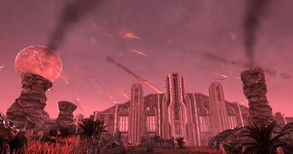
Rather than filling the journey with conversations and traditional characters, The Solus Project relies heavily on environmental storytelling. Ancient tombs, enormous caves, mysterious structures, inscriptions, abandoned mechanisms, and other discoveries slowly reveal the planet's history. The player effectively becomes an astronaut and archaeologist simultaneously. This approach rewards curiosity because optional areas and hidden passages frequently contain resources, upgrades, or additional pieces of the world's mystery. The game contains five islands and five major tomb and cave environments, creating ten substantial handcrafted areas with numerous secrets scattered throughout them.
Survival mechanics give exploration consequences. Hunger, thirst, exhaustion, temperature, moisture, and other physical conditions influence the protagonist, while the environment can become lethal through storms, tornadoes, lightning, meteors, earthquakes, and extreme temperatures. Days can become dangerously hot while nights become bitterly cold, making preparation and awareness important. The simulation extends beyond the player's basic needs, with changing tides, weather conditions, plants that respond to the climate, and other environmental systems helping the planet appear more dynamic than a static collection of levels.
These mechanics work best when they reinforce the atmosphere rather than dominate the adventure. The Solus Project is not primarily about constructing elaborate bases or endlessly manufacturing equipment. Scavenging is instead tied to staying alive and rebuilding communication equipment. Debris from the crashed spacecraft can be discovered throughout the landscape, encouraging players to investigate locations that might otherwise appear insignificant. Numerous upgrades can also be found, making thorough exploration worthwhile beyond simply uncovering story information.
The planet itself is arguably the game's most memorable character. Traveling across barren islands can create an impressive sense of scale, but eventually the player must descend into cavern networks connecting different portions of the archipelago. These underground sequences significantly change the mood. Open landscapes give way to oppressive corridors, ancient chambers, darkness, and unsettling evidence of whoever inhabited the world before humanity arrived. The transition allows The Solus Project to move naturally between science-fiction exploration and survival horror without requiring conventional enemies around every corner.
Puzzle solving is another important component. Ancient mechanisms and environmental obstacles force the player to study surroundings, locate useful objects, manipulate devices, and understand unfamiliar structures. The puzzles generally complement the archaeological theme rather than feeling like unrelated challenges inserted merely to slow progression. Keys, hidden passages, interconnected layouts, and concealed areas also give the design an intentionally old-school character. There is relatively little hand-holding, so players are expected to observe carefully and occasionally become lost while determining where to go next.
That limited guidance can be both a strength and a weakness. Discovering something independently is satisfying, but complicated environments occasionally make navigation frustrating. Survival requirements can also interrupt exploration at inconvenient moments. Players primarily interested in narrative discovery may find hunger, thirst, sleep, and temperature management distracting, while dedicated survival enthusiasts may consider these systems less expansive than those found in crafting-focused sandboxes. The game occupies a middle ground, using survival as pressure rather than making it the entire purpose of play.
Fortunately, the experience offers flexibility in how demanding those systems become. Difficulty can be adjusted from a punishing survival experience toward a considerably more relaxed journey, allowing players to emphasize whichever elements they find most appealing. This flexibility suits a game where atmosphere and exploration are arguably more important than proving mastery over survival statistics. The adventure also has a defined beginning and conclusion, providing a stronger sense of narrative progression than an indefinitely continuing sandbox.
Presentation contributes enormously to the feeling of isolation. Alien skies, dramatic weather, shifting light, enormous underground spaces, strange architecture, and environmental sound establish an atmosphere that alternates between peaceful wonder and uneasiness. Darkness can make even ordinary exploration threatening, while sudden environmental disasters remind the player that nature is often the greatest immediate enemy. The lack of constant traditional opposition actually strengthens certain sequences because danger becomes less predictable.
The game also supports VR through Vive and Oculus functionality, including different locomotion and rotation options, although it was fundamentally designed as a conventional non-VR experience. Controller support, Steam achievements, captions, and other Steam features round out the package. VR is particularly suitable for the game's enormous spaces and sense of physical scale, but a headset is unnecessary to appreciate its strongest qualities.
The Solus Project succeeds because its exploration, survival systems, puzzles, environmental simulation, and storytelling largely reinforce the same central idea: complete isolation on an alien world whose history is gradually becoming more disturbing. It can be slow, occasionally confusing, and mechanically rough around the edges, and players seeking combat-heavy science fiction or elaborate base construction may find it mismatched with their expectations. For players who enjoy atmospheric exploration, archaeological mysteries, environmental survival, and solitary science-fiction adventures, however, it delivers an unusual and memorable journey. Hourences and Grip Games created an experience with a distinctive sense of place, while publisher Teotl Studios brought forward a game whose ambition is particularly impressive considering its relatively small development origins.
Rating: 8/10