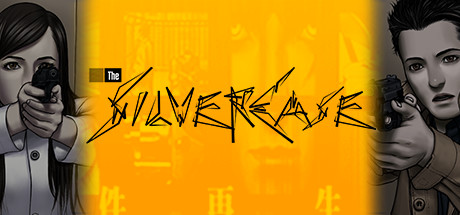
The Silver Case is a surreal and psychologically dense visual novel that stands as one of the most distinctive works ever created by Goichi Suda, long before the director became internationally recognized through titles like Killer7 and No More Heroes. Originally released for the PlayStation in 1999 and later remastered for modern platforms, the game remains an incredibly unusual blend of detective fiction, political conspiracy, cyberpunk philosophy, and psychological horror. It constantly rejects conventional storytelling in favor of fragmented narratives, abstract symbolism, and experimental presentation, creating an experience that feels less like a traditional visual novel and more like a descent into paranoia and societal decay. Even decades later, The Silver Case still feels bold, uncomfortable, and creatively unlike almost anything else in gaming.
The story takes place in the fictional “24 Wards,” a massive urban district plagued by political corruption, violent crime, and growing social instability. A string of disturbing murders begins terrorizing the city, and investigators quickly realize the crimes resemble the work of Kamui Uehara, a notorious serial killer believed to have been eliminated years earlier during the original “Silver Case” incident. Players experience the narrative through two interconnected perspectives. One storyline follows members of the Heinous Crimes Unit investigating the murders directly, while the second centers on freelance journalist Tokio Morishima, who slowly becomes entangled in the same web of violence and conspiracy. As both perspectives unfold, the game gradually reveals a world consumed by psychological manipulation, government corruption, and ideological collapse.
One of the game’s greatest achievements is its atmosphere and visual presentation. The Silver Case embraces a fragmented multimedia style that constantly shifts between text overlays, low-polygon environments, still photography, animated sequences, and abstract visual effects. Dialogue often appears inside moving windows layered over distorted imagery, giving the entire experience a dreamlike and unstable quality. Rather than trying to create realism, the game deliberately disorients players through its presentation, reinforcing the themes of fractured identity and mental instability running throughout the narrative. The result feels deeply experimental even by modern standards.
The writing is exceptionally ambitious and frequently philosophical. Although the game begins as a murder mystery, it quickly expands into discussions involving morality, crime, social conditioning, memory, media influence, and the psychological effects of violence. Conversations regularly shift between grounded investigative work and abstract ideological debates, creating a story that constantly blurs the line between reality and delusion. The narrative rarely provides straightforward explanations, instead expecting players to piece together meaning from fragmented information, symbolism, and conflicting perspectives. This complexity can occasionally become overwhelming, but it also gives the story extraordinary depth compared to more traditional detective games.
Character writing is another major strength. The detectives investigating the murders feel emotionally damaged and morally exhausted, shaped by years of exposure to violence and corruption within the city. Veteran investigator Kusabi stands out particularly well as a cynical figure trying to maintain control within a society that increasingly feels unstable and meaningless. Journalist Tokio Morishima provides a different perspective, acting as a more psychologically vulnerable character whose curiosity gradually drags him deeper into the chaos surrounding the case. Kamui himself functions less as a simple antagonist and more as a terrifying symbol tied to the city’s collective trauma and social collapse. Nearly every important character feels psychologically compromised in some way, which strengthens the game’s oppressive atmosphere.
Visually, the remastered version successfully preserves the strange identity of the original release while making it more accessible for modern audiences. The low-resolution 3D environments and retro interface design remain intentionally stylized rather than outdated. The game’s visual approach constantly evokes late-1990s Japanese cyberpunk aesthetics, mixing industrial imagery, distorted urban environments, and surreal transitions into a presentation style that feels uniquely tied to its era. Even today, very few games attempt storytelling in such an aggressively unconventional manner.
The soundtrack is equally impressive and plays a massive role in shaping the emotional tone. Industrial ambient tracks, eerie electronic compositions, and melancholic melodies create a constant sense of paranoia and emotional fatigue. The music rarely offers comfort or release. Instead, it reinforces the game’s themes of isolation, instability, and societal decay. Certain tracks become deeply associated with particular characters or revelations, helping maintain emotional cohesion even when the narrative itself becomes fragmented and difficult to fully interpret.
Gameplay remains intentionally minimalistic throughout most of the experience. Players primarily read dialogue, explore locations from a first-person perspective, and occasionally solve puzzles or interact with investigative sequences. There is little traditional gameplay in the conventional sense, which may disappoint players expecting more interactive mechanics. However, the simplicity allows the game to focus entirely on atmosphere, storytelling, and psychological immersion. The Silver Case is fundamentally about absorbing information, interpreting symbolism, and slowly unraveling a deeply unsettling mystery rather than overcoming mechanical challenges.
At the same time, the game’s unconventional structure will absolutely divide players. The pacing can become slow during lengthy dialogue-heavy sections, and the fragmented storytelling occasionally borders on intentionally confusing. Certain narrative threads remain ambiguous even after the credits roll, forcing players to draw their own conclusions regarding major themes and character motivations. Players seeking a clear and straightforward detective story may struggle with the game’s abstract presentation and philosophical focus.
However, these qualities are also what make The Silver Case so memorable. The game refuses to simplify itself for accessibility or mainstream appeal. It fully embraces surrealism, ambiguity, and experimental storytelling in ways few narrative games are willing to attempt. Every aspect of the experience feels deeply personal and artistically driven, as though players are exploring the chaotic interior logic of a broken society rather than consuming a conventional crime thriller.
The Silver Case succeeds because of how fearlessly original it remains. Even years after its release, it still feels daring in ways many modern narrative games do not. Its mixture of psychological horror, political conspiracy, and fragmented storytelling creates an atmosphere unlike almost anything else in the visual novel genre. While its slow pacing and unconventional structure may alienate some players, those willing to engage with its strange world will discover a deeply rewarding and intellectually fascinating experience.
For fans of experimental storytelling, psychological thrillers, and narrative-driven games that prioritize atmosphere and thematic complexity over traditional gameplay, The Silver Case remains one of the most important and distinctive visual novels ever created. Its surreal presentation, philosophical writing, unforgettable atmosphere, and emotionally exhausting mystery combine to form a genuinely unique experience that still stands apart from nearly every other detective game released before or since.
Rating: 8/10