The Last Federation.
A very unique game, like pretty much every game by Arcen Games.
This is a combination of a 4X game and a Tactical Action Combat game where you control one ship. How does that work? Well, you are in a 4X game, but you are one single alien with a really powerful ship. The 4X game is the world in which you inhabit, but you do not actually control any of the Civs. To put it another way, you are in a simulated 4X game world, and you are one quite powerful individual who seeks to influence this world.
What happened is that you were part of an ancient and super powerful Civ. This Civ held universal sway, controlling and ruling other smaller Civs. But they were all destroyed. You are the last survivor of this Civ. You have one ship left, so you are very powerful, but you are only one person. So you have a much out-sized impact on galactic events for one person, however, destroying a whole Civ army by yourself is probably out of the question.
So you watch and wait while the many civs that currently exist, but which are not spacefaring, learn spaceflight and join the galactic community. This waiting period is short, and you can raise any Civ you wish to spaceflight immediately. However, when a civ is space-faring, they become aware of all the other Civs that exist but not at that tech level, and they place their own satellites their planets to watch. So whenever you fly to a planet to lift a Civ, you have increasingly difficult time sneaking through the array of satellites above a planet, because the more people that are space-faring, the more satellites to avoid. This feeds one of the most important mechanics, which is how much each Civ likes you. A Civ will get a boost to how much they like you if you raise them to space. However, every other Civ that detects your action will dislike you somewhat for this act. And it is this balance of actions that drives the experience.
Every Civ likes themselves, so helping them makes them like you. But every Civ fears the other Civs, so your actions to help one Civ will make others fear you and dislike you. This seems impossible to manage. However, Civs will form bonds with other Civs. So if two Civs like each other, then helping one makes the other one like you as well. This is why getting Civs working together is so important, because your actions are liked by more people. But this process is difficult.
Every Civ has their own political system. One may be essentially a democracy with favours as currency, but another might be a hive mind with one insect leader. The currency of favour for one Civ is completely useless for every other Civ. They have very different desires and buffs and debuffs. However, they all use roughly the same technology.
You may worry about how to unite everyone into a single federation. That is actually hard, and not required. You can kill or save whoever you want. You can choose what your goal is, and decide whether you were successful or not in dealing with all the various randomly generated events.
The set of actions available to you is mind boggling. It is very vast, but they are all labelled to show you the actual benefit you will get to important things like how much every Civ will like or dislike you for an action. However, some actions have additional benefits and it will take a while to understand those things. It is also the case that there may be multiple pages of actions available. As in, you cannot just open the interaction page for a civ and see everything there. There are multiple pages of different possible actions. The categories make sense, but until you get a real hang of what you can do, it is possible there will be whole sets of actions available that you didn’t even know existed. Time moves forward, but you can speed or slow or stop it as much as you like.
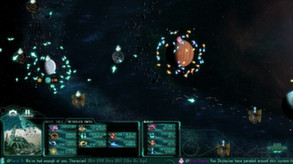
I said there was combat, but I haven’t talked about it yet. Remember how I talked about satellites surrounding planets and sneaking past them? This is one of the things you actually perform via the tactical action turn based combat. I say turn based, but it is a weird hybrid, where it is real time divided into bits. You are in an overhead view, and control your one ship. There will be many other ships and structures and turrets and other things. This is a type of bullet hell game, but without reflexes. Time is divided into maybe one or two second chunks. For each chunk, you control how you move and where you shoot, and with which gun. You also control where your energy for the turn goes. It can be divided between Gun power, movement power, and shield power. There is an absolute amount of power, so you choose priority levels. Gun power increases are obvious. Movement power increases both how far you can move for the turn, but also how tightly you can maneuver, which is useful for dodging bullets. Shield power increases shield regen. Guns are quite different, and you also have some special abilities. You may wonder whether frozen time makes it impossible to tell where bullets are moving, but the bullets are shaped so that you can tell where they are moving even when frozen. I don’t remember ever being hit by something I didn’t know was going to be where it ended up being. You can get in combat quite a bit, not only through choice, but through assassins trying to kill you. You cannot die and lose the game, but dying means you spend time regenerating to fully working again, which means lost time to influence the universe. Time will move forward and you have no control over what happens.
The Last Federation is very unique. It allows you to do things you would never have thought possible. But that variety can be both difficult to understand, and possibly not interesting to do. Your interaction with the universe is mostly like a 4X. So if you are routinely use your imagination to turn number representations into real felt experiences, then this will be more acceptable. However, even though you have a lot of choices, its not like you are managing completely different mechanics systems. You are largely dealing with a limited set of mechanics with a lot of apparent variety, but not really in that you are picking between different options that largely move the same meters different amounts, and choosing between those things. But also dealing with individual complicated political systems that will take quite a bit to understand. There are also a lot of possible outcomes, because of the inter-relations of many unique groups.
The game has changed a lot over the years. When I first played it when it came out, I played for something like 10 hours without resolving a single play through. The second time, years later, I played for three or four hours and completed a run, so there are massive changes that have happened over the years.
The Last Federation is very novel, but your interactions can be somewhat obscure, and might not be as varied as you may think at the start. But there is a lot to inspire the imagination. I recommend it, but it is very weird.