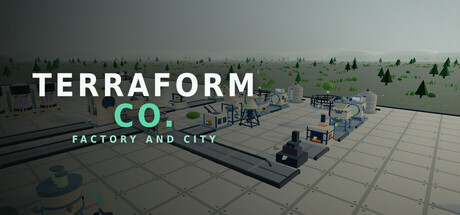
Terraform Co: Factory and City
One pod, one core, and an unsurveyed plot on a green world. Clear the ground, trap native grazers, mine metal and rock, and belt it all into a factory — then build the city that buys what you make. Fill contracts, climb the S&G-15 index, and keep the raiders off your core.
Estimated lifetime revenueLow confidence
—gross
—
Modeled estimate, not a reported figure. How we estimate →
Est. copies sold
0
mid estimate
Reviews
0
Review score
—
Concurrent players
About
About the game
Site 12. One pod, one core, and whatever you remember.
Terraform Co. runs the off-world division, and you just got posted to an unsurveyed plot on a green planet with nothing built on it. The company wants two things out of the rock, in this order: a working operation, and a profit.You are #15 of 15 on the S&G-15, the planet's stock index. Fourteen companies are above you.
Factory feeds depot, depot feeds town, town pays for the next factory
That's the whole company, and it's the loop the entire game runs on.Start with your hands. Clear dirt and rock with a pickaxe, tranq a native grazer and carry it back to a pen — grazers breed, and a full pen is a livelihood. Then stop doing it yourself. Belts haul while you're somewhere useful, automated miners work the ore you were chipping at, and machines turn all of it into things people will pay for.
- Ore — crush, smelt and forge it into alloy, with sand, slag and glass falling out as byproducts you'll want to recycle rather than dump.
- Premium metals — pulverize ingots to dust, enrich it with acid into pure alloy, and turn that into power cells.
- Electronics — etch crystal dust into wafers and foil, assemble microchips, then smartphones, then laptops.
- Food — the grazer line, all the way up to a suspiciously premium burger.
- Chemicals — vats, acid, glycerin, dye and fragrance, gluing the organic and mineral sides together.
- Five tech tiers, gated behind what you've actually produced — not a menu you buy your way through.
Then build the city that buys it
Product isn't money until somebody buys it, and nobody lives here yet. So you lay the first road.Buy and place buildings, and the town grows on top of your factory's output. Residents move into your houses, drive and walk the streets you laid, and spend money in the shops you placed. But shops don't conjure stock — you supply them. Belt goods into a Cargo Depot and it runs vans out to every shop that wants them. New building types unlock from production milestones, so the town's growth is paced by the factory's.
It's a second economy stacked on the first, and it's alive down to street level: cars queue at junctions, pedestrians cross at the kerb, vans pull into loading bays.
Climb the S&G-15
Coins come from selling. Rank comes from contracts.Each of the fourteen rival corporations has a fixed ladder of supply contracts in its sector. Clear a ladder and you overtake that company — a headline runs, and their trade secret becomes a permanent perk of yours. Ladder contracts are untimed, so they're the campaign; timed spot orders pay the bills in between.
A live headline engine moves sell prices with booms, bubbles and shortages, and rumours land about a day ahead of the effect — so a factory that's paying attention can build toward the spike. The market terminal puts the index board, contract ladders, spot orders, a price grid with sparklines and the news feed in one place.
Clear all fourteen ladders and Terraform Co. tops the index.
And the raiders
Alien raiders drop on the landing pad and run at your core — they want it shut down, and they'll help themselves to your stock on the way. It's an interruption to build against rather than the job itself.Your bat never runs dry, which is the whole appeal of it. The tranq gun takes things alive. Raider types keep fixed identities from the first raid to the fortieth — runners are always faster than you, armored always shrug off the first few swings — so the pressure comes from numbers and composition, not from a stat slider quietly outpacing you.
Built to be looked at
Grounded industrial art direction: worn matte machinery, honest materials, real proportions, with saturated colour reserved strictly for the things you need to read at a glance. If it's glowing, it means something.The build browser's icons are photographs of the actual buildings, taken by the game itself — so they can't go stale, and what you see in the menu is exactly what lands on the ground.
