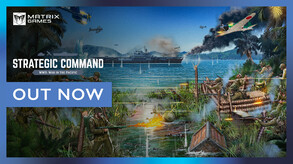
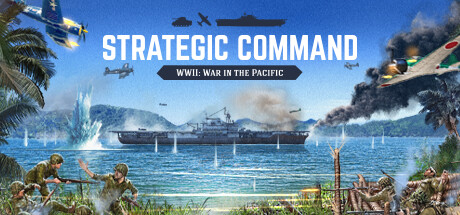
Strategic Command WWII: War in the Pacific is a turn-based strategy game. It offers a comprehensive experience of the Pacific Theater, challenging you to achieve victory in one of history's greatest conflicts.
Modeled estimate, not a reported figure. How we estimate →
Media

About
Strategic Command - WWII: War in the Pacific and its flagship 1941 Day of Infamy campaign comes with an impressive 36,000 hex map, providing you with the opportunity to wage war from India and Burma in the west, via the Dutch East Indies, Malaya, the Philippines, Guadalcanal, the Kokoda Trail, Iwo Jima, Tarawa and Midway to the west coast of North America, at an approximately 80km/50mi scale.
The flagship campaign begins with the surprise attack on Pearl Harbor on the 7th December 1941 and the rapid expansion of Japan’s Empire into South East Asia and the Pacific.
As Japanese carriers strike Pearl Harbor, Allied forces across the Pacific and Southeast Asia face attacks from Hong Kong to New Guinea. Simultaneously, Chinese and Japanese forces clash for control of China.
Strategic Command - WWII: War in the Pacific offers the opportunity to command the forces of 7 major powers, including Japan, Australia, China, the USA, UK, and USSR. Engage in battles spanning both land and sea, from Okinawa to Burma, and experience the conflict through immersive 3-D unit graphics or NATO counters as Japan strives to seize resources and weaken Allied fleets and armies.
There are 5 quick-to-Play Mini-Campaigns, from the Soviet-Japanese clash at Khalkhin Gol in 1939 to the climactic invasion of Manchuria in 1945:
1939 Khalkhin Gol – Nomonhan – Soviet and Japanese forces clash for a second time in the east.
1942-43 Solomons Campaign – the US begins its campaign to fight back against Japan. US Marines under the command of Vandegrift have landed on Guadalcanal, and a major battle is about to begin.
1944 The Marianas Campaign – the US launches Operation Forager with amphibious landings on Saipan, Tinian and Guam, with the aim of securing these locations prior to the liberation of the Philippines.
1945 Iwo Jima – US forces have been ordered to capture this island, only 750 miles from Japan. The Japanese defenders have been subjected to several days of bombardment by the US navy, however they are well dug in and US Marines will be needed to defeat them.
1945 August Storm – The Soviet Union invades Manchuria in the final battle of the Second World War. After years of neglect, the once-mighty Kwantung Army faces overwhelming odds in their efforts to defend some of Japan’s oldest conquests.
Six immersive Campaigns take you through key periods in the Pacific theater of World War II. Every campaign promises competition and replayability, with Victory Conditions varying from time-based tasks to conquering territory.
New gameplay elements, introducing Airfields as a new resource type with unique rules, and experiencing iconic events like the Doolittle Raid. Navigate changing naval supply rules with the introduction of Naval Construction, also known as Seabees.
Scorecard so you can easily track your progress towards victory – and compare scores
A Turn Counter. so you can easily keep track of time as you lead your forces into battle
A choice of 3-D unit graphics or NATO counters
Very easy to use Editor to make your own scenarios
Genres
Stats
All-time low is the lowest price we've recorded for this game since we started tracking it.
Languages: English, French, German, Spanish - Spain, Simplified Chinese
Engagement
Hours played at review time, across 40 reviews with recorded playtime.
Reviews
Themes across 40 recent reviews and how positive each mention is. A keyword signal, not full sentiment analysis.
positive critical· bar length = how often the theme comes up
Reviews
There are several major problems with the Japanese Order of Battle in the Day of Infamy Campaign. The CVs Hiryu, Kaga, and Zuikaku were all part of the Pearl Harbor Strike Force and should be present at the start of the campaign. In addition, CVL Zuiho should be present at start as well. In the campaign, the Japanese are forced to buy these units and they will not arrive until 1943 at the earliest. This seems to be a rather egregious error and severely impacts Japan both militarily and economically. This is a serious historical error as well and is not confidence inspiring about the accuracy of the Japanese order of battle. That having been said, the game system works well and the program is bug free and easy to learn to use. What a pity that the order of battle is so badly done. The game system is very good as is true of the whole Strategic Command series.
Someone else who reviewed the game put it best. They made a game where the ships are the armies but didn't bother improving the system to make the Naval War game fun or engaging in any capacity. There are not many Pacific War games out there, but this one is not worth playing. Its pretty convoluted and a mess, reading the manual is hardly much help at explaining anything whatsoever. And I did read it multiple times but it still doesn't explain to me why my Submarine does 0 Damage to the enemy battle ship even when its running silent and was waiting for 2 turns. And how the enemy Battleship just calls in his destroyer buddy and just nukes the submarine in one turn. The land war in China is such a slog that its almost not worth moving any units at all and focusing on the rest of the actual war. Speaking frankly you do not get enough units to protract a war across all these fronts, like at all. You can say i'm a Heart of Iron fanboy and you might be right, but I still got plenty of grievances with that game, and this game somehow exacerbates those grievances and makes them worse. Like why is the Kido-Butai, on the day of Pearl Harbor, only have 3 carriers and like 3 escorting ships. What happened to the other 3 that participated in the attack? What happened to the rest of the fleet? Why are there no marines on Wake Island? Why is Wake island and Guam basically undefended? What are they just foot notes? A lot of islands in the Pacific on the Day of Infamy start are undefended entirely. Why does it feel like the only ships worth building are Battleships and Carriers since all the others clearly do nothing and cost too much for what they do? Why do my Army units do nothing? Oh you can make ships Cruise and they can sail like half the Pacific in 1 turn... What. The. ♥♥♥♥. Like why is that even an option? I get the whole concept of concentration of forces but the US Navy doesn't exist on day one of the game for some reason, and I know cause I checked. You get Saratoga and then make the ships or wait for the production queue to roll over after you end enough turns. The Japanese forces are also artificially buffed for god knows why so its not even an actual asymetric fight its just ♥♥♥♥♥♥♥♥ cause their units on a per unit basis are just better. LET ME MAKE THIS ABUNDANTLY CLEAR. The US Forces did not have inferior equipment on the start of the war, they had far too cautious submarine commanders, cautious carrier commanders like Fletcher, and far too Cautious and frankly uneducated Cruiser commanders like Captain Howard Bode, who believed that using Radar would illuminate his own position to the Japanese at night like a giant Flashlight. Compare that to Rear Admiral Gunichi Mikawa who was a genuinely skilled, seasoned, and respectable adversary for the Battle of Savo island, who's attack while calculated, was a massive risk and hedged more on sheer luck than the stupidity of the enemy. So the fact that the Japanese just magically get artificial buffs to try and inflate their combat ability in the early war just makes no sense frankly.
The naval system is a fail. All in all a real stinker. The order of battle is wrong. Very inaccurate. Where are the Japan CV's at in 1941? So many are missing and need to be built. Did you forget that part? The stacking system is a general failure too. Getting tired of the crap slitherine/Matrix is pumping out. Sub par crap.
The original game is awesome, and by now lots of players are well aware of it. But the "Empires" DLC is new, and deserving of a review. As one would expect of a "Fury" game, the DLC is well researched and obviously well tested. Download and installation are easy-peasy. Game play is smooth, starting positions make sense and reflect the afore-mentioned research. I agree with the developers comment that Chinese military tech is tepid compared to the red-hot Japanese capability. Yet, it is not a cake-walk for the Japanese. There are a LOT of Chinese units, while their tech might be lacking, there's not much to criticise about morale, and with an accompanying HQ readiness is not bad either. Very intriguing decision events, with good notes to help you. I love the way not all of the Chinese provinces are on the same page as Chiang Kai-Shek, and he in turn is not even on speaking terms with Mao. (the two have managed to cobble together a fragile peace however, while the Japanese threat continues). The various provinces kind of join in over time, although often there are ways to accelerate the pace. Treachery can rear its head, too. There is a chance the Japanese can bribe the defender in Peking to abandon the city, for example. There are other such twists in the game too. Hanging on the Shanghai is an absolute "must" for Japan. I have started a half dozen times as Japan and find that by the time six months has gone by, sometimes less, I am in serious trouble. The AI is ruthless at intermediate, and does a fairly good job of using its navy, such as it is. When I finally get an HQ ashore, I am still hemmed in to about a dozen hexes in and around Shanghai, and failing to make great strides anywhere else. Some context here: I am, at best, a middle of the road player. I am well educated in military history, have read a plethora of accounts and analyses of various WW1 and WW2 battles, but I'm no Yamamoto or Yamashita :P So, to some extent, I would expect better tacticians than me would do better around Shanghai. But, for a modest investment, this DLC adds a ton of play value, and I haven't even tried the several other scenarios in the DLC.
A good beer and pretzel game. I wish you could stack units, but that' the way the SC games are designed and I get why they do it. But the War in the Pacific? Arguably, the most lopsided war for the past 500 years. Japan had ZERO chance to win. If you can beat the allies in this game, then something's wrong with it. Playing as the Japanese, I'll give the game credit for an accurate atmosphere. You can't do anything in China, and you actually feel "victory disease" well into 1942 because you can mop up everything you can reach without taking too much damage. Then reality starts to hit, when the overwhelming economic resources and endless ships of the allies began to arrive, curing victory disease quickly. Then it's a downhill slide from there with no hope of victory. It's still a fun game, nevertheless, although I would not want to play as the allies even against a human opponent.
Extremely challenging, but an excellent interface and UI with a tried and tested "open ended" strategy approach. The scale of "Pacific" feels just right, and the game keeps you on the edge despite the inevitable industrial might of the US prevailing most of the time. I have yet to see a Japanese victory.
I am REALLY enjoying this game, I was totally lost at first, but I'm starting to get the hang of it. Watching tutorials on YouTube helps a ton. I was afraid that it was going to be too detailed like War in the Pacific, but this game hits the right balance between super detailed and beer and pretzels.
Strategic Command WWII: War in the Pacific is a turn-based grand strategy game developed by Fury Software and published by Matrix Games that tackles one of the most demanding and logistically complex theaters of the Second World War. Rather than focusing on fast-moving land campaigns, the game places its emphasis on the vast distances, naval dominance, and long-term planning that defined the Pacific conflict. From the opening moments, it is clear that this is a game about patience, foresight, and coordination, where victory is achieved not through quick offensives but through sustained strategic pressure across land, sea, and air. The scale of the game is one of its most defining features. The map spans an enormous area, covering East Asia, Southeast Asia, Australia, the Indian Ocean, and the central and western Pacific. This sheer scope fundamentally shapes how the game is played. Armies cannot simply march from objective to objective, and fleets take time to reposition across oceans. Supply lines stretch thousands of miles, and maintaining them becomes just as important as winning battles. Amphibious operations, carrier task forces, and airfield placement are central mechanics, forcing players to think carefully about staging areas, logistical hubs, and the long-term sustainability of any offensive. Gameplay follows the established Strategic Command framework, where each turn involves managing production, research, diplomacy, and military operations. Players must decide how to allocate limited resources between building new units, upgrading existing forces, investing in technological advancements, or reinforcing critical areas. Research choices have a particularly strong impact in the Pacific setting, as improvements to naval aviation, carriers, submarines, and logistics can dramatically alter the balance of power over time. These decisions create a constant tension between immediate operational needs and long-term strategic goals, ensuring that no choice feels trivial. The campaign structure offers a wide range of scenarios that capture different phases of the Pacific War. Early campaigns focus on the outbreak of hostilities in Asia and the rapid expansion of Japanese forces, while later scenarios shift toward the Allied counteroffensive and the slow, methodical push toward Japan. Each campaign presents its own challenges, from defending overstretched empires to coordinating multinational Allied forces with differing priorities and strengths. The inclusion of later-war scenarios adds variety and allows players to experience how changing technology and production capacity reshape strategic possibilities. Naval warfare is at the heart of the experience, and the game places heavy emphasis on fleet composition, positioning, and attrition. Carriers, battleships, submarines, and escorts all have distinct roles, and losing major naval assets can have long-lasting consequences. Control of sea lanes determines not only military movement but also economic survival, especially for island-based nations. Air power, particularly carrier-based aviation, plays a crucial role in projecting force across the map, while land-based airfields serve as essential anchors for offensive and defensive operations. The interplay between these elements creates a strategic environment where dominance is rarely absolute and must be constantly defended. Land combat, while less frequent than naval engagements, remains significant and often decisive. Island campaigns are slow and costly, requiring careful preparation and support. Terrain, supply, and entrenchment heavily influence outcomes, making reckless invasions disastrous. The game does not shy away from portraying the grinding nature of Pacific land warfare, where progress is incremental and losses are often high. These mechanics reinforce the importance of choosing battles wisely rather than attempting to seize every objective at once. Visually, Strategic Command WWII: War in the Pacific adopts a clean and functional presentation that prioritizes clarity over spectacle. The hex-based map, unit icons, and interface are designed to convey information efficiently, allowing players to manage a massive theater without unnecessary clutter. While the graphics are modest by modern standards, they serve the game’s strategic focus well, keeping attention on planning and execution rather than visual flair. The interface can feel dense at first, but it becomes intuitive with experience, especially for players familiar with other titles in the Strategic Command series. The artificial intelligence provides a solid strategic challenge, particularly in managing defensive lines, exploiting overextensions, and applying pressure in key regions. While experienced players may eventually learn its tendencies, the AI is generally capable of sustaining long campaigns and responding sensibly to shifting situations. Multiplayer options further enhance replayability, allowing human opponents to test each other’s strategic vision across lengthy campaigns where patience and consistency matter as much as tactical skill. Strategic Command WWII: War in the Pacific is not a game designed for quick sessions or casual play. It demands time, careful thought, and a willingness to accept slow progress as part of the experience. However, for players who enjoy deep grand strategy and appreciate the unique challenges of the Pacific Theater, it offers a rich and rewarding simulation. By emphasizing logistics, naval power, and long-term planning, it captures the essence of the Pacific War in a way few games attempt, making it a standout entry for strategy enthusiasts seeking a thoughtful and comprehensive portrayal of one of history’s most complex conflicts. Rating: 7/10
战棋初次入坑,中文汉化目前还是比较不错的,希望可以把前2部作品也一起提供下汉化,这样更有可能购买,以及规则书的汉化
还可以,目前我个人有以下几个建议:1.手册以及战略指导的汉化问题;2.在游戏AI回合过程中,经常有卡顿甚至是闪退的情况希望可以关注一下;3.是否可以有一个教学的小剧本;4.希望能够把贵工作室之前的作品(WWI/WWII)进行汉化(一直观望没入手的原因就是汉化问题);5.就是在游戏过程中无法进行STEAM截图,比较困扰。希望可以在未来看到更多贵工作室的作品!
Related
Related
Trends
Modeled estimate over time, reconstructed from Steam's monthly review histogram.
Momentum
Pace estimated from the game's recent review growth (our daily snapshots) at its own sales-per-review ratio — a momentum signal, not booked sales.
Audience
Estimated from the language of this game's reviews — a proxy for where players are, not official Steam demographics.
Related
| Unfair Flips | $119.2K | 2.5K | 89% | $1.99 |
| Warp | $119.2K | 426 | 67% | $9.99 |
| BrokenLore: DON'T WATCH | $119.2K | 464 | 83% | $7.19 |
| Hack, Slash, Loot | $119.2K | 754 | 52% | $5.99 |
| Mortal Glory 2 | $119.2K | 306 | 88% | $11.99 |
| Keeper's Toll | $119.3K | 788 | 90% | $6.99 |