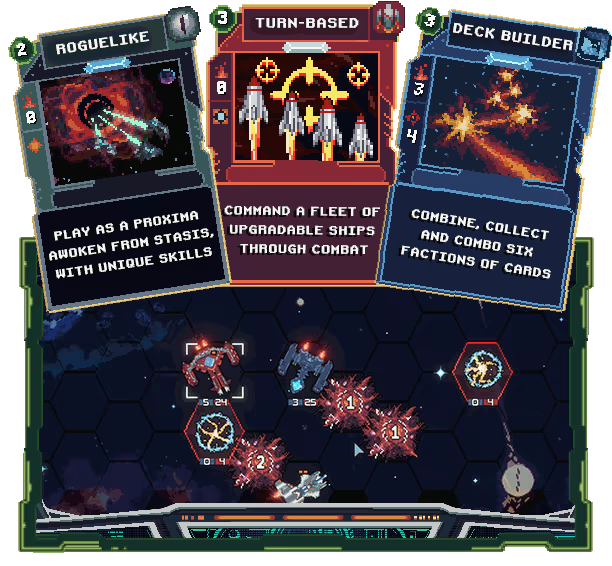
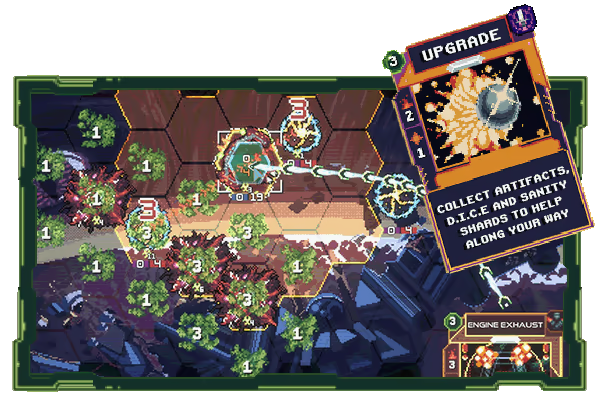
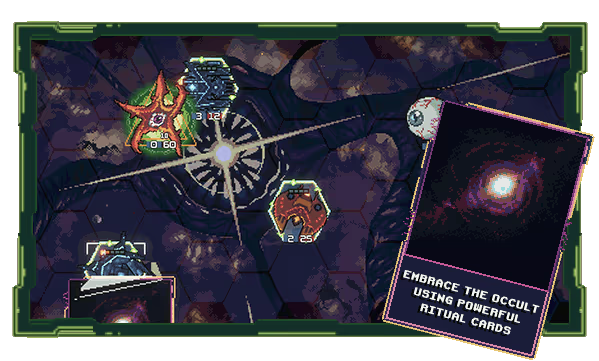
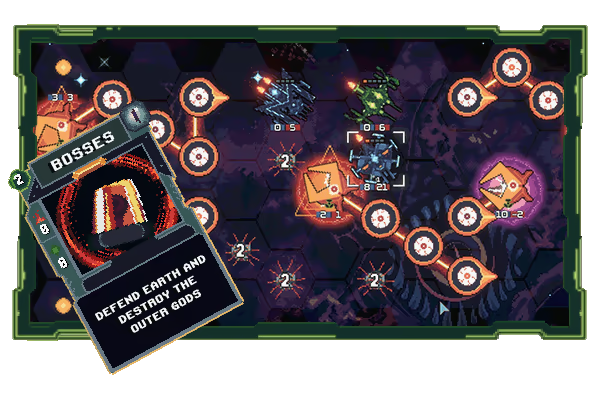
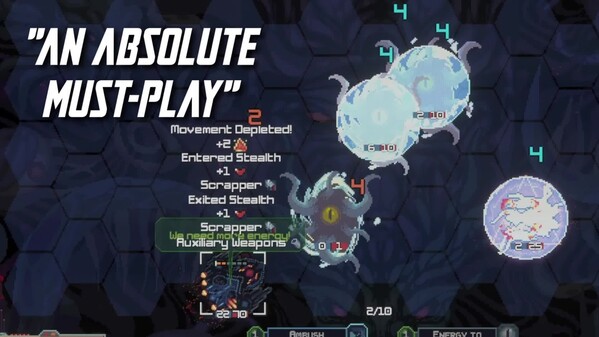
Earth has fallen. Science and the Occult have united forces to brace for the arrival of the Eldritch. But will the efforts against this strange, alien race be enough? Play as one of many Proximae used to help defend humanity in this turn-based, roguelike, intergalactic deck builder.
Modeled estimate, not a reported figure. How we estimate →
Media

About


Stats
All-time low is the lowest price we've recorded for this game since we started tracking it.
Languages: English*, French, Italian, German, Spanish - Spain, Japanese, Russian, Simplified Chinese, Korean, Traditional Chinese*languages with full audio support
Engagement
Hours played at review time, across 40 reviews with recorded playtime.
Reviews
[h2]Stop Countering the Player’s Build[/h2] Starless Abyss is a great turn-based roguelike. I genuinely believe that. However, there is a very thin line between a deckbuilder that encourages experimentation and one that looks at your build and says, "Oh, I see what you picked. Here’s a boss that hard counters it." Mines build? Euclidean shows up and wipes the entire field of mines. Turret build? Time to throw in the Corruptor and make turrets borderline unusable. Laser or melee build? Astra arrives and ruins your run with constant lockdowns. No matter how many runs I played after the tutorial phase, the fun steadily disappeared. I never felt encouraged to commit to a build. Instead, I felt forced to juggle multiple archetypes at once just to avoid being completely shut down by a single boss. If I wanted to use turrets, I also had to squeeze in lasers or mines to compensate for the inevitable counter. If I leaned into mines, I still had to prep for whatever existed solely to delete them. It became a cycle of countering the counter, not building something interesting. The result is a game that discourages specialization. That is a problem in a roguelike built around builds. The music is great. The visual design is excellent. But mechanically, this approach undermines the core appeal. The captain choice also feels unbalanced. On one side, you control multiple ships that overheat rapidly and feel fragile. On the other, you have single-ship captains with massive health pools, strong defenses, and high overheat capacity. Pair that with evasion builds and the game becomes trivial. My first two runs heavily favored me. Every run after that ended in frustration. Not because of difficulty, but because bosses would not stop directly countering whatever final build I committed to. [h2]Conclusion[/h2] The squad system feels like busywork. It adds nothing meaningful to the gameplay and mostly makes me want to intentionally wipe the squad and play as a single ship. Functionally, it makes little difference. The game itself is not particularly difficult. You can create absurdly strong builds, especially with mines stacking into the tens of thousands of damage. Meanwhile, lasers and missiles often struggle to break single digits on a good run. The issue is not power. It is punishment. If you commit to a focused, efficient deck, the game will eventually hard counter it with a boss designed specifically to invalidate your choices. That is not challenge. That is design working against the player in a way that makes it look like it's difficult. [quote] Please consider following my [url=https://store.steampowered.com/curator/41005226/]Curation page[/url]. I cover a wide range of genres both paid and unpaid, providing unbiased opinions as well as regular giveaway events. [/quote] [b]Video Review TBD[/b] https://youtu.be/3DalBr8g8s4
Starless Abyss is p.cool. I was looking for a good card based game and found one. [EDIT] A few weeks later, but I just want to note this here: There's stars. Like a lot of them, at all times. This is not a major problem at all and I haven't finished everything yet, but at no point have I ever been in what I would call a "Starless" Abyss. I'm not saying change the name, I'm not saying do a graphical overhaul but...there's stars. My god, its full of stars.
Stylish af roguelite deckbuilder where you also control a fleet of ships on a hex-grid. Super fun with some caveats. Pros: great presentation, the art is awesome, the music is very good, it's just all really juicy. General gameplay is fun, thinking is required, but it's not a massive number cruncher, meaning you can play your turns rather quickly. Strikes a nice balance imo. It also feels like a lot of love was poured into the game, e.g. the fun little boss-intros, the starless chillin' thing when you idle in the main menu, etc. Cons: My main gripe with the game is that the descriptions should give more precise information. Sometimes stuff happens or stuff doesn't work and I can't tell if I just misunderstand a card / an artifact / an enemy or if it's bugged. E.g. the ritual card "Exterminate" imo is straight up bugged and doesn't work because it only lets me destroy my own turrets, while it definitely sounds like it should be able to hit enemies. Also the "Stealth" mechanic. From the description I thought it was bugged, since some of my stealthed up ships still got hit sometimes. Got that cleared up by reading in the forums though, finding out that the description in-game just doesn't mention when and how stealthed ships can still be hit. Anyway, it's really fun and despite some minor frustrations, I'd absolutely recommend it to anyone enjoying deckbuilders.
The commanders are not balanced. Not only that, you just unlock weaker and weaker commanders. I don't know how the designer mind works. Maybe their minds are also infected by eldrich entities. Also there is no ban. So with all the "upgrade" you just get more and more "trash card" making you harder to build your desired deck. So yes, the game will get harder and more desprate with all your progress. I know it is not intended by the designer, just bad designing.
Refunded Mewgenics and bought this instead
What an absolute gem. I had no idea what to expect but boy was I hooked! Ticks all the right boxes for me. I highly recommend it.
Starless Abyss, developed by Konafa Games and published by No More Robots, is a dense and unapologetically complex blend of roguelike structure, deckbuilding, and tactical strategy wrapped in a bleak, cosmic horror setting. It immediately distinguishes itself from more accessible entries in the genre by refusing to simplify its systems, instead inviting players into a layered experience where nearly every mechanic interlocks with another. The result is a game that can feel daunting at first, but gradually reveals a deeply rewarding core for those willing to engage with its intricacies. The premise revolves around a desperate, multidimensional war against incomprehensible cosmic entities. You assume the role of a pilot jumping between fractured timelines, each run representing another attempt to avert total annihilation. This narrative framing isn’t just decorative—it reinforces the roguelike loop in a meaningful way. Failure doesn’t feel arbitrary; it becomes part of a broader cycle of trial and error across collapsing realities. That integration of story and structure gives the game a stronger sense of purpose than many of its peers, grounding its mechanics in a consistent thematic identity. Gameplay unfolds across a branching map filled with encounters, events, and opportunities to strengthen your fleet. At its core, the game operates as a deckbuilder, but it complicates this foundation by introducing hex-based positioning and multi-unit control. Instead of focusing on a single character, you manage a small fleet of ships, each occupying space on the battlefield and interacting with enemies through movement, range, and orientation. Cards are used not only for attacks and defenses but also for repositioning, resource manipulation, and tactical adjustments. This creates a constant balancing act between managing your deck and controlling the battlefield, where poor positioning can be just as punishing as a weak hand. What makes Starless Abyss stand out is how tightly woven its systems are. Heat management, energy usage, card synergy, and spatial awareness all feed into one another, meaning that decisions rarely exist in isolation. A single action can have cascading effects, influencing not just the current turn but the entire flow of a battle. Outside of combat, the game introduces additional layers through event-based encounters that often rely on dice rolls, adding an element of calculated risk to progression. These moments break up the combat loop while reinforcing the game’s emphasis on decision-making under uncertainty. Combat itself is deliberate and demanding. Enemies telegraph their actions, giving players the opportunity to respond, but the margin for error narrows significantly as the game progresses. Encounters become increasingly complex, with overlapping threats that require careful planning and adaptability. Boss fights, in particular, test the player’s understanding of the game’s systems, often forcing them to rethink their approach entirely. While this level of challenge can be immensely satisfying, it also contributes to the game’s steep learning curve. Early runs can feel overwhelming, as the game expects players to absorb a large amount of information without extensive guidance. Visually, the game strikes a strong balance between style and clarity. Its pixel art design captures a vivid contrast between human technology and alien horror, using bold colors and unsettling designs to create a distinct atmosphere. Despite the visual intensity, the game maintains readability, which is crucial given the complexity of its combat. The presentation complements the gameplay effectively, reinforcing the sense of scale and danger without obscuring important information. That said, the game is not without its shortcomings. The interface can feel crowded, particularly during more complex encounters, and some systems are not explained as clearly as they could be. This lack of onboarding can make the initial experience more intimidating than necessary, potentially discouraging less patient players. Additionally, the reliance on randomness—both in card draws and event outcomes—can occasionally undermine strategic planning, leading to moments where failure feels out of the player’s control. While these issues do not overshadow the overall experience, they do highlight the challenges of balancing depth with accessibility. Ultimately, Starless Abyss is a game that prioritizes depth and ambition over immediate approachability. It demands time and attention, but in return offers a level of strategic complexity that few roguelikes attempt. For players who enjoy mastering interconnected systems and experimenting with different approaches, it can be an exceptionally rewarding experience. For others, its steep learning curve and dense mechanics may prove to be a barrier. In the end, Starless Abyss succeeds in carving out a unique identity within its genre. It is a challenging, intricate, and thoughtfully designed game that doesn’t compromise on its vision. While it may not appeal to everyone, those who invest in it will find a rich and engaging experience that stands out in a crowded field. Rating: 8/10
I love it. It's a card battler just like Slay the Spire but with much more strategic depth. Now, it doesn't have extra modes or extended runs, no endless mode and superficial permanent progression. If it had something more like Against the Storm with long term goals and challenges, it would have had much more replay value.
Roguelite deckbuilders aren't really my thing, but I went ahead and picked up Starless Abyss on a whim (because... spaaaace!) Cool setting, cool graphics, lots of depth. It took me about 3 hours to finish my first run (about 45-60 minutes per "act," with 3 acts total... am I just slow, ha ha?) and in the end, it boiled down to pure RNG on my last turn/last hand. But that's the nature of the game, right? Anyway, I really enjoyed it. The hex-based combat is very tactical, especially with the inclusion of cover mechanics. Enemies are varied and most player ships have an innate trait that favors using them in specific roles rather than just pew-pewing your way through the sector.
优秀的画风,故事背景,人物背景,这些带有明显的克苏鲁风格, 当 然游戏机制上与克苏鲁没啥牵扯,就属于卡牌肉鸽一类的。 但是卡牌种类,流派,以及飞船,道具等等的组合可以说是百花齐放,各有优劣(个人喜欢隐形缸脑流~) 喜欢这一类的不容错过(没太多新手指引,要自己摸索摸索,当然这一过程很有乐趣!)
Related
Related
Trends
Modeled estimate over time, reconstructed from Steam's monthly review histogram.
Momentum
Pace estimated from the game's recent review growth (our daily snapshots) at its own sales-per-review ratio — a momentum signal, not booked sales.
Audience
Estimated from the language of this game's reviews — a proxy for where players are, not official Steam demographics.
Related
| The Enjenir: The Engineering Physics Building Simulator | $185K | 704 | 92% | $8.99 |
| 大明王朝1789 | Ming dynasty 1789 | $185K | 466 | 46% | $9.99 |
| Camping Simulator: The Squad | $185.1K | 1.1K | 58% | $4.99 |
| Frogun | $184.9K | 634 | 80% | $14.99 |
| Path of Giants | $184.9K | 1K | 97% | $8.99 |
| Might & Magic: Clash of Heroes - Definitive Edition | $184.9K | 452 | 81% | $8.99 |