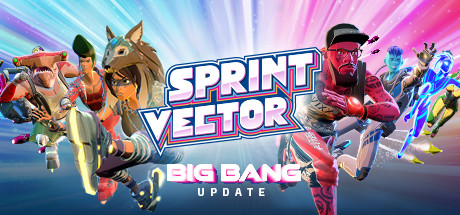
Welcome to Sprint Vector Championship Intergalactica, where the physical thrill of extreme sports meets the unhinged energy of a zany game show! Run, jump, climb, drift, and fly at extreme velocity as you race up to 8 players and battle obstacles in this frenetic VR adrenaline platformer!
Modeled estimate, not a reported figure. How we estimate →
About


Stats
All-time low is the lowest price we've recorded for this game since we started tracking it.
Languages: English**languages with full audio support
Engagement
Hours played at review time, across 40 reviews with recorded playtime.
Reviews
Themes across 40 recent reviews and how positive each mention is. A keyword signal, not full sentiment analysis.
positive critical· bar length = how often the theme comes up
Reviews
It's amazing game, if you see this on sale like I did and you're not sure, it's still great in 2025, works with my Q3 with virtual desktop and do yourself a favor, do like me and also get it for a few of your friends, fun times to be had for sure. https://store.steampowered.com/app/590690/Sprint_Vector/#
실제로 움직이는게 아닌데 화면은 뛰어가니 저한테는 어지럽네요
Sprint Vector is a VR game that looked at the concept of fun and said actually what if nausea instead. Survios built a racing game where you pump your arms to run at speeds the human vestibular system was simply not designed to process and then had the audacity to ship it as entertainment. The physical exertion is real, the sweat is real, and the complete disconnection between what your arms are doing and what your eyes are seeing is the kind of sensory betrayal that your inner ear does not forgive quickly or quietly. To be fair to Survios the locomotion system is technically impressive. Arm pumping as a movement solution for VR is a genuine attempt to solve the comfort problem through physicality rather than teleportation, and in theory getting your body involved should help. In practice your brain looks at the speed differential between your actual stationary body and your virtual body screaming around a track and files an immediate complaint with whoever is in charge. The workout is legitimate at least. If you wanted cardio and happened to also want to feel vaguely ill while getting it, Sprint Vector was ahead of its time in that very specific niche. Beat Saber makes you sweat without trying to kill you. Superhot VR makes you sweat without moving faster than your eyes can track. Sprint Vector makes you sweat and then charges you for the privilege of lying down afterward. Hard pass. The headset deserves better games and so do your legs.
this ♥♥♥♥ is insanely fun but really hard to master, and you'll spend your first 5-15 minutes in un-skippable cutscenes dialogues so grab a seat. After that, the 15 or so minutes I played resulted in my arms feeling weaker than the first week after i discovered how to wank as a teen.
Motion Sickness Activator...
не подходит для Valve index
наиграно 51 минута: прошёл три обучалки и не выйграл ботов ни разу этот обзор будет обновляться
Sprint Vector is a bold and physically demanding VR racing experience that fully commits to the idea that movement itself should be the core mechanic. Developed and published by Survios, the game rejects conventional controller-based locomotion in favor of a system that turns your own arm motions into speed, momentum, and control. Rather than simply simulating racing, Sprint Vector asks players to perform it, blending arcade competition, platforming, and extreme sports energy into something that feels uniquely suited to virtual reality. At its core, Sprint Vector is built around a proprietary locomotion system that transforms arm-swinging into forward movement. Players physically pump their arms to sprint, steer, and drift, creating a sense of speed that is far more visceral than traditional thumbstick movement. Jumping, climbing, wall-running, and gliding are all layered into this system, requiring coordination and spatial awareness as much as raw endurance. Once mastered, the controls feel fluid and empowering, allowing players to chain movements together in a way that feels more like parkour racing than traditional track-based competition. The game’s setting leans heavily into exaggerated sci-fi spectacle. Framed as an intergalactic racing championship, Sprint Vector surrounds its races with colorful characters, over-the-top announcers, and tracks that feel ripped from a futuristic game show. Courses twist through alien ruins, industrial complexes, and surreal floating arenas, each packed with environmental hazards, alternate routes, and high-risk shortcuts. Learning these tracks becomes just as important as physical execution, as the fastest paths often demand precise timing and confident movement. Racing itself is chaotic and kinetic. Power-ups scattered across the tracks add a light combat element, allowing players to disrupt opponents or gain brief advantages, but they never overshadow the importance of movement skill. Victory is determined less by luck and more by mastery—knowing when to sprint hard, when to conserve energy, and how to smoothly transition between climbing, jumping, and gliding without losing momentum. The game rewards players who can maintain rhythm and flow under pressure, turning each race into a physical and mental challenge. Sprint Vector offers both solo and multiplayer content, with online races supporting multiple competitors at once. Multiplayer is where the game’s intensity truly shines, as racing against real players amplifies the sense of urgency and competition. Cutting someone off on a tight corner or overtaking an opponent with a perfectly executed glide feels exhilarating in a way that few VR games manage to replicate. That said, the reliance on online play also means the experience is strongest when the player base is active, and quieter periods can make finding full races more difficult. Visually, the game adopts a stylized, high-contrast aesthetic that prioritizes clarity and performance over realism. Bright colors, exaggerated geometry, and clear visual cues ensure that players can read the environment even at high speeds. This design choice works well in VR, where motion and clarity are critical to comfort and immersion. Sound design further reinforces the adrenaline-fueled tone, with energetic music and enthusiastic commentary pushing players to stay engaged and keep moving. The physical nature of Sprint Vector is both its greatest strength and its biggest barrier. Extended play sessions can be genuinely exhausting, turning the game into an unintended workout. For some players, this is a major selling point, making the game feel active and immersive. For others, fatigue can set in quickly, especially during longer multiplayer sessions. The learning curve can also be steep, as mastering the locomotion system takes time and practice, and initial attempts may feel awkward or overwhelming. Comfort is another consideration. While many players find the arm-driven movement surprisingly comfortable compared to stick-based locomotion, the speed and intensity can still be challenging for those sensitive to motion in VR. Sprint Vector is clearly aimed at players who are already comfortable with VR and willing to adapt to physically demanding control schemes. Community reception reflects this polarized appeal. Many players praise the game for its originality, depth, and sheer energy, viewing it as one of the few VR titles that genuinely feels impossible outside the medium. Others acknowledge its creativity but note that its physical demands and shrinking multiplayer population limit its long-term accessibility. Even so, it is often remembered fondly as a standout example of VR design that fully embraced the platform’s strengths rather than working around its limitations. Ultimately, Sprint Vector is not a casual racing game and does not try to be one. It is an aggressive, movement-driven experience that rewards commitment, practice, and physical effort. For players looking for a VR title that feels fast, competitive, and uniquely embodied—where winning means mastering both the game and your own coordination—it remains one of the most distinctive racing experiences available on the platform. Rating: 8/10
its really a shame i bought it, it gives me insane headaches and sometimes the movement just doesnt wanna work at all
Strains your joints and muscles at the point where you are down and having to do a 180 at high speed. Levels are a ♥♥♥♥♥♥♥♥♥♥♥ preventing gaining momentum.
Related
Related
Trends
Modeled estimate over time, reconstructed from Steam's monthly review histogram.
Momentum
Pace estimated from the game's recent review growth (our daily snapshots) at its own sales-per-review ratio — a momentum signal, not booked sales.
Audience
Estimated from the language of this game's reviews — a proxy for where players are, not official Steam demographics.
Related
| 武林志2 (Wushu Chronicles 2) | $472.3K | 794 | 41% | $19.99 |
| Super Fancy Pants Adventure | $472.5K | 2.2K | 93% | $9.99 |
| Approaching Infinity | $471.9K | 734 | 95% | $17.99 |
| Ascension: Deckbuilding Game | $472.9K | 1.7K | 89% | $9.99 |
| PHOGS! | $471.6K | 1.4K | 79% | $24.99 |
| Iron Meat | $473.2K | 1.1K | 97% | $19.99 |
Related
| Assetto Corsa | $88.7M | 172.3K | 93% | $19.99 |
| Wreckfest | $34M | 41.1K | 88% | $29.99 |
| Automobilista 2 | $14.4M | 15.7K | 92% | $39.99 |
| SpeedRunners | $12.4M | 37.1K | 94% | $14.99 |
| s&box | $7.4M | 9K | 59% | $19.99 |
| Aerofly FS 4 Flight Simulator | $2.9M | 1.3K | 89% | $59.99 |