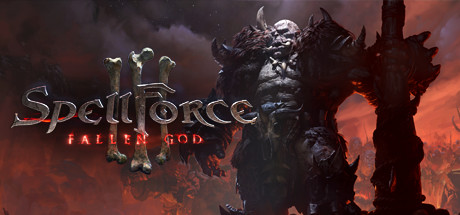
SpellForce 3: Fallen God is one of the most refreshing fantasy strategy experiences released in recent years because it approaches the genre from a completely different perspective. Instead of focusing on heroic kingdoms, noble warriors, or large empires fighting for dominance, the game centers on a desperate troll tribe struggling to survive in a world that views them as monsters. Developed by Grimlore Games and published by THQ Nordic, this standalone expansion pushes the SpellForce formula further than ever by combining emotional storytelling, deep role-playing systems, and large-scale real-time strategy mechanics into a surprisingly cohesive adventure. More importantly, it succeeds in giving the series its own identity rather than simply imitating older fantasy strategy games.
The campaign follows Akrog, a young troll chieftain trying to lead the Moonkin tribe through a period of collapse and suffering. Disease spreads among his people, hunters slaughter trolls for profit, and starvation slowly weakens what remains of the tribe. From the beginning, the story establishes a much more personal and tragic tone compared to previous SpellForce entries. Akrog is not portrayed as a legendary hero destined for greatness but as an uncertain leader forced to carry impossible responsibilities while watching his people disappear around him. His journey across the continent of Urgath in search of a way to restore hope becomes the emotional core of the entire game.
What makes the narrative especially compelling is how much effort is invested into developing troll society and culture. The trolls are not reduced to savage fantasy stereotypes. Instead, they are depicted as spiritual, emotional, and deeply connected to ancient traditions that are slowly vanishing under pressure from stronger civilizations. Their rituals, beliefs, and relationships create a sense that this is a living culture fighting against extinction. The game explores themes involving survival, identity, prejudice, and sacrifice in ways rarely seen within fantasy strategy titles. Many story moments carry genuine emotional weight because the player understands what is truly at stake for the Moonkin tribe.
The worldbuilding throughout the campaign is excellent. Urgath feels ancient and dangerous, filled with forgotten ruins, tribal settlements, hidden caves, sacred locations, and hostile territories shaped by centuries of conflict. Exploration plays a major role in maintaining immersion because nearly every map contains optional quests, secrets, crafting materials, and lore that expand upon the history of the world. Rather than simply serving as filler between battles, side content often deepens the narrative or reveals additional details about the trolls and the societies surrounding them. This attention to environmental storytelling helps the world feel alive and believable.
The role-playing systems are among the strongest in the series. Character progression offers significant flexibility through multiple skill trees and combat disciplines that allow players to create highly specialized builds. Troll characters can focus on brute-force melee combat, primal magic, support abilities, ranged attacks, elemental powers, or hybrid combinations that mix several disciplines together. The synergy between skills encourages experimentation because different combinations can drastically change how battles unfold. Unlocking new abilities consistently feels rewarding, especially during tougher encounters where tactical decision-making becomes essential.
Combat during exploration sections balances accessibility with strategy. Positioning, ability timing, healing management, and crowd control all matter during larger fights, particularly against stronger enemies and bosses. Troll combat abilities feel appropriately heavy and aggressive, giving encounters a brutal physical intensity that separates Fallen God from more traditional fantasy RPGs. Companion characters also contribute strongly to the gameplay because each possesses unique abilities and personalities that influence both combat and story interactions.
The RTS component remains one of the defining features of the SpellForce series, and Fallen God arguably presents the most refined version of it. The game transitions naturally between RPG exploration and massive strategic battles involving armies, territory control, and resource management. Instead of feeling disconnected, both gameplay styles support one another remarkably well. Players may spend one moment exploring ancient ruins with a small party and the next defending settlements from large enemy invasions or launching assaults against fortified positions.
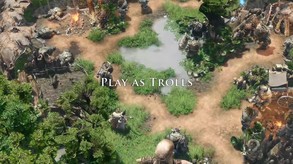
The troll faction itself is one of the most creative additions the series has introduced. Their economy and construction systems differ significantly from previous factions, emphasizing organic growth and tribal survival rather than traditional city building. Structures appear more alive and primitive, perfectly matching the faction’s identity. Troll armies focus heavily on resilience, raw strength, and overwhelming aggression, making them feel mechanically distinct from humans, dwarves, or dark elves. The developers clearly designed the faction with enormous care, ensuring that every unit and mechanic reinforces the tribal atmosphere of the campaign.
Large-scale battles are consistently impressive. The sector-based economy system introduced in earlier SpellForce 3 expansions returns with further refinements, reducing unnecessary micromanagement while still maintaining strategic depth. Expanding territory remains vital because sectors directly influence military strength, resource production, and defensive capabilities. Battles become increasingly intense as armies grow larger, siege creatures enter combat, and magical attacks begin dominating the battlefield. Despite the scale, the game usually remains readable enough to preserve tactical control.
Visually, Fallen God delivers some of the strongest environmental design in the franchise. Forests, ruins, mountains, and tribal settlements are richly detailed and atmospheric, creating a world that feels dangerous yet beautiful. Lighting effects and spell animations enhance the cinematic feeling of combat, especially during nighttime battles or large sieges illuminated by fire and magic. While character animations occasionally lack the refinement of larger-budget RPGs, the overall art direction remains highly effective and memorable.
The soundtrack deserves considerable praise for how well it supports the emotional tone of the story. Tribal-inspired music blends with orchestral themes to create an atmosphere filled with melancholy, mystery, and determination. Voice acting is also consistently strong, helping the trolls feel emotionally authentic rather than exaggerated fantasy caricatures. Conversations involving grief, loyalty, and sacrifice are delivered with enough sincerity to make several scenes surprisingly impactful.
SpellForce 3: Fallen God succeeds because it delivers something genuinely uncommon within modern fantasy games. It combines emotional storytelling, meaningful RPG progression, strategic warfare, and creative worldbuilding into one unified adventure while giving players a perspective rarely explored in the genre. By focusing on the trolls and their desperate struggle for survival, the game creates a memorable atmosphere that separates it from more conventional fantasy epics.
Rating: 8/10