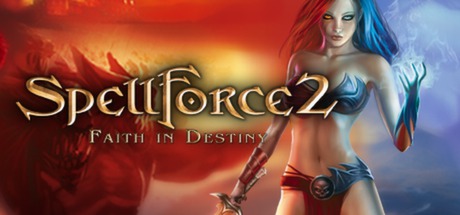
SpellForce 2: Faith in Destiny attempts to continue the ambitious blend of fantasy role-playing and real-time strategy that made the earlier SpellForce games stand out, and despite its flaws, it still delivers an experience that feels unique within the genre. Set in the war-torn world of Eo, the game builds its identity around large-scale conflict, ancient prophecies, dragon lore, and the struggle against an overwhelming enemy force threatening the remnants of civilization. It is a game filled with ambition, combining personal hero progression with battlefield command in a way that very few fantasy titles even attempt.
The story takes place after the devastating events of previous SpellForce entries, with the magical portal network known as the Portal System now destroyed. Entire nations and races have become isolated, trade and communication have collapsed, and chaos spreads across the world. Into this unstable situation emerges the threat of the Nameless, a mysterious and destructive force capable of consuming entire regions. Players step into the role of a Shaikan warrior tied to ancient dragon bloodlines, and the campaign quickly transforms from a local conflict into a desperate fight for survival against extinction itself.
One of the game’s strongest qualities is the atmosphere created by its worldbuilding. Eo feels broken and vulnerable, which gives the adventure a darker tone than many traditional fantasy RPGs. Cities are struggling to survive, alliances are fragile, and ancient powers long believed dormant begin to awaken again. The narrative may rely heavily on classic fantasy themes, but the sense of scale helps keep the campaign engaging. There is always the impression that every battle matters because civilization itself is slowly collapsing under the weight of war and supernatural catastrophe.
Faith in Destiny continues the series tradition of merging two very different gameplay styles into one cohesive system. During exploration and story sequences, the game functions much like a traditional RPG. Players travel through towns, forests, ruins, and dungeons while controlling a party of heroes. Quests, dialogue, loot collection, and skill customization all play major roles. Characters can specialize in different combat styles ranging from melee combat and archery to elemental magic and support abilities, allowing players to build heroes according to their preferred playstyle.
Character progression remains satisfying throughout the campaign because new abilities and equipment consistently make heroes feel more powerful. Weapons and armor upgrades have a noticeable impact during combat, and experimenting with different combinations of spells and skills gives the gameplay variety over the course of the lengthy adventure. The RPG systems may not be as deep as those found in hardcore role-playing games, but they are strong enough to create a meaningful sense of growth and investment.
Once larger battles begin, the game shifts toward its real-time strategy mechanics. Players gather resources, build structures, recruit armies, and lead troops into battle across expansive maps filled with enemy forces and strategic objectives. The RTS side of the game focuses more on accessibility than extreme complexity, which works well within the hybrid structure. Hero characters remain central to combat, often acting as powerful units capable of influencing entire battles through devastating abilities and tactical positioning.
One of the more memorable additions in Faith in Destiny is the increased emphasis on dragons. Flying across the battlefield and participating in combat while mounted on dragons helps reinforce the epic scale of the story. These moments add spectacle to the gameplay and strengthen the connection between the player character and the ancient forces shaping the world. It also gives the game a distinct identity compared to other fantasy strategy titles that rely solely on traditional armies and magic systems.
The campaign benefits from strong mission variety. Some scenarios focus on exploration and story progression, while others emphasize defense, large-scale assaults, dungeon crawling, or survival against overwhelming enemy numbers. This constant change in pacing helps the game avoid becoming repetitive despite its considerable length. Optional side quests and hidden rewards also encourage exploration, rewarding players who spend time engaging with the world beyond the main objectives.
Visually, the game clearly shows its age, but the fantasy art direction still manages to create an appealing atmosphere. Landscapes filled with ruined castles, icy mountains, dark forests, magical towers, and corrupted wastelands all contribute to the feeling of a world caught in endless war. Spell effects and large-scale battles occasionally look impressive even by modern standards, especially when dragons and magical armies clash in chaotic encounters. While character models and animations are dated, the environmental design still carries enough charm to keep the world immersive.
The soundtrack is another highlight. Orchestral music gives battles a grand and heroic tone, while quieter ambient tracks support exploration and emotional story moments effectively. Combined with solid voice acting, the music helps maintain immersion throughout the campaign. Even during slower sections, the audio design consistently reinforces the game’s fantasy atmosphere and sense of scale.
Unfortunately, Faith in Destiny also struggles with technical and design issues that prevent it from fully matching the quality of earlier SpellForce titles. Pathfinding problems during large battles can become frustrating, particularly when units fail to navigate terrain properly or become stuck during crowded encounters. The interface also feels outdated, making inventory management and army control more cumbersome than they should be. Some balancing problems and awkward animations further contribute to the feeling that the game lacked final polish.
Pacing is another issue in certain sections of the campaign. Some missions become overly drawn out, especially during RTS-heavy battles where combat drags on longer than necessary. Players who prefer fast-paced action RPGs may struggle with the slower and more methodical structure. At times, the game’s ambition works against it, as combining two genres this extensively occasionally leads to systems that feel less refined than they would in a more focused experience.
Even with these flaws, SpellForce 2: Faith in Destiny remains compelling because of how different it feels from most fantasy games. Very few titles attempt to merge role-playing progression, strategic warfare, dragon combat, and large-scale storytelling into a single package. The result may not be perfect, but it is undeniably memorable. The game succeeds in creating the sensation of leading both legendary heroes and entire armies through a world slowly falling apart under the pressure of war and supernatural destruction.
For fans of fantasy strategy RPGs, Faith in Destiny still offers a rewarding experience filled with exploration, character building, epic battles, and rich fantasy lore. While technical shortcomings and uneven pacing hold it back from reaching the heights of the best entries in the series, the game’s atmosphere, scale, and unique gameplay structure continue to make it worth experiencing for players who appreciate ambitious genre hybrids.
Rating: 6/10