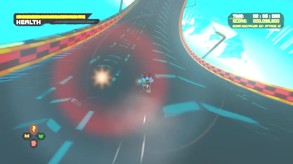
Fast paced 3D action platformer.
Modeled estimate, not a reported figure. How we estimate →
Media

About
Genres
Stats
All-time low is the lowest price we've recorded for this game since we started tracking it.
Languages: English
Engagement
Reviews
Themes across 40 recent reviews and how positive each mention is. A keyword signal, not full sentiment analysis.
Reviews
While i didnt hate this game as much as others did. I can see why this is the weakest of the Spark the Electric Jester trilogy. And no i dont mean because Sparks is not the main character of this game. Its a 1st attempt at a 3d game and it shows. Most enemies are a non issue because you can pretty much jump over them. And sadly bosses arent much better. Each boss follows the same pattern pretty much. Wait for the boss to start their attack,parry and then wail on them. Even the final boss falls victim to this. You'll mostly like to die to due to losing speed on loops or going too fast on them and falling to your death. There are some things i like about it. The soundtrack is remarkable. Even when i died a lot to falling. I still kept going because the music was that good. Especially the songs for bosses. I like that Fark has a double jump by default. And when you achieve high speed its very exhilarating! That being said i cant really recommend it. At least not at full price. If you still plan to play this game wait for a huge price drop. I got this on the spring sale for 6.50 . And its still too much. Maybe 3 bucks is the lowest i go. At the very least check out the soundtrack.
Idk its ok I guess. I never played Sonic Adventure which is apparently what this game is like. The transition of this game to 3D compared to game 1 comes with some hiccups. The camera is a nightmare, jerking all around throughout the level. Also the platforming can be a bit floaty with a strange sense of momentum, as well as intermittently inputs being eaten. A lot of the game plays itself it feels as you just run around paths while bumps shoot you along. Theres tons of enemies but its truly pointless to fight them so you just run past them. Theres bits which act as currency but you never will use them for a single thing so theyre pointless too. The story was a bunch of blah blah blah, couldn't care less and didn't find it interesting at all. Boss fights are mostly just stand in front of the guy and spam light attack and press block at the right time, rinse and repeat. Sometimes during boss fights it can be hard to tell whats going on with all the flashing lights etc. It's also quite short. But overall its still not bad, just mediocre. 7/10.
Related
Related
Trends
Modeled estimate over time, reconstructed from Steam's monthly review histogram.
Hours played at review time, across 40 reviews with recorded playtime.
positive critical· bar length = how often the theme comes up
Honestly a rough playthrough, game is a short one even though that doesn't present as a main problem for me. This game lost a ton of its soul in the transition to 3D, I gave it a lot of leeway to impress me but it failed to do so throughout the course of the entire game, the stages were good but by the time you got to actually get to some hard ones the game felt the need to throw another boss in your face. I never really understood the need that 3D speed platforming game developers have to put some sort of combat in a game style that (in my opinion) clearly wasn't designed for it. The platforming is good enough to the point where we could've done with 4-5 extra stages, more modes to go through them such as time trials and so on and the bosses could've just been cutscenes or reworked to play more like Sonic 3D games where they play more like platforming challenges. Nevertheless it's a decent game that I cannot give a thumbs down, especially considering that the third, from what I hear, is much better. Hopeful for the next one!
A remarkable first attempt at transitioning to 3d platforming and combat. The levels are all really interesting and well paced, remaining brisk yet not too vapid. This game is very replayable due to the length being *just* right in regards to doing a quick run in one session (much more than the 1st or 3rd game). Each Jester power offers fun variances on platforming and combat, though I wish their specific differences were better explained in-game. Some people argue that Fark is too difficult to control in this game, which I understand but don't personally feel. I appreciate how loose he feels, giving lots of room for player expression. Spark 3 has a weightier feel that is fantastic, but I don't think it means this game handles bad itself. There are many shortcuts in this game that come through becoming intimately familiar with the base mechanics and jester powers that are very satisfying. The ability to parry while moving adds such a fun element of risk and reward to navigating the levels and fights, though some people may argue it invalidates the hazards. I recommend playing on the hardest difficulty, as it adds tremendous risk to this style of play. The story, while weird, was very entertaining and concluded with a cinematic finale. The presentation is pretty competent for what it is, but the look and feel is really solidified in the third game. Despite Spark 3 having the levels of this game as an addition, I still think this version is worth playing due to its differing mechanics, boss fights and cutscenes. While it may not be the best Spark game, it may be the one I am most likely to keep returning to.
Quite a change for the Spark the Electric Jester series. I feel this second game was heavily inspired by Sonic Adventure, even down to the jank. It has very similar speed physics that don’t play well with loops and tilts. Which become more present later in the game. So much so that I quickly got tired of the mechanic. However, you can recover more easily from these falls than in Sonic Adventure. I was later informed that an option in the settings menu existed that would help fix this. Turning Smoothness, which is on by default. Switching this option off improved all the issues controlling the character. You just need to know it’s there. That's not all, though. Combat takes a huge step down from the original. You are given a shield that allows you to parry. This parry is all you need in combat. Simply go for the parry and slap the attack button. It becomes bland really fast when every boss feels like a joke. The story is also just ok? Honestly, just go read the wiki or something. While short, I don’t think this game is worth the time.
unfortunally, I can recommend this game only for progress reasons - if you already played Spark 1 and wanna know how the story leads up to Spark 3 or wanna see the evolution from this to Spark 3, but other than that, Spark 2 is kinda there. It's not a bad game but it's not that great either, it certinally feels (which it is) a first attempt at making a 3D game although I gotta say that the way Spark 1's 2D gameplay was translated into 3D in this game was very poor, at least Spark 3 is the one that exposed all the cracks in this game. First off, the combat was babyfied - while in Spark 1 the combat felt actually challenging in this game, the combat was reduced in just "button smash". The bosses gets defeated so quickly because all you have to do is to smash the attack button and parry when any attack is coming, and that's it, there's barely even a challenge except for the final boss, thus making the game less replayable than the other two Spark games. The level design feels too linear, it might not seem at first but after I finished with Spark 3 I realized how in depth the stages were compared to Spark 2, which, would you look at that, I wasn't hallucinating. Also, you can replay the Spark 2 stages in Spark 3 after you beat the game, and while Spark 3 makes Spark 2's stages better, they're still inferior compared to Spark 3's base game stages. And lastly, the biggest sin of this game is the tons of underutilized characters, some of them got their time to shine in Spark 3 but Romalo, Astra and E.J were totally wasted characters. E.J's entire character was "the rude rival" which got obliterated in his boss fight and never seen again after that. Romalo actually had a purpose to exist in Spark 1, but now he's completely useless, Astra is his best friend but that doesn't add anything to his character since Astra's character is as deep as E.J's - she shows up for two cutscenes, then you fight her and Romalo near the end of the game and that's it, they're gone! Astra makes an appearance in Spark 3 but only in the Clarity backstory cutscene, other than that, Astra and Romalo are totally wasted characters. TL;DR: I recommend Spark 2 only if you're interested to see how the story goes and leads up to Spark 3 or if you wanna see how Feperd improved in making games. I don't think this game is bad, but it's not good either, it's just mid.
Забагованная херня которая доставила фан!
Spark the Electric Jester 2 is a fast-paced 3D action platformer developed and published by Feperd Games that represents a bold evolution of the series, shifting from the 2D speed-running roots of the original game into fully three-dimensional spaces built around momentum, exploration, and expressive movement. Rather than attempting to mimic modern open-world trends, the game draws clear inspiration from classic high-speed platformers, focusing on large, self-contained stages that reward mastery, experimentation, and player creativity. It is a title driven by passion and ambition, aiming to deliver the thrill of speed while still allowing room for combat, discovery, and mechanical depth. This sequel places players in control of Fark, a robotic character whose story unfolds in the aftermath of the first game’s events. While the narrative is present and more pronounced than in its predecessor, it functions primarily as a framing device rather than the core attraction. Themes of identity, purpose, and rebellion run through the story, conveyed through stylized cutscenes and in-game dialogue. The writing is earnest and straightforward, providing context and motivation without interrupting the flow of gameplay. For most players, the story enhances the experience without demanding emotional investment, keeping the focus squarely on movement and level design. Movement is the heart of Spark the Electric Jester 2, and it is where the game truly shines. Levels are expansive and vertical, designed to be tackled in multiple ways depending on how aggressively or methodically you play. Speed pads, rails, slopes, and aerial routes encourage players to maintain momentum, while alternate paths and hidden areas reward curiosity and spatial awareness. Unlike strictly linear platformers, stages here feel more like playgrounds built for velocity, allowing skilled players to chain actions together fluidly while newcomers can still progress at a slower, more deliberate pace. Combat is integrated directly into traversal rather than existing as a separate system. Fark can attack enemies using homing strikes, energy-based abilities, and a shield that allows for parrying incoming attacks. Successful parries build energy that can be unleashed in powerful counterattacks, adding a layer of timing and risk-reward decision-making to encounters. While many enemies can be bypassed entirely by maintaining speed, the game occasionally forces engagement through enemy placement or boss encounters, ensuring that combat remains relevant without overwhelming the platforming focus. Boss battles are a standout feature, often shifting the tempo and demanding a stronger emphasis on combat mechanics and pattern recognition. These encounters test the player’s ability to read attacks, time parries, and capitalize on openings, providing a satisfying contrast to the free-flowing nature of regular stages. While some bosses can feel punishing on first attempts, they generally reward learning and adaptation rather than raw reflexes alone. Level design throughout the game reflects a clear understanding of momentum-based gameplay. Stages are filled with loops, branching routes, and vertical transitions that feel deliberately crafted to support speed and experimentation. Collectibles and optional challenges are placed in ways that naturally guide players to explore without forcing completionist behavior. This design philosophy gives the game strong replay value, as returning to earlier levels with improved skills reveals faster routes and previously inaccessible secrets. Visually, Spark the Electric Jester 2 adopts a colorful, stylized aesthetic that emphasizes readability and motion over realism. Environments are vibrant and varied, ranging from industrial zones to futuristic cityscapes, and the exaggerated character designs complement the game’s energetic tone. While the graphics do not aim for technical realism, they are effective in communicating speed, scale, and danger, which is essential given how quickly players can move through the world. The soundtrack plays a key role in sustaining momentum, delivering high-energy tracks that reinforce the sense of urgency and motion. Music shifts dynamically between exploration and combat-heavy moments, helping maintain engagement during extended play sessions. Sound effects provide clear feedback for movement, attacks, and parries, supporting the game’s mechanical clarity even during chaotic sequences. Despite its strengths, the game is not without flaws. Camera control can occasionally struggle to keep up with rapid movement, especially in tight or vertical sections, which can lead to momentary disorientation. Some combat abilities feel underutilized outside of boss fights, and the learning curve may feel steep for players unfamiliar with momentum-driven platformers. These issues do not fundamentally undermine the experience, but they do highlight the game’s indie nature and ambitious scope. Taken as a whole, Spark the Electric Jester 2 is a confident and energetic 3D platformer that prioritizes speed, freedom, and player expression. It succeeds by embracing classic design philosophies while introducing enough modern mechanics to feel fresh and engaging. While it lacks the polish and budget of larger studio productions, it compensates with strong level design, satisfying movement, and a clear creative vision. For players who enjoy mastering fast platformers, experimenting with routes, and chasing that perfect run, it offers a rewarding and memorable experience that stands out within the indie action-platformer landscape. Rating: 8/10
this game is so much bloody fun, the art and environments are awesome, the music is amazing and hitting parries on stage hazards for speed boosts is like crack to me. it also runs really well on my crappy, aging laptop (runs better than spark 3) which is a major bonus for me!
Disclaimer, a 5/10 for me is a critics 7. 6.8/10 great but so short that i beat it on hard jester within refund time and felt like i just held forward to win a lot(i refunded it and rebought it for the bit tho) (I played 3 first this retreads a lot of positives lol)This game is what 3d sonic shouldve been. Momentum based, no scripted routes, getting hit wont stop u in tracks if ur skilled. rewards quick thinking w/ faster routes. no gimmicks and if there are u can skip em w/ skill. Bridges 1 and 3 perfectly. Sadly, its got 3 big flaws. The sonic sequalitis problem of hold forward to win. (Sonic 2, advance 2, adventure 2) causing it to be shorter than it should. The megaman x7 problem of adding a z axis making the intuitive combat philosophy of fight it or tank it reduntant by walking around(spark 3 fixes it w/ combat walls) But honestly the shortness makes it way more replayable compared to 3 despite 3 having the better overall level philosphy.
Momentum
Pace estimated from the game's recent review growth (our daily snapshots) at its own sales-per-review ratio — a momentum signal, not booked sales.
Audience
Estimated from the language of this game's reviews — a proxy for where players are, not official Steam demographics.
Related
| Starvester | $189.3K | 750 | 70% | $6.99 |
| Cargo! The Quest for Gravity | $189.4K | 450 | 81% | $9.99 |
| Shadowgate | $189.4K | 709 | 87% | $14.99 |
| The Solitaire Conspiracy | $189.3K | 769 | 89% | $11.99 |
| Churn Vector | $189.3K | 583 | 91% | $14.99 |
| Logiart Grimoire | $189.4K | 375 | 95% | $19.99 |