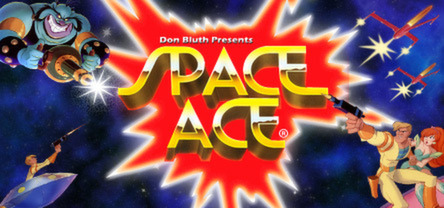
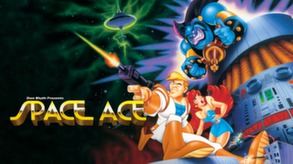
Space Ace, developed and published by Digital Leisure Inc., stands as both a game and a preserved artifact of an era when arcade innovation sought to blur the lines between animation and interactivity. Originally released in 1984 as a LaserDisc arcade title, Space Ace was conceived by Don Bluth and his team, the same visionary animators behind Dragon’s Lair. The game represented one of the earliest and most ambitious attempts to merge the hand-drawn artistry of cinema with the excitement of video gaming. The Steam version by Digital Leisure maintains this legacy by offering a faithful recreation of the original experience, allowing modern players to witness the beauty and challenge of one of the most visually stunning yet mechanically unconventional games of its time. While its core remains unchanged, it continues to fascinate as a window into a period when imagination often exceeded technological limitation.
The premise of Space Ace is unapologetically pulpy and perfectly suited for its animated presentation. You play as Ace, a bold hero who has been de-aged into a teenage version of himself, known as Dexter, by a villainous alien called Commander Borf. Borf’s evil plan to subjugate humanity using his “Infanto-Ray” is as cartoonish as it sounds, and it’s up to Ace to fight back, rescue his girlfriend Kimberly, and restore his heroic form. The story unfolds entirely through gorgeously animated sequences, each filled with exaggerated expressions, slapstick humor, and thrilling set pieces that could have been pulled straight from an animated sci-fi adventure film. The tone is campy and self-aware, embracing the tropes of 1980s space opera with unrestrained enthusiasm. There’s no subtlety to be found here, but that’s precisely what gives the game its charm—it’s a lighthearted and vividly drawn adventure that feels like stepping into a Saturday morning cartoon.
What makes Space Ace so remarkable, even decades later, is its animation. The hand-drawn work of Don Bluth’s studio remains breathtaking, capturing a level of fluidity and detail that was far ahead of its contemporaries. The use of LaserDisc technology allowed developers to stream full-motion animation instead of relying on sprites or polygons, creating an experience that looked more like an animated film than a game. Every movement, explosion, and comedic stumble is rendered with expressive artistry, and even now, the vibrancy of the colors and the energy of the action sequences hold up remarkably well. The Steam version preserves this visual splendor in high definition, ensuring that players can appreciate the richness of the art without the graininess or mechanical inconsistencies of aging hardware. Watching Ace transform between his younger and adult forms mid-action or seeing the dramatic flourishes of each scene unfold is a reminder of how ambitious and creative early gaming could be when driven by artistry rather than technical power.
However, while the visuals remain captivating, the gameplay reveals the limitations of its time. Space Ace, much like Dragon’s Lair, is structured entirely around quick-time inputs that must be performed with near-perfect timing. Each scene presents a brief window in which the player must press a direction or action key to survive and progress. Success moves the story forward, while failure results in an elaborate death sequence and the chance to try again. This design made sense in 1984, when arcade cabinets were designed to eat quarters, but in a modern context, it can feel punishingly rigid. There is no true freedom of movement or exploration; the game operates more like a test of memorization and reflexes than an interactive adventure. Players who expect to control Ace in real time or make meaningful decisions will quickly realize that their input is limited to repeating precise sequences until they master them. Yet for those willing to accept its structure, there’s a hypnotic rhythm to the gameplay—a cinematic flow that rewards persistence and sharp focus.
Part of what keeps Space Ace engaging, even with its mechanical simplicity, is its energy and personality. The pacing is relentless, propelling players from one perilous scenario to another with barely a pause. Each sequence feels like an episode of an ongoing cartoon serial, complete with exaggerated villains, improbable physics, and a dash of humor. The soundtrack enhances this tone perfectly, combining orchestral swells and quirky effects to match the mood of every scene. The exaggerated sound design, from Ace’s confident exclamations to Borf’s booming threats, adds to the sense of spectacle. It’s a game that thrives on momentum—each mistake is met with a theatrical death, each success greeted with a triumphant surge of animation that propels you into the next challenge.
The Digital Leisure version preserves the original’s authenticity while adding the convenience of modern accessibility. The inclusion of multiple difficulty settings allows players to choose between shorter, more forgiving runs or the full-length arcade experience complete with alternate scenes and harder timing windows. It also includes the option to toggle visual indicators for directional inputs, making it easier to learn the game’s demanding sequences. These features demonstrate respect for both purists seeking the original challenge and newcomers who simply want to experience the game’s artistry without excessive frustration. The port runs smoothly, and the video quality is crisp, giving the animation a vibrancy it lacked in earlier home versions. However, beyond these visual and structural improvements, the core experience remains the same—an interactive animated film that prizes timing over strategy.
Yet for all its nostalgic appeal, Space Ace’s gameplay can feel archaic to modern audiences. The lack of agency, the unforgiving timing, and the repetitive trial-and-error loop stand in stark contrast to contemporary design sensibilities. There’s an unavoidable tension between its cinematic presentation and limited interactivity; the player is both participant and spectator, occasionally pressing buttons to keep the story moving. For players who appreciate historical context, this limitation is part of its charm—it represents an experimental period when developers were still exploring what games could be. But for those looking for a sense of depth or replayability, Space Ace is unlikely to provide it. Once you’ve completed the game or watched the sequences unfold, there’s little reason to return aside from appreciating the artistry or attempting higher difficulty runs.
Despite its mechanical simplicity, Space Ace remains an important cultural artifact and an enduring testament to Don Bluth’s artistry. Its campy humor, exaggerated animation, and pulpy sci-fi narrative give it a distinct personality that still entertains, provided you approach it with the right expectations. It’s less a traditional game and more an interactive time capsule—one that showcases the creative ambition of an era when technology and art were pushing each other toward new possibilities. The Steam version, through its faithful restoration, allows both nostalgic players and newcomers to experience that innovation firsthand, even if its structure feels frozen in time. Space Ace may not satisfy those seeking depth or freedom, but as a historical experience and a piece of interactive animation, it remains a vivid and joyful reminder of how audacious and inventive early video games could be.
Rating: 8/10