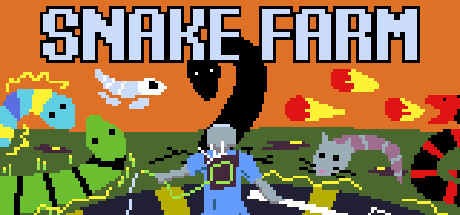
SNAKE FARM is a peculiar and inventive indie roguelike action game created and published by Heather Flowers, a developer known for crafting experimental and mechanically distinctive small-scale titles. At first glance the game resembles the growing wave of minimalist survival shooters that emerged after the success of Vampire Survivors, but it quickly reveals its own strange personality through a bizarre premise and a clever gameplay twist. Players take on the role of a desperate farmer living on borrowed time, tasked with harvesting value from dangerous snakes over the course of ten in-game days. The goal is simple in theory yet chaotic in practice: raise snakes, fight them, extract resources from them, and continually reinvest those resources to summon even more powerful snakes in pursuit of a higher score. The game’s world runs on an absurd economic loop where oil, teeth, and other snake by-products become the currency of survival, and every run becomes a story about greed, risk, and the inevitable consequences of pushing too far.
What immediately distinguishes SNAKE FARM from many other roguelike shooters is the unusual way enemies are introduced. Instead of waves spawning automatically, the player is responsible for purchasing the snakes that appear on the farm. Each snake type comes with its own cost, behavior, and reward value, meaning the player is constantly balancing potential profit against danger. Weak snakes might be easy to handle but offer minimal returns, while stronger varieties promise larger rewards at the risk of overwhelming the player if too many are released at once. This system transforms the entire gameplay loop into a deliberate gamble, where players are essentially engineering their own disaster in the hopes of maximizing their score. It adds a layer of strategic tension that many similar arcade shooters lack, because every challenge on the screen is ultimately a consequence of the player’s own decisions.
The moment-to-moment gameplay unfolds in a top-down arena where movement, positioning, and quick reflexes are essential. The player navigates the farm while attacking waves of writhing enemies using a variety of farming tools and improvised weapons. These tools range from simple melee instruments to ranged attacks that can pierce, ignite, or otherwise manipulate groups of snakes. The action can quickly escalate into a frantic dance of dodging and counterattacking as enemies swarm from multiple directions. Because the player is responsible for summoning them, the chaos has a unique flavor; every overwhelming situation is a direct result of earlier choices. The combat feels intentionally straightforward but responsive, allowing players to focus on maneuvering through increasingly dense clusters of enemies while making split-second decisions about when to spawn the next set of snakes.
A large portion of the game’s appeal lies in its upgrade system and the variety of items that can dramatically alter a run. As players defeat snakes and harvest their valuable resources, they gain access to equipment that modifies the behavior of weapons, increases survivability, or introduces entirely new mechanics. Some upgrades emphasize raw damage output, allowing players to carve through large crowds with ease, while others focus on crowd control or utility effects that change how enemies behave. The roguelike structure means that these upgrades appear in different combinations across playthroughs, encouraging experimentation and adaptation. Players might discover synergistic builds that allow them to summon huge numbers of enemies without immediately being overwhelmed, while other attempts may spiral out of control due to poor upgrade choices or excessive ambition.
The structure of each run is built around a ten-day cycle that functions as both a timer and a pacing mechanism. As the days progress, the pressure increases and the temptation to summon stronger snakes grows. Early runs often involve cautious experimentation, but experienced players quickly realize that high scores require bold decisions. The system subtly encourages greed: spawning just a few more powerful enemies might provide the resources needed for a powerful upgrade, but it could also trigger a chain reaction of danger that spirals beyond control. This delicate balance between restraint and ambition is what gives SNAKE FARM its distinctive tension, turning every playthrough into a calculated risk management exercise wrapped in a fast-paced arcade shooter.
Another notable aspect of the game is its distinctive tone. The humor and thematic presentation lean heavily into surreal satire, portraying the act of farming snakes as part of an absurd economic system driven by exploitation and profit. The idea that a farmer’s entire livelihood revolves around extracting value from increasingly deadly creatures creates a darkly comedic metaphor about capitalism and self-destructive ambition. Even the scoring system reinforces this theme, since the ultimate goal is not survival or narrative completion but rather the pursuit of higher numbers and more efficient resource extraction. The game rarely takes itself seriously, but its tongue-in-cheek presentation gives the otherwise simple mechanics a memorable identity.
Visually, SNAKE FARM adopts a minimalist pixel art style that prioritizes readability over elaborate detail. The farm environment is small and contained, but it gradually becomes cluttered with snakes, debris, and environmental effects as each run escalates in intensity. The snakes themselves vary in color and movement patterns, making them easy to distinguish even when the screen fills with activity. This visual simplicity works well with the chaotic gameplay, ensuring that players can still track threats and navigate safely through the battlefield. The sound design complements the action with energetic effects and subtle atmospheric audio that heightens the tension as more enemies appear.
Despite its originality, the game’s limited scope may not appeal to every player. The small arena and repeated structure mean that the experience is fundamentally built around short sessions and replayability rather than narrative progression or exploration. Players looking for a long campaign or evolving environments may find the structure somewhat repetitive after extended play. However, this simplicity is also part of the game’s arcade-like charm. It is designed to be played in bursts, with each run offering a fresh opportunity to experiment with different upgrade combinations and risk strategies.
In the end, SNAKE FARM stands out as a clever and refreshingly unusual entry in the modern roguelike shooter landscape. Its most compelling innovation is the ability for players to control their own difficulty by purchasing enemies, turning every match into a self-designed challenge. Combined with its dark humor, fast-paced action, and replay-driven structure, the game manages to feel both chaotic and thoughtfully designed. While it may be small in scale compared to larger roguelike titles, its creativity and distinctive mechanics give it a strong identity. For players who enjoy experimental indie games and arcade-style roguelikes that reward risk-taking and strategic decision-making, SNAKE FARM delivers a memorable and surprisingly addictive experience that proves even the strangest ideas can produce compelling gameplay.
Rating: 9/10