Brutal next chapter of Amiga's legendary beat'em up 'Franko: The Crazy Revenge' is here. It's time to clean the streets of shit. The iconic game finally gets a sequel it deserves. Are you ready? They are coming!
Modeled estimate, not a reported figure. How we estimate →
Media

About
Stats
All-time low is the lowest price we've recorded for this game since we started tracking it.
Languages: English*, Polish*, German, Spanish - Spain, Simplified Chinese, Portuguese - Brazil*languages with full audio support
Engagement
Hours played at review time, across 40 reviews with recorded playtime.
Reviews
Themes across 40 recent reviews and how positive each mention is. A keyword signal, not full sentiment analysis.
positive critical· bar length = how often the theme comes up
Reviews
BUGS
Miooodzio! Amiga rules!
Das spiel ist ganz in ordnung für zwischendurch mit tollen hintergründe mit trainer das spiel durchzocken fand ich trotzdem besser
Bardzo przyjemny beatup. W miarę wymagający, z rozbudowanym wachlarzem ciosów jak na ten gatunek. Dobrze mi się grało mimo kilku błędów.
Zostałem pozytywnie zaskoczony! Gra bardzo dobra, grywalna, pełna odniesień do dawnego Franko (plus znacznie więcej). Bijatyka 2D w starym, dobrym stylu.
Dla mieszkańców Polski a w szczególności Szczecina pozycja obowiązkowa ! "Bitemap" wyśmienity, nasiąknięty gęstym klimatem naszych ulic :)
Jest klimat FRANKO z Amigi :) Brawo.
Great, brutal game :)
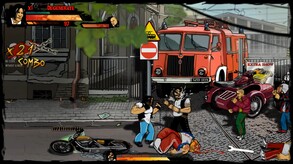
Skinny & Franko: Fists of Violence, developed by Blue Sunset Games and Console Labs S.A. and published by Console Labs S.A., is an unapologetically brash and violent revival of a cult classic from the early days of Polish gaming. It serves as a spiritual sequel to Franko: The Crazy Revenge, a 1990s side-scrolling brawler that became infamous for its raw depiction of street life, crude humor, and over-the-top brutality. Nearly three decades later, this modern continuation aims to recapture that chaotic energy while expanding its world, tightening its combat, and bringing the franchise to a new generation. What emerges is a game that feels both reverential and reckless—a nostalgic throwback wrapped in a modern coat of paint, simultaneously ambitious and rough-edged in execution. Set in the grimy, fictionalized streets of Szczecin, the story once again follows Franko, a hardened street fighter with an iron fist and a short temper. After years of relative peace, he returns home to rescue his friend Skinny, who has been dragged into a new wave of urban violence. The plot is straightforward and deliberately so; this is a game that doesn’t concern itself with narrative depth or subtlety. Instead, it leans fully into its gritty tone and absurd machismo, presenting a world filled with thugs, corrupt officials, and chaotic energy that echoes both 1990s action films and the rebellious spirit of its predecessor. The dialogue is crude, the humor dark, and the violence exaggerated—intentional design choices that reinforce its identity as an unfiltered street brawler rather than a polished, cinematic experience. The gameplay follows the traditional beat ’em up formula that defined the genre’s arcade roots. Players move from left to right through hand-drawn stages, pummeling enemies with a mix of punches, kicks, weapon attacks, and environmental interactions. The game boasts a wide arsenal of over fifty weapons—ranging from knives and bats to chairs and chains—each adding a sense of chaos and unpredictability to combat. There’s also a combo meter and special attack system that rewards aggressive play, encouraging players to experiment with different attacks and timing. On paper, this system offers impressive variety, but in practice, it can feel inconsistent. The combat often oscillates between satisfying bursts of fluid movement and clunky, uneven brawls where enemy hit detection and reaction timing falter. Some encounters feel dynamic and well-paced, while others descend into button-mashing frustration as enemies interrupt combos or crowd the screen without clear telegraphing. Visually, Skinny & Franko: Fists of Violence is striking in its commitment to hand-drawn animation. Every movement, from punches to knockdowns, has been illustrated frame by frame, giving the game a unique visual personality that sets it apart from more sterile digital art styles. The environments are gritty and densely detailed, capturing the essence of crumbling urban decay with graffiti-covered walls, cracked pavement, and dimly lit alleyways. There’s a deliberate roughness to the art direction that mirrors the game’s tone—imperfect but alive, full of texture and personality. The aesthetic sits somewhere between comic book exaggeration and realistic grime, which gives the game a distinct sense of identity even when its mechanics stumble. The soundtrack complements this raw atmosphere with heavy beats, distorted guitars, and rhythmic percussion that fuel the adrenaline of street combat. Every punch, crash, and explosion lands with weight, and though the voice acting sometimes veers into awkward territory, it fits the game’s irreverent, underground attitude. One of the more polarizing aspects of Skinny & Franko is its pacing. Levels are long, often stretching beyond thirty minutes, and the absence of frequent checkpoints means that failure can be punishing. Dying late in a stage often sends you all the way back to the beginning, forcing a full replay of what might already have felt like an exhausting brawl. While this structure may appeal to old-school players who thrive on endurance and memorization, it can test the patience of modern audiences accustomed to tighter pacing and more forgiving design. The difficulty curve is equally uneven, with sudden spikes that seem to rely more on overwhelming numbers than on strategic escalation. These design choices reinforce the game’s retro sensibilities but can also make it feel archaic in moments where fluidity and fairness should have taken precedence. Despite these issues, the game exudes a kind of defiant charm. Its irreverence and sense of identity are hard to ignore. It doesn’t attempt to sanitize its violence or humor; instead, it celebrates them as central to its personality. There’s a strange honesty in how blunt and unrefined it is—it knows exactly what it wants to be and never apologizes for it. For fans of the original Franko, this sequel’s authenticity is its greatest strength. The streets of Skinny & Franko’s world are filled with winking references, familiar visual motifs, and the same anarchic sense of humor that made the first game such a cult phenomenon. It’s a game made for those who miss the rawness of 90s beat ’em ups, where every punch felt heavy and every encounter was laced with reckless energy. Technically, Skinny & Franko performs adequately, though it carries some of the rough edges typical of smaller studio productions. Frame pacing can falter in the busiest moments, hitboxes occasionally feel inconsistent, and weapon durability sometimes disrupts combat rhythm more than it enriches it. Yet for all its imperfections, the game maintains a sense of passion and sincerity that keeps it from feeling hollow. You can see the developers’ love for the genre and their source material in the smallest details, from the expressive character animations to the environmental Easter eggs scattered throughout each level. It’s rough around the edges, yes, but it’s a kind of roughness that feels handcrafted rather than careless. Ultimately, Skinny & Franko: Fists of Violence stands as both a nostalgic homage and a flawed experiment. It captures the aesthetic and spirit of old-school beat ’em ups but struggles at times to reconcile that heritage with modern expectations of pacing, balance, and polish. It’s a game made by enthusiasts for enthusiasts—those who can appreciate its grit, humor, and raw creativity despite its uneven mechanics. For players seeking a smooth, refined brawler, it may prove too chaotic or unforgiving. But for those who grew up in the age of coin-operated arcades, who miss the wild, unfiltered energy of street brawlers from decades past, it offers a fiercely individual experience. Skinny & Franko may not be perfect, but it is undeniably alive, pulsing with the rebellious heart that made the genre unforgettable in the first place. Rating: 8/10
The game went huge evolution from its first release (initially played on Switch since premiere) and now it's more brutal, funny and sarcastic and I can feel more of its predecessor SOUL. Please bring more quirks from OG Franko like "spadaj pierdolo" & "blah, blah, blah" - FULL & HONEST recommendation.
Related
Related
Trends
Modeled estimate over time, reconstructed from Steam's monthly review histogram.
Momentum
Pace estimated from the game's recent review growth (our daily snapshots) at its own sales-per-review ratio — a momentum signal, not booked sales.
Audience
Estimated from the language of this game's reviews — a proxy for where players are, not official Steam demographics.
Related
| Oxygen | $70.3K | 897 | 72% | $2.99 |
| No Return | $70.3K | 374 | 45% | $7.99 |
| Thousand Floors | $70.4K | 249 | 52% | $9.99 |
| Yakiniku simulator | $70.3K | 394 | 94% | $4.99 |
| Deep Corp | $70.4K | 311 | 91% | $7.99 |
| Max's Big Bust - A Captain Nekorai Tale | $70.3K | 111 | 97% | $19.99 |