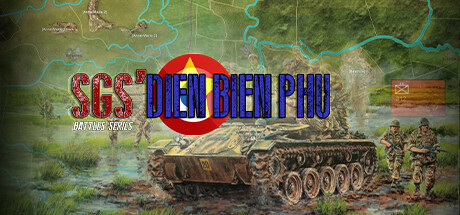
The emblematic siege battle of Dien Bien Phu that ended French rule over Indochina in 1954. Fight for the defense of the fortified camp or try to storm it, in order to reach the upcoming Geneva Peace Conference in a position of force.
Modeled estimate, not a reported figure. How we estimate →
Media

About

SGS Battle For Dien Bien Phu is the fourth game of the now well-established SGS Battle Series, covering intense fights and battles in well know (or not) small but fighting-heavy locations ; ‘grand’ tactical’ scale for regiment, battalion, company and even platoon-size units (depending on the games) and game turns which represent a very short real period of time (one or two days, half a day, a few hours…).

One of the many particularities of the Battle series compared to other SGS relates to a unit activation system which means that not all units will necessarily be able to move and fight in a turn. This will only be possible for them if they have been activated. And depending on the battles or the episodes during them, the activation limits will be more or less important.
Dien Bien Phu is a very remarkable battle on many aspects, and not only because it ended the Indochina War (1946-1954). It was also the first clear victory of the revolutionaries in the post-WW2 conflicts over decolonization. You can play both side, French or Vietminh (the Communist Vietnamese liberation movement) ; against another player in PBEM, or against the AI.
SGS Battle For Dien Bien Phu covers the complete period of the battle, from March till May of 1954 (the battle as a whole extends from March 13, 1954 May 7, 1954). That is to say that some of the initial operations are covered, not only the actual siege itself.
When the game ends, there must be a victor. Either the besieged French CEFEO (Corps Expeditionnaire Français d’Extreme-Orient) troops have withstood the onslaught and still hold on the camp, having bloodied their opponent’s main battle force, and it that case the negotiating position of France at the Geneva Peace Conference will be stronger. Or the Vietminh (VM) forces, as historically, seize the whole fortified area and capture the surviving enemy, inflicting a terrible blow to their foe and achieving the decisive position at the conference (the historical revolt), leading to Vietnam independence under their terms.
The game will contain a grand campaign scenario covering the battle from March until Mayr, as well as other (intermediate or shorter - see below) scenarios based on different starting days or limited to specific areas (Gabrielle or Isabelle ‘Points d’Appuis’, or even the off-map sectors of the Vietminh supply networks, where a guerrilla war of its own may occur)

We plan to also provide the players with interesting options to explore potential what-if situations.
The player will also find in the game historical events.
Those can be strictly historical or random depending on their nature, and/or depending on the game setting (historical scenario or what if). A more efficient French air force or Artillery? The intervention of US B29 bombers from Guam flattening Vietminh artillery positions? More Soviet and Chinese support? Or, on the contrary, a scenario where all external events occur at exactly the same time as in History.
Most events generate even more immersion, sticking to a historical reality. All are carefully designed, with extensive historical research, to go beyond the game, to bring its playful dimension closer to what could be a highly interactive history book.
Gabrielle : un court scénario sur la première attaque de ce point d'appui français à l'extrémité nord de la zone fortifiée. Très court (5 tours), avec peu d'unités, parfait pour apprendre les mécanismes spécifiques à ce SGS.
The Battle of the Five Hills: from March 30 to April 7, one day per round, a battle taking place around Dominique 3 and Eliane 2. A 6-turn intermediate scenario.
Dien Bien Phu Alternative Campaign: the entire battle from March to May 1954. This campaign allows you to choose options at the start of the game (a stronger French garrison, Viet Minh regiments not deployed at Dien Bien Phu, etc.), as well as the possibility of launching Operation Vautour (the option exists, but the delay between the moment the option is chosen and its completion means that the operation may not take place). A 56-turn scenario.
Dien Bien Phu Great Historical Campaign : the entire battle from March to May 1954. All major events are strictly historical (with some latitude on dates, for re-playability) and very few 'what-if' options. Operation Desperado (engagement of anti-Viet-Minh maquis, such as the "Cardamone" maquis) to relieve Dien Bien Phu from enemy pressure, and Operation Condor (with the Godard relief column), which historically began before the fall of the entrenched camp, occur in this campaign as in the alternative campaign. A 56-turn scenario.

Scale
In this specific game, units are mostly company (French) or battalion-size (Vietminh). They confront each other in almost WW1-like position warfare focusing on the various ‘Point d’Appuis’ (strongpoints) created by the French around the center of the valley. The map cut is sometimes unusual in terms of shape, allowing us to represent the effect of the field of fire of the defensive artillery, mortars and machine-guns. Also, "off map boxes" are integrated to represent more distant areas and, most important of all, the source and supply network of the Vietminh (the control of which is crucial to ensure victory in an otherwise long battle of artillery and attrition)
Each turn is one day.
The game consists mainly of ground units and some French air units. Many units are also to be seen more as support assets or elements to boost the efense (mostly) or the attack (sometimes)
All the types of units present at Dien Bien Phu in 1954 appear in the game: armored vehicles, paratroopers, maquis (a.k.a. guerrillas), infantry and militia, engineers, artillery and even a few unique assets or weapons.
Estimated Playtime: from 1h to many hours… with great replayability.
Favored Side/hardest to play : depending on the scenario played and in the campaign it can alternate, being harder for one side at one point in the game before becoming easier (and harder for the opposing side). French are on the defensive (but still can make some counter-attacks, or harass VM supply lines), while the brunt of the assault and conquest bear on the Vietminh.

Genres
Stats
All-time low is the lowest price we've recorded for this game since we started tracking it.
Languages: English, French, Spanish - Spain, Simplified Chinese, German, Vietnamese
Reviews
Highly detailed, yet not too hard to grasp, game over the tragic struggle for Dien Bien Phu. The number of units and counters in the game at first can be a bit intimidating, but a quick read through of the rules pdf file, tells you what you need to know about the game mechanics. The NOTES and HISTORICAL NOTES interspersed throughout the pdf document help me understand what the designer is trying to achieve from a historical perspective, although I would recommend that the player check out the Wikipedia article on the battle of Dien Bien Phu (just google "Battle of Dien Bien Phu and it will come right up), to get a feel for why things are set up as they are, designed and play the way they do. I like that SGS titles provide the situations and unit arrivals like they occurred historically, but you are not strictly forced to follow historical actions. In other words, gameplay is not too 'canned'. I especially like the 'cards' element as it adds a bit of chance to the gameplay so that no two games are ever the same.
I bought this game (and returned it) because I couldn't figure out how to play it. No tutorial, in game link to tutorial videos just went to their YouTube page, nothing specific and nothing for this particular game. No manual that I saw...it may be there somewhere, I couldn't see one. Wanted to play, couldn't figure it out. May buy it again later if they share info on how to play it.
This was my first SGS game and i was pleasantly surprised. As others have noted there isn't much in the way of a tutorial but after a few turns it was easy enough to figure out. i would not let the lack of a comprehensive tutorial deter you from buying the game. The cards system creates a fair bit of uncertainty to the AIs moves to the battle which is a good change up. some issues i have noticed is that the AI was very aggressive early into the battle taking multiple positions but after i stifled two attacks the AI was completely neutered and ceased all pressure instead gradual building a ring of defenses around me. it still wasn't enough by the time the campaign ended and i was easily able to win. Hopefully this will be improved upon with patches later on. There are a few bugs here and there but the auto save feature on this game is awesome, you can easily reload your last save and keep playing. i would also hope in later patches the human player gets more movement cards earlier in the campaign. If you have any historical interest in this battle or the first Indochina war just go ahead and buy the game, i promise you will get a kick out of simply organizing an ad hoc foreign legion attack. As a side note the music in the game is superb and really sucked me into this title.
I believe this is an excellent addition to the SGS series. I teach the Vietnam War as part of a curriculum for postgraduate military education. WhileI haven't had the time yet to dive fully into longer scenarios in the game, I like what I see so far. I do not normally review games on Steam, but was driven to do this by a negative post that, in my opinion, was unfair. Perhaps I should do it more often. I teach case studies such as the War in the Pacific, Korea, and Vietnam. SGS delivers titles that provide useful context and insight, while not being so complex that it impacts work and family life for busy military professionals. I am looking forward to SGS's take on the Indochina War - but I expect the AI will be challenging to program as an effective opponent to due to the complexity and length of the conflict- so I'll need to find a real-life opponent for that one. SGS, please keep up the great work. Mahalo, Mark
Серьёзная и очень детализированная игра, к тому же на редкую в игровой индустрии тему. Огромное количество исторических подразделений, ощущается буквально как интерактивный учебник с отличной музыкой и интересным геймплеем. Игра требует некоторое время для понимания как всё работает, пары часов должно хватить, иногда подвисает, но удобная система автосохранений решает проблему. Для полного погружения рекомендую историческую книгу «Ад в очень маленьком месте» Бернарда Фолла и художественный фильм «Дьенбьенфу» Шёндёрффера. P.S. Легионер! Не слушай вьетминьскую пропаганду! Хоть на странице игры указанно, что русский язык не поддерживается, однако он внезапно есть.
I've just played through all 56 turns of the campaign game as the Viet Minh vs French AI and, while the game research, OB and map, are excellent, there are some particular issues that marred things: --You have a very limited number of stack activations using cards and as a result all sorts of minor units (even noting there are some units always able to move)--"ants" we call them in the trade--end up sitting doing nothing. Waste a precious activation card on a few supply or combat support units you want to move forward? Ich don't think so. --Likewise a powerful force appeared on the map edge and was thus only moveable with a strategic map(s) activation card (which are very rare); even with that there was no way to get it onto the battlefield by the end of the game. Was this play-tested? --You are given all these entrenchment reinforcements but even as time passes and you advance they are only placeable in certain areas with no rhyme or reason that I can ascertain. Likewise many minor support units have to be assigned to divisional boxes and the majority stay there... because there are limited activation cards. --Victory conditions: even though I took 90%+ of French strongpoints, occupied the airfield, all of the town of Dien Bien Phu and had clearly defeated the French it was termed as a minor victory of 49% with a score of 124 VPs. Seems a bit off. No losses of men given in the game to see how you are going turn by turn and aggregate. --Encasement reinforcements are given but can only be put into one location; in any case I saw no option to move artillery there, nor would I have wanted to. --While warnings are given in the special rules not to ignore the strategic map areas I encountered only one instance where they became at all relevant. This dimension of things is really lacking here as the French had been battling to control these areas with mixed results for quite awhile, finally retreating to Dien Bien Phu in force to let the Viet Minh come at them, rather than engage in further fruitless forays into the hinterlands to engage them. The game scants this larger context for the most part from what I could see. --I have not played the French out yet but it seems clear from what I have read in the notes that the French transports remain a constant throughout the game which is surely not correct. For example: "During the later days of the battle, we benefited from the intervention of large American cargo planes flown by the pilots of Maj. Gen. Claire Chennault’s Civil Air Transport airline [later the CIA’s Air America], operating from Nationalist Chinese territory on Taiwan." (from the memoir of Pierre Fauroux who was an executive officer in a para btn there). --Not sure why Colonel Langlais seems to be penalized in the cards when in fact he took over the paras and basically the entire defense when de Castries, depressed at realizing he had put himself into a hopeless cul de sac, went hors de combat. Langlais was strategically short-sighted but seen as tactically potent by most accounts, and he was in an entirely tactical situation at this point. Suggestions: --The unit activation cards should be simply used for stacks that can move and attack. --In line with the above the rest or lull cards of various sorts should allow units to move from stack to stack or from the sides of the map forward, without being able to engage in combat. As it is players are frustratingly hamstrung by this limitation. --Post the special rules (which are the best I have seen in an SGS game) somewhere as a pdf rather than only accessible on the game launch screen, which means you can either read these extensive rules, or play the game. Overall this game has the clear potential to be a chef-d'oeuvre in the genre (which is why I recommend it even with these critiques). The OB and artwork are first-class, the map is very good, but the playability issues I note above make it a frustrating experience to play.
Cela semble une superbe simulation de la bataille de Dien bie, phu. Bravo!!
Critique complète sur Carnet d'un Stratège : https://carnetdunstratege.fr/test-sgs-battle-for-dien-bien-phu/ Si Battle For Hué reste ma préférence, Dien Bien Phu me séduit par son approche lente et insidieuse. Les manœuvres et batailles de contact perdent sensiblement en importance au profit d’une vision stratégique centrée sur une bonne gestion de l’attrition. Si j’adhère pour ma part à l’idée, son caractère punitif et son rythme particulier ne conviendront toutefois pas à tous les profils. Moins révolutionnaire que la bataille pour Hué, moins élégante aussi, Dien Bien Phu étoffe quand même la série SGS qui évolue dans le bon sens mais affiche de sérieuses limites techniques. Un bel épisode qui requiert patience et indulgence en raison des défauts énoncés.
Already played both sides of this conflict and would recommend purchasing this game. I would respectfully suggest, however, that the AI be tweaked, if possible, to have the Viet Minh attack French positions with more troops after an initial artillery barrage or two to destroy most of the perimeter defenses instead of wasting shell fire off the main board; target the crucial French airfield and truck/transport positions as a priority to reduce chances of re-supply or at least fire upon exposed French tank brigades outside the perimeter; always approach French positions using trench system; and, have Communist "intelligence/spy" cards (or game artillery phase) that allow the V.M. AI to see which French bunkers have reduced troops or defenses just like the French have spy planes during the Artillery phase in order to concentrate fire.
I love the subject matter (would highly recommend the books Hell in a Very Small Place and The Last Valley: Dien Bien Phu and the French Defeat in Vietnam if you're interested in learning more about one of the most underrated decisive battles of the last 100 years). The presentation and usability of this game are also really good for what it is. For a newcomer to this series though, I think I need to find another entry point, as Battle for Dien Bien Phu doesn't have any in-game tutorial info, or much in the way of dedicated online resources yet. If you're already into the series, however, I think you'll really enjoy this entry. If you like SGS games, it's worth it just to learn more about this fascinating life-and-death struggle in the northwestern highlands of Indochina.
Related
Related
Trends
Concurrent players on Steam, sampled daily since tracking started.
Related
| Transcripted | $8.9K | 55 | 95% | $7.99 |
| Dead World | $8.9K | 76 | 96% | $3.99 |
| Landlady Seduction Simulator | $8.9K | 306 | 72% | $0.99 |
| Your Friend's Mom | $8.9K | 259 | 73% | $0.49 |
| ALUMNI - Escape Room Adventure | $8.9K | 54 | 69% | $8.99 |
| City Life 2008 | $8.9K | 252 | 81% | $0.99 |