Saratoga is a digital implementation of the Saratoga, Volume I of the Great Battles of the American Revolution wargame published by GMT Games and designed by Mark Miklos.
Modeled estimate, not a reported figure. How we estimate →
About
Saratoga is a solo or two-person turn-based strategy wargame that is Volume I in the Great Battles of the American Revolution wargame series created by designer Mark Miklos and published by GMT Games. The game focuses on the Battle of Saratoga on September 19, 1777 which proved to be the turning point of the American Revolution.
Players can battle human opponents online or play against the game's AI. There are three scenarios that offer opportunities to explore alternate histories, including a British counterattack on the next day.
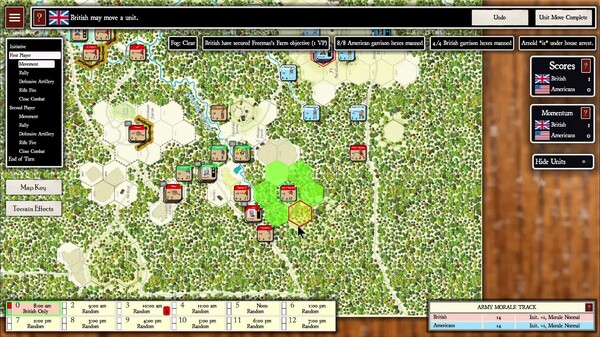
Saratoga features gameplay based on the historical wargaming boardgames of the 70's and 80's. Players maneuver markers that represent their units on a hexagonal map that mimics the gameboard and cardboard counters of traditional boardgames. Players alternate their turns with the first player being determined either by the scenario or randomly. During their turn a player will conduct maneuver for their units and then engage in combat using units with capabilities based on the historical record. Combat is resolved through die rolls modified by terrain, the ability of nearby leaders and the characteristics of the units in the combat.

Saratoga is Volume I of the enormously popular Great Battles of the American Revolution series designed by Mark Miklos and published by GMT Games.
Each side has an historically accurate order of battle that encourages the player to attempt to outdo the generals of history. Saratoga has scenarios that simulate "what-if" situations as well. What if the British had counter-attacked the next day? What if Benedict Arnold had gotten his way and been free to attack?
Combat includes modifiers for leadership, each unit's abilities and terrain to provide a realistic simulation. There is also a "press your luck" component that allows players to spend momentum to modify die rolls or in some cases to re-roll dice.
Genres
Stats
All-time low is the lowest price we've recorded for this game since we started tracking it.
Engagement
Reviews
Themes across 41 recent reviews and how positive each mention is. A keyword signal, not full sentiment analysis.
Reviews
This is a faithful representation of the board game, very well done. As it goes, it is also an interesting (and key) battle of the American Revolutionary War. I would love to see more titles from this series (White Plains, Brandywine, Germantown, etc).
Saratoga, developed by Hexes of War and published by GMT Games in partnership with Hexes of War, is a meticulous digital adaptation of a classic tabletop wargame that explores one of the most pivotal engagements of the American Revolutionary War. Rather than attempting to modernize or streamline its subject matter into a flashy strategy spectacle, the game fully embraces its roots in traditional hex-and-counter design. It transports players directly into the operational and tactical challenges surrounding the 1777 Battle of Saratoga, presenting warfare not as cinematic drama but as a careful exercise in positioning, timing, morale management, and calculated risk. This is a title designed primarily for dedicated strategy enthusiasts and historical wargamers—players who appreciate deliberate pacing and rule-driven systems over rapid, action-oriented gameplay. At its core, Saratoga functions as a turn-based tactical simulation. Units are represented by counters on a hexagonal grid, each reflecting specific historical formations with their own combat values, movement allowances, and morale characteristics. Terrain plays a significant role in shaping engagements; forests, clearings, and elevations influence line of sight, movement costs, and combat effectiveness. The system rewards players who understand the interplay between unit cohesion and battlefield geography. Maneuvering forces into advantageous positions before committing to an attack is often more important than raw numerical strength. Combat resolution incorporates a structured blend of deterministic factors and chance, introducing a calculated tension that mirrors the unpredictability of historical warfare without descending into chaos. One of the most compelling aspects of Saratoga is its scenario design. Rather than presenting a single static campaign, the game offers multiple scenarios that explore different dimensions of the battle. Players can reenact the full historical engagement, focus on specific segments of the fighting such as the clashes around Freeman’s Farm, or explore alternate-history possibilities that imagine different strategic decisions. These varied setups enhance replayability and encourage experimentation. Each scenario demands distinct tactical approaches, as force composition, terrain control, and victory conditions shift subtly depending on the context. The result is a game that invites repeated study and analysis, with outcomes shaped by careful planning rather than scripted events. The digital format brings significant advantages over the physical board game from which it is derived. Bookkeeping tasks that would normally require manual tracking—such as combat modifiers, morale checks, and movement restrictions—are handled automatically. This streamlining reduces the cognitive load associated with managing complex rule sets, allowing players to focus more on strategic thinking. The inclusion of an AI opponent further expands accessibility, making solo play practical without the need to coordinate with another human opponent. While the AI’s decision-making can occasionally feel cautious or influenced heavily by probability swings, it provides a competent adversary that reinforces the game’s tactical foundations. Visually, Saratoga adopts a functional and readable aesthetic. The map design emphasizes clarity over flourish, ensuring that terrain features and unit positions are easily distinguishable at all times. Counters retain a traditional board-game appearance, reinforcing the sense that this is a digital tabletop experience rather than a conventional 3D strategy title. Animations and effects are minimal, and the overall presentation prioritizes information transparency. For players accustomed to more cinematic war games, the lack of dynamic battlefield visuals may seem understated. However, for those who value clarity and precision, the restrained presentation enhances rather than detracts from immersion. The learning curve can be steep, especially for players unfamiliar with hex-based wargames. Understanding movement allowances, stacking limits, combat resolution charts, and morale mechanics requires patience. The interface, while functional, may take time to master, as selecting units and issuing commands demands familiarity with the system’s structure. Yet once these hurdles are overcome, the depth of strategic possibility becomes apparent. Every decision carries weight, and small positional adjustments can have cascading effects on the broader engagement. Historically, Saratoga succeeds in conveying the gravity of its subject matter. The battle it portrays marked a turning point in the American Revolutionary War, influencing international alliances and shifting the momentum of the conflict. By focusing tightly on this event rather than broadening its scope unnecessarily, the game achieves a sense of historical concentration. It invites players not only to test their tactical skills but also to reflect on how leadership, terrain, and coordination shaped real-world outcomes. Ultimately, Saratoga stands as a thoughtful and faithful adaptation that prioritizes authenticity and depth over spectacle. It will not appeal to players seeking fast-paced action or elaborate visual immersion, but it offers a rich and rewarding experience for those who appreciate meticulous military simulation. Through its structured scenarios, detailed mechanics, and commitment to historical fidelity, it provides a satisfying digital battlefield where careful planning and disciplined execution determine victory. For dedicated wargamers and strategy historians alike, Saratoga represents a compelling addition to the growing library of serious digital board wargames. Rating: 7/10
Media

Related
Related
Price dynamics, follower growth, revenue and sales trajectories with interactive tooltips
This and every other Pro feature is free until October 20, 2026. A free account is all it takes.
Languages: English
Hours played at review time, across 41 reviews with recorded playtime.
positive critical· bar length = how often the theme comes up
I've been playing GMT's Battles of the American Revolution series wargame for close to 15 years and I am thrilled with the Steam adaptation. The features are well thought out and add so much to the game play (like highlighting all possible hexes you can move to). Controls are intuitive, gameplay is fun, and the development team is constantly listening to players and actively improving the game. Highly recommend.
Based on the board game and a good adaptation and once I understood the rules and sequence of play a bit better it played fast. Best played against a live opponent to get the most out of it.
Absolutely superb adaptation of Mark Miklos' BoAR game series. The interface is clean, the AI is reasonably competent, and the art and music make for a nice atmosphere. I hope the developers add more battles using the same engine. My only gripe is that defining the combats for each round can be a bit of a headache, as the function to do this automatically does not always work: sometimes it leaves out stacks and forces you to review each combat until all units are engaged. Along with Rebel Fury and the smaller Waterloo and Gettysburg, this is a must have for hex-and-counter fans. The fact that the game runs natively on Mac is a huge bonus for me.
I originally had trouble figuring out the close combat. An update helped. I think this game is great. I highly recommend
i have the board game. wonderful game. recommeneded. Thanks GMT and everyone who had a hand in this game.
There are still bugs that have been reported but have not been fixed. Unfortunately, the impact of said bugs is significant to the detriment of gameplay.
I don't have the tabletop game and can't comment on it! All I can say is that I really like it and it's fun. It's playable on Windows and Linux Mint! I highly recommend it.
Un gran juego con una digitalización a su altura. Claro, bonito en su sencillez, y perfecto para acompañara mi copia física. Espero que Hexes of War pueda continuar con más juegos de la serie! A great game with digitalization to match. Nice graphics, beautiful in its simplicity, and perfect to accompany the physical copy. I hope Hexes of War can continue with more games in the series!
Selling now
See how fast this game is selling right now — estimated copies and revenue per day from recent review growth.
Players by region
Where this game's players are, estimated from review languages.
Related
| Game | Estimated lifetime revenue | Reviews | Review score | Price |
|---|---|---|---|---|
| $15.8K | 63 | 81% | $12.99 | |
| $15.8K | 53 | 91% | $16.99 | |
| $15.8K | 137 | 92% | $5.99 | |
| $15.8K | 100 | 91% | $9.99 | |
| $15.8K | 108 | 88% | $14.99 | |
| $15.8K | 91 | 67% | $5.99 |
Related
| Game | Estimated lifetime revenue | Reviews | Review score | Price |
|---|---|---|---|---|
| — | 0 | — | — | |
| $10.1K | 22 | 95% | $9.99 | |
| $508.9K | 905 | 95% | $24.99 | |
| $100.7K | 193 | 71% | $19.99 | |
| $90.8K | 583 | 83% | $4.99 | |
| $67.1K | 227 | 82% | $11.99 |