(Français, lire plus bas)
EN 🔷You play as Eugene Harlow, trapped in a time loop that begins at 8:00 PM in your psychiatrist's office in Rue Valley. Your goal is to find a way out.
🟩PROS🟩
+ The story is quite... surprising. :)
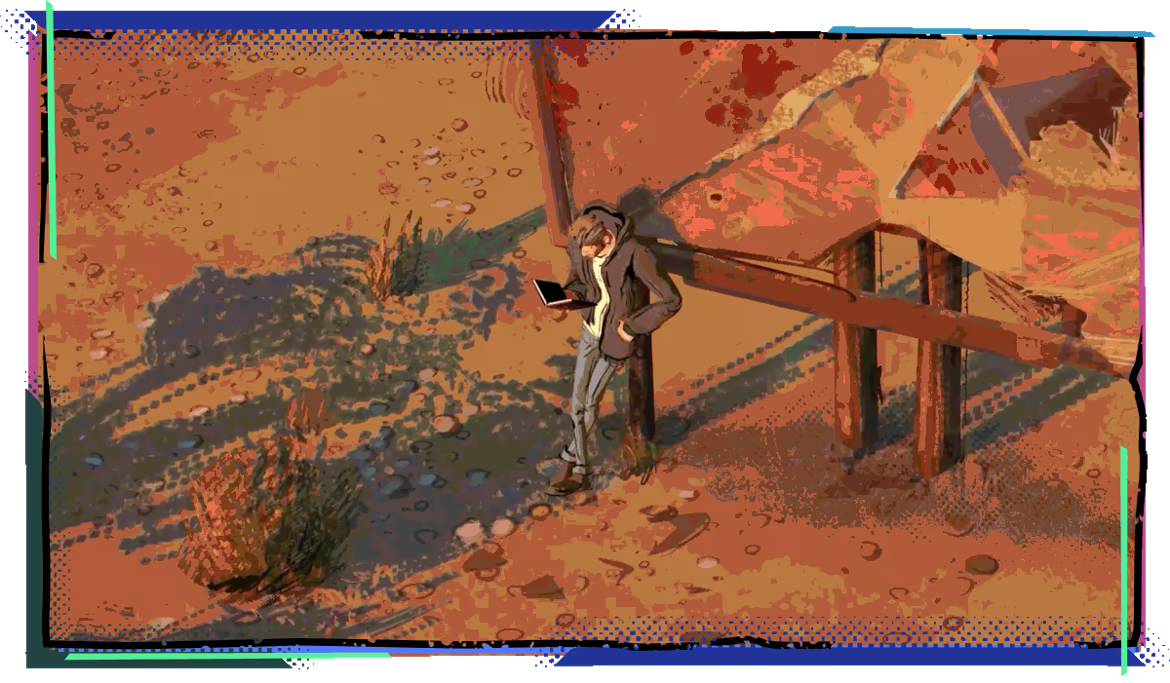
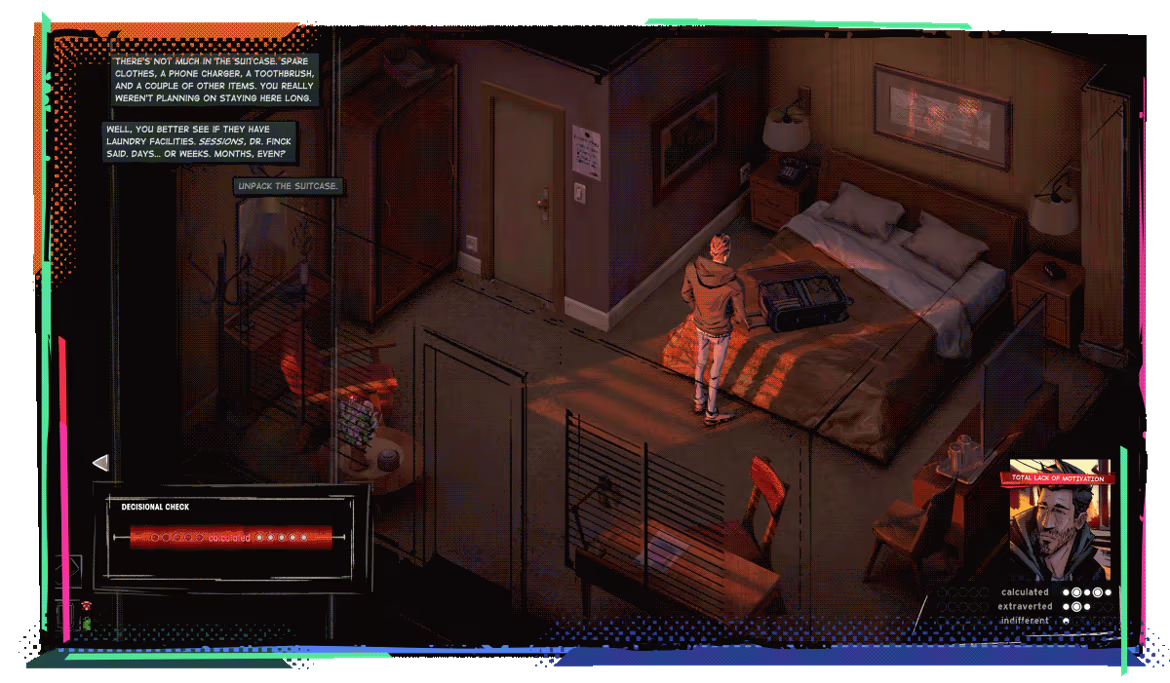
+ The art direction is perfect; the visuals are stunning. I LOVE IT!
+ Isometric view.
+ Excellent voice acting.
+ An intense psychological experience if you take the time to reflect on the psychiatrist's words and the events. It tackles powerful themes (grief, depression, etc.).
+ The deduction mechanics are interesting without being overly complicated.
+ Commentary from our "inner voice."
+ There are 2 (two) possible endings.
+ It took me about 17 hours to finish my playthrough, far longer than I expected!
+ Manual save option.
🟨COULD BE BETTER🟨
+/- The player has to do a lot of back-and-forth movement to solve problems and understand the loop. Unfortunately, this is inherent to the time-loop concept; while repetitive, it fits the narrative.
+/- Lots and lots and LOTS of dialogue and text to read.
+/- There were parts of the story I didn't quite grasp, even after completing all the side quests and getting the "good ending."
+/- Playing with a controller, I sometimes struggled to select objects to interact with and had to switch to the mouse for greater precision.
🟥CONS🟥
- Not much exploration. Few locations to visit.
- There's a whole subplot involving Mars and the colonies, but it isn't really fleshed out.
- I was left wanting more answers regarding the Rue Valley water supply and Jason Burns.
⭐⭐⭐⭐Rue Valley drew me in with its narrative focus and art style. Honestly, I don't like time loops at all, whether in books, TV shows, movies, or games, but I wanted to give this one a chance despite the mixed reviews.
---> I am pleasantly surprised by this little game.
Eugene is depressed, exhausted, and seeing a psychiatrist. Trapped within the misery of his own mind, he finds himself locked in a time loop. Is it real? Is there a way to break the loop?
You might think Rue Valley offers a sci-fi story, but in reality, it delivers hours of therapy and self-discovery: a human tale about trauma, depression, and grief, and how to move forward if you're willing to see things differently.
I won't lie; having undergone years of therapy myself, I felt deeply invested in this story, especially regarding Dr. Finck’s analysis of Eugene’s memories. It was fascinating, and I saw myself in some of the things said, which prompted me to reflect on my own life and experiences. For that reason, I’m left with a positive impression of Rue Valley, despite its flaws.
The gameplay is simple: you interact with your surroundings and talk to people to gradually piece together what’s happening. When the loop resets, you have to try different approaches to see what changes or if you can learn new information. Your character also takes on certain "statuses" that influence his behavior.
As for the story, there are many intersecting lives (residents who cross paths or avoid one another) but there are also elements of the lore, specifically regarding "Coral Destiny" and Mars, that remain rather vague and, in my opinion, underutilized. Perhaps that was a red herring, a way to make us think the game was heading into sci-fi territory when it was actually a human drama all along?
In any case, it is a poignant story with a meaningful message. I come away from it feeling hopeful (probably because I got the "good ending", though I imagine it’s a different story for those who got the "bad ending"...) and revitalized. I needed this.
--------------------------------------------------------
FR 🔷Vous êtes Eugene Harlow et êtes coincé dans une boucle temporelle qui démarre à 20h00, dans le cabinet de votre psychiatre, à Rue Valley. Votre but sera donc d'essayer de vous en sortir.
🟩EN POSITIF🟩
+ L'histoire est assez... étonnante. :)
+ La direction artistique est parfaite, les visuels sont magnifiques. J'ADORE !
+ Vue isométrique.
+ Excellents voices actors (sous-titres en français).
+ Expérience psychologique intense quand on prend le temps de réfléchir aux mots du psychiatre et aux évènements. Les thèmes abordés sont forts (deuil, dépression...).
+ Le travail de déduction est intéressant et pas trop compliqué.
+ Les commentaires de notre "voix intérieure".
+ Il y a 2 (deux) fins possibles.
+ Environ 17 heures de jeu pour terminer ma partie, c'est bien plus que ce à quoi je m'attendais !
+ Possibilité de sauvegarder manuellement.
🟨POURRAIT ETRE MIEUX🟨
+/- Le joueur doit faire énormément de va-et-vient pour résoudre les problèmes et comprendre la boucle. Cela fait malheureusement partie du principe de la boucle temporelle, donc même si c'est répétitif c'est cohérent avec le récit.
+/- Beaucoup, beaucoup, BEAUCOUP de dialogue et de texte à lire.
+/- Il y a certaines choses que je n'ai pas compris dans l'histoire, alors que j'ai fait toutes les quêtes secondaires et que j'ai eu "la bonne fin".
+/- En jouant à la manette j'avais parfois du mal à sélectionner un objet avec lequel interagir, je devais repasser à la souris pour plus de précision.
🟥EN NEGATIF🟥
- Pas vraiment d'exploration. Peu de lieux à voir.
- Il y a tout un truc avec Mars et les colonies mais ce n'est pas développé plus que ça.
- Je reste sur ma fin concernant l'eau de Rue Valley et Jason Burns.
⭐⭐⭐⭐Rue Valley est un jeu qui m'a attiré par son côté narratif et sa DA. Honnêtement, je n'aime pas du tout les boucles temporelles (ni dans les livres, ni les séries/films, ni dans les jeux) mais j'ai voulu lui donner une chance malgré les reviews moyennes.
---> Je suis agréablement surprise par ce petit jeu.
Eugene est dépressif, fatigué et suivit par un psychiatre. Il est enfermé dans la misère de son esprit, puis se retrouve enfermé dans une boucle temporelle. Est-ce réel ? Existe-t-il un moyen de casser la boucle ?
On pourrait croire que Rue Valley nous offre un récit de science-fiction alors qu'en réalité il nous offre des heures de thérapie et de compréhension de soi : un récit humain qui nous parle de traumatisme, dépression, deuil et comment aller de l'avant si on accepte de voir les choses autrement.
Je ne vais pas vous mentir, moi qui ai fait des années de thérapies, je me suis sentie très impliquée dans cette histoire, surtout avec l'analyse du Dr Finck sur les souvenirs d'Eugène. C'était passionnant, et je me suis reconnue dans certains de ses propos, ce qui m'a amené à réfléchir sur moi-même et ce que j'ai vécu. Pour cette raison, je garde de Rue Valley un sentiment positif malgré les défauts que je lui trouve.
Le gameplay est simple : vous devez interagir avec ce qui vous entoure, discuter avec les gens pour essayer de comprendre petit à petit ce qui se passe, et lorsque la boucle recommence vous devez essayer différemment pour voir ce qui change ou si vous pouvez obtenir des informations complémentaires. Votre personnage aura parfois certains "statuts" qui vont influencer son comportement.
Côté histoire, il y a plein de vies qui se croisent (des habitants qui se côtoient ou qui s'évitent) mais il y a aussi une partie du lore qui reste assez flou et pas assez exploité selon moi avec Coral Destiny et Mars. Peut-être était-ce un leurre, pour nous faire penser que le jeu partait sur de la science-fiction, alors qu'il s'agit en réalité d'un drame humain ?
Dans tous les cas, c'est une histoire poignante, qui est pertinente dans ce qu'elle propose. J'en ressors avec de l'espoir (probablement parce que j'ai eu la "bonne fin", mais j'imagine que pour ceux qui ont eu la "mauvaise fin" ça doit pas être le même discours…) et un nouveau souffle. J'en avais besoin.