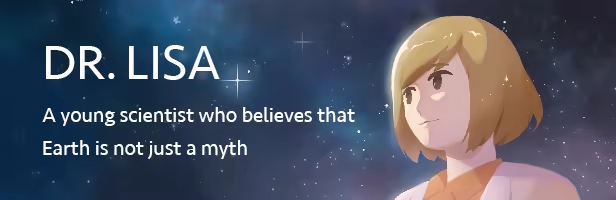
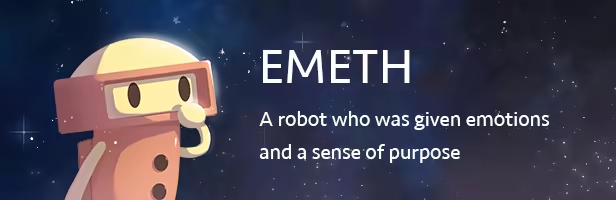
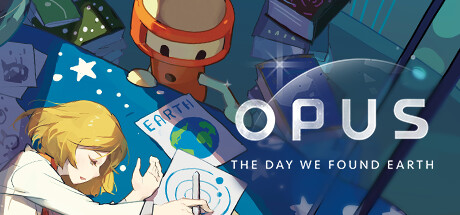
Dive into the boundless galaxy and embark on an emotional adventure! Help little robot Emeth to fulfill a century-old promise by finding Earth in order to save Mankind—so step into the spaceship, operate a deep space telescope, and find out what’s out there in the unknown.
Modeled estimate, not a reported figure. How we estimate →
About


Genres
Stats
All-time low is the lowest price we've recorded for this game since we started tracking it.
Languages: English, Japanese, Simplified Chinese, Traditional Chinese, Korean
Engagement
Hours played at review time, across 43 reviews with recorded playtime.
Reviews
Themes across 43 recent reviews and how positive each mention is. A keyword signal, not full sentiment analysis.
positive critical· bar length = how often the theme comes up
Reviews
Пиксельхантинг на космическую тематику с существенным гриндом в конце для открытия всех достижений. Пойдет, с учетом короткой продолжительности.
OPUS: The Day We Found Earth — A Decade Later I first stumbled onto this game back in elementary school. I was just a kid messing around on a laggy tablet, endlessly scrolling the Play Store looking for Minecraft clones. I don't even remember why I tapped on this one, but something about it caught my eye. Of course, I couldn't afford the full game back then. Naturally, I went digging for a pirated version and got a nasty virus instead—which, honestly, fair enough. I never got to finish it, and eventually, the memory just faded. Then, last week happened. I was trying to explain a vague memory of a game to a friend—something about a girl, spirits, and a rocket. After some digging, I realized I was actually thinking of the sequel, OPUS: Rocket of Whispers. But right there next to it was the first game: The Day We Found Earth. Seeing that title just made everything click. I finally played it through tonight. Sitting down with it now, a decade later, was a surreal experience. It’s less of a game and more of an emotional space. You just sit there, let the story unfold, and feel things. The ending left me with this beautiful, hollow feeling—the kind you get when something ends exactly right, but you're still not quite ready to let it go. The craziest part is realizing the demo I played as a kid must have cut off right in the middle. I’ve been carrying around an incomplete version of this story for over ten years without even knowing it. Getting the actual ending tonight didn't feel like some massive revelation; it felt like quietly closing a door I didn't know was still open. Looking back, it all makes sense now. The Day We Found Earth is honestly the reason I fell in love with story games when I was a kid. It shaped my taste, teaching me early on that the most memorable games are the ones with a heavy emotional pull. Whether I'm sinking hundreds of hours into a massive, sprawling RPG world today, or just sitting down for a short emotional journey, that deep appreciation for a good narrative all started with this little robot. It was easily the best hour and a half of pure nostalgia, and exactly why I’m so determined to buy Rocket of Whispers and experience the rest of the OPUS universe once I've saved up enough money again. (A quick honest note to end this: My English isn't the greatest, so I used AI to help me structure and translate exactly how this game made me feel. I just really wanted to do the memory justice. Sorry if I sound like I'm overreacting a bit lol)
OPUS: The Day We Found Earth is a simple adventure (“hidden object”-style game) about finding Earth-like planets. It is mainly characterized by the minimalism of its storytelling. With very few means, it manages to evoke a sense of spatial and temporal scale and encourages reflection. It is especially recommended if you are already fascinated by space. I definitely did not regret finishing this small game, and it did have an impact. However, I would not have been able to complete it in a single sitting, because the gameplay becomes quite repetitive and uneventful in the middle section (relaxing? heh). The gameplay is effective in the sense that it makes you feel how enormous the number of stars is that you can theoretically select, and how unlikely it is to find a small blue planet like Earth—especially when you are just randomly poking around without a plan. This fits very well with the game’s central theme. The same applies to its premise: humanity has left and forgotten Earth, but now seeks to find it again, as it is their last hope. Because it is the only home they have ever known.
剧情扯蛋,找到地球就完结了。玩法无聊找星星找到了也没什么反馈。
7.5/10 给童年补个票。小品解密游戏,属于太空的科幻浪漫。 剧情一般;老游戏30帧太要命了,找1000颗星的成就也太多了。
设定很浪漫,但说是巡天遥看一千河,你就真让我扫描一千颗星星啊,不要设计这种纯粹拖游戏时长的成就好吗。
观测编号10000:地球 与地球相似度-99.7% 距离:66932光年 准备跃迁 只要抬头,就能看见Lisa
作为opus系列的发端,优质的独立游戏,虽然剧情属于开局一眼望的到头还是很吸引人玩下去。全成就不算难,7个小时玩玩停停,有一种独特的禅意体验。下一部见。
Full Game Walkthrough : https://youtu.be/ac0QAHsEzgo
首先说[b] 绝对的值得入手! [/b]喜欢太空和剧情的可以放心冲!! 表达能力有限,但还是想为了喜欢的游戏留下点什么。依旧是玩儿过的手机游戏,因为提前知道了故事的剧情,所以从踏上这趟旅程开始,眼泪就在不断酝酿,直到那个决堤的时刻。[spoiler]丽萨博士和真诚博士最终还是永远的留在了那片银河,甚至离苦苦寻找的目标只有那么近[/spoiler]。 我一直很讨厌重复又浪费时间的事情,总觉得有限的时间应该花在更有意义的地方。但是每次打开望远镜,发现一个新行星后返回太空船,面对这些重复了一遍又一遍的步骤时,我并没有像往常急切地想要跳过,或许是想作为奥伯斯号的一员,真正经历一次寻找的过程;又或许,只是不愿那么快面对[spoiler]丽萨博士已经不在的事实[/spoiler]。博士又是怎么度过那些漫长到看不见尽头的寻找,甚至怀疑自己的时刻的呢? 故事的最后当然找到了“地球”,艾姆也完成了和博士的约定。但艾姆和智能体丽萨的旅程还没结束吧,她们将继续在探索太空的过程中,期盼与丽萨博士于银河相见的那一天。 游戏时间不做参考,主线剧情大概两个小时,几个小彩蛋任务半小时左右。成就扫描1000颗星时算了下时间,扫100颗星大概用时12到13分钟。
Related
Related
Trends
Concurrent players on Steam, sampled daily since tracking started.
Momentum
Pace estimated from the game's recent review growth (our daily snapshots) at its own sales-per-review ratio — a momentum signal, not booked sales.
Audience
Estimated from the language of this game's reviews — a proxy for where players are, not official Steam demographics.
Related
| Hex of Steel | $454.6K | 886 | 96% | $24.99 |
| Maestro | $454.6K | 561 | 96% | $24.99 |
| TasteMaker | $454.7K | 1.3K | 83% | $11.99 |
| Omega Labyrinth Life | $454.7K | 356 | 67% | $59.99 |
| VenusBlood HOLLOW International | $454.3K | 314 | 96% | $44.99 |
| Nexus 5X | $454.8K | 935 | 91% | $14.99 |