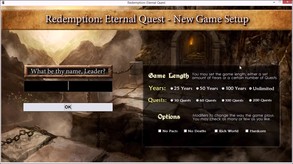
Redemption: Eternal Quest is a casual RPG/Sim game which combines the feel of an RPG with roster management sim mechanics. You become the leader of a band of adventurers, guiding them through quests, watching them grow and signing them to pacts while keeping your gold pouch filled.
Modeled estimate, not a reported figure. How we estimate →
Media
About
Stats
All-time low is the lowest price we've recorded for this game since we started tracking it.
Languages: English**languages with full audio support
Engagement
Hours played at review time, across 40 reviews with recorded playtime.
Reviews
Themes across 40 recent reviews and how positive each mention is. A keyword signal, not full sentiment analysis.
positive critical· bar length = how often the theme comes up
Reviews
meh.
Redemption: Eternal Quest is an indie fantasy management RPG developed by SimProse Studios and published by Conglomerate 5, and it occupies an unusual space between traditional role-playing games and long-term simulation design. Instead of placing the player directly in the boots of a single hero, the game casts you as a guiding force behind a rotating band of adventurers, emphasizing oversight, planning, and consequence over moment-to-moment control. From the outset, it makes clear that its primary interest lies not in cinematic storytelling or tactical micromanagement, but in the slow accumulation of decisions that shape a party’s fate across many cycles of risk and reward. The core structure revolves around managing a roster of adventurers who undertake quests on your behalf. Each character has individual attributes, tendencies, and hidden traits that influence performance and survivability, and over time they grow older, suffer injuries, recover, or even decline. This sense of persistence gives the game much of its identity, as characters are not disposable units but long-term investments whose careers unfold unpredictably. Choosing who to recruit, who to train, and who to retire becomes a meaningful strategic layer, especially when resources are limited and failure carries lasting consequences. Quests form the backbone of progression, and each decision to embark on a mission is a calculated gamble. Higher-risk quests promise greater rewards but also increase the chances of serious injury or permanent loss, forcing players to weigh ambition against sustainability. There is no guarantee of success, and even experienced adventurers can falter, which reinforces the game’s emphasis on uncertainty. Rather than pushing players toward constant escalation, Redemption: Eternal Quest encourages patience, conservative growth, and an acceptance that setbacks are part of the journey rather than signs of failure. Combat itself is abstracted through a card-driven resolution system rather than direct tactical encounters. Players influence outcomes by deploying cards and managing probabilities, which adds a layer of strategy while keeping the focus on preparation rather than execution. This system divides opinion, as it can feel either refreshingly hands-off or frustratingly opaque depending on expectations. While it avoids the tedium of repeated turn-based battles, it also limits the sense of agency during encounters, placing greater importance on decisions made before the quest ever begins. Economy and logistics quietly underpin everything. Equipment upgrades, healing costs, training investments, and contractual obligations all compete for limited funds, and poor financial planning can stall progress just as effectively as failed quests. This economic pressure reinforces the game’s identity as a management simulation, where success comes from balancing growth with stability. The absence of a strong narrative arc means that much of the story emerges organically, shaped by which characters thrive, which fall, and which hard choices define your campaign. Visually and technically, the game is modest and functional rather than striking. Its interface prioritizes information clarity over flair, and while it shows its age in presentation, it generally succeeds in communicating the systems at play. Some rough edges and dated design decisions can interrupt immersion, particularly for players accustomed to modern quality-of-life features, but they rarely undermine the core loop once understood. The focus remains squarely on systems and outcomes rather than spectacle. Player reception reflects the game’s niche ambitions. Those who enjoy slow-burn simulations and emergent storytelling often appreciate the depth of its character management and the replayability born from randomness and long-term consequences. Others find the experience repetitive or underwhelming, especially if approaching it with expectations of a story-driven RPG or tactically rich combat system. The game does little to hold the player’s hand, and its appeal depends heavily on whether one finds satisfaction in indirect control and probabilistic outcomes. Ultimately, Redemption: Eternal Quest is best understood as a management-focused fantasy simulation rather than a conventional RPG. Its strengths lie in its persistent characters, meaningful consequences, and the quiet tension of balancing risk against longevity. While its presentation and combat abstraction limit its broader appeal, it offers a distinctive experience for players who enjoy shaping outcomes from behind the scenes. For those willing to embrace its deliberate pace and systemic focus, it provides a thoughtful and often compelling take on what it means to lead adventurers rather than be one. Rating: 5/10
Слишком многа букавок и циферок
Against a backdrop of monotonous projects, this work was a breath of fresh air. It reminded us why we all fell in love with RPGs in the first place, and it did so with such mastery that it can safely be called a work of art.
[h1] [/h1]
найс игра
Não gostei nada. O jogo é muito rudimentar. Há jogos muito melhores nessa temática. Visto que a distribuidora é a Conglomerate 5 desconfio que seja só mais um shovelware...
总结来说,游戏未能充分利用其富有潜力的世界观和题材优势,游戏体验上的诸多不足使其难以满足玩家对于高品质RPG游戏的期待。开发商应在后续更新中认真对待玩家们的反馈意见,针对上述问题进行大幅优化与改进,才能使这场“永恒之旅”真正成为玩家心中的难忘冒险。
Zgodnie ze swoją nazwą, w Redemption Eternal Quest nie ma żadnego „wygrywania”, jest tylko ciągła praca. Biorąc pod uwagę, że tak naprawdę nie ma żadnych dynamicznych zabaw ani niespodzianek, wyobrażam sobie, że REQ będzie rodzajem gry, która byłaby popularna na Facebooku lub jako gra mobilna – zakupy w grze, łączenie się ze „znajomymi” i wyłączanie limitu czasu zadania. Jeśli odrzucisz to wszystko, otrzymasz tego rodzaju grę – nie nudną, ale nie na tyle wciągającą, aby regularnie do niej wracać.
⠀⠀⠀⠀⠀⠀⠀⠀⠀⠀⠀⠀⠀⠀⠀⠀
Related
Related
Trends
Concurrent players on Steam, sampled daily since tracking started.
Momentum
Pace estimated from the game's recent review growth (our daily snapshots) at its own sales-per-review ratio — a momentum signal, not booked sales.
Audience
Estimated from the language of this game's reviews — a proxy for where players are, not official Steam demographics.
Related
| Dungeon Digger | $3.4K | 109 | 81% | $1.99 |
| Lighter | $3.4K | 61 | 84% | $1.99 |
| Darkness Revenge | $3.4K | 116 | 84% | $1.99 |
| Rescue Operation | $3.4K | 299 | 87% | $3.99 |
| Lern Island Letters | $3.4K | 66 | 94% | $2.99 |
| Death Sees Twice: Spot the Difference | $3.4K | 66 | 80% | $2.99 |