qomp, developed by Stuffed Wombat, Britt Brady, Miroko, and Clovelt, and published by Atari, is an elegant and quietly profound reimagining of one of gaming’s oldest ideas. It begins with a simple premise: what if the ball from Pong decided to escape? From that curious question emerges a minimalist puzzle-platformer that transforms a relic of gaming history into a meditative journey of motion, timing, and self-discovery. qomp takes the essence of arcade simplicity and stretches it into something philosophical—a game that feels both mechanically pure and thematically introspective. It’s a celebration of restraint, proving that a single-button game can still evoke surprise, challenge, and emotional resonance.
At its core, qomp is defined by a single input: clicking or pressing a button changes the ball’s direction, flipping it between upward and downward angles as it constantly moves forward. This mechanic, though simple, carries incredible depth. Every level is built around the physics of that one decision—when to change direction and when to let momentum carry you. The player never stops moving, so progress depends on mastering rhythm, precision, and anticipation. Early stages introduce gentle challenges, allowing players to understand the nuances of the mechanic. As you move deeper into the labyrinth, the game layers complexity with spikes, moving traps, locked gates, and environmental puzzles that require exact timing and spatial awareness. It’s a design philosophy that embraces gradual evolution: each new obstacle feels like a natural extension of what you’ve already learned, never overwhelming but always demanding a little more finesse.
The level design in qomp is a marvel of minimalism. Each area is a compact test of patience and dexterity, and every environment feels handcrafted to explore a specific idea. The game introduces water sections where movement slows and control becomes heavier, transforming the same mechanic into a new kind of challenge. Other levels feature rotating hazards or pressure switches that require precise manipulation of your momentum. The pace remains steady and deliberate, striking a balance between reflection and tension. There’s an understated brilliance in how the game teaches without text or tutorials—players intuit mechanics simply through play, guided by rhythm and visual cues rather than explicit instruction. The learning process feels natural, and each small victory is immensely satisfying because it’s earned through understanding, not hand-holding.
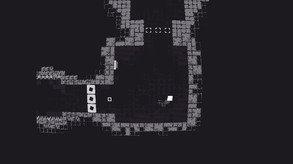
Visually, qomp is striking in its simplicity. The environments are rendered in bold, minimal colors—blacks, grays, and muted tones—while the white ball remains a constant focal point. This clean design not only keeps the gameplay readable but also contributes to the game’s meditative quality. There’s a sense of solitude to the world, a quiet emptiness that makes each small movement feel meaningful. The soundtrack complements this atmosphere beautifully, weaving ambient tones with subtle, almost melancholic melodies that underscore the loneliness of your journey. Each sound cue, from the dull thud of hitting a wall to the sharp ring of unlocking a gate, is carefully chosen to create rhythm and immersion. The minimalism works in harmony with the theme—the absence of clutter allows emotion and meaning to emerge from silence and repetition.
The story in qomp is intentionally abstract, but it resonates through its simplicity. There is no dialogue, no narration, and no explicit plot, yet the experience feels personal. The concept of a Pong ball breaking free from its endless loop carries a surprising emotional weight—it becomes a metaphor for escape, autonomy, and self-determination. The game transforms what could have been a gimmick into a subtle narrative about finding freedom and confronting the unknown. Every obstacle you overcome feels symbolic, every new mechanic a reflection of growth. The finale in particular delivers a sense of closure that’s quiet yet moving, suggesting that freedom is not without cost, and that even in escape there’s an element of uncertainty. It’s storytelling through mechanics rather than exposition, and it succeeds with remarkable grace.
Despite its many strengths, qomp’s brevity may leave some players wanting more. Most will finish the game within two to three hours, depending on how often they struggle with later puzzles. But its short length feels deliberate rather than lacking. Like a poem, qomp is meant to be concise—a distilled expression of movement and thought. The challenge curve is fair, though some of the final stages demand near-perfect timing and can verge on frustration. Still, the generous checkpoint system keeps the experience fluid and forgiving, ensuring that failure never feels punishing. A few players may find the controls too restrictive or the minimal visuals too stark, but for those who appreciate focus and refinement, these design choices are exactly what make the game memorable.
The game’s accessibility options are another thoughtful touch. Players can enable invincibility or visual adjustments to make the experience less punishing without diminishing the core design. After completing the main story, challenge stages unlock to push your mastery further, offering replayability for those who crave precision. qomp’s mechanical purity invites experimentation—it’s one of those rare games where mastery feels almost meditative, where each click becomes a heartbeat in the rhythm of the experience.
qomp stands as a testament to how simplicity can yield profound engagement. It distills the language of video games to its essence—movement, timing, cause and effect—and uses that purity to craft an experience that feels both nostalgic and entirely new. It’s a spiritual successor to Pong not because it imitates it, but because it reinterprets it. Instead of endless back-and-forth motion, qomp transforms the ball’s journey into a metaphorical escape from constraint. The result is a game that feels deeply human in its quiet search for purpose within structure. It’s minimalist, yet layered; playful, yet contemplative.
In the end, qomp is a masterclass in design minimalism, a rare example of how a simple idea can be elevated through care, rhythm, and restraint. It invites players not just to play, but to reflect—to find meaning in movement and beauty in repetition. Its short, focused journey lingers long after it’s over, not because of spectacle or story, but because of how it makes you feel through motion alone. For anyone who appreciates elegant design and the poetry of simplicity, qomp is an unforgettable experience—small in size, but vast in resonance.
Rating: 9/10