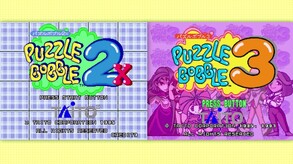
In Puzzle Bobble 2X and Puzzle Bobble 3, shoot bubbles that pop when 3 or more of 1 color touch. Try standard mode, challenge mode, stage creation, and 1,026 player-made stages. Also play BUST-A-MOVE 2 Arcade Ed. and BUST-A-MOVE 3. New: rewind, slow mode, and quick save.
Modeled estimate, not a reported figure. How we estimate →
About
Genres
Stats
All-time low is the lowest price we've recorded for this game since we started tracking it.
Languages: English, Japanese
Engagement
Hours played at review time, across 40 reviews with recorded playtime.
Reviews
Themes across 40 recent reviews and how positive each mention is. A keyword signal, not full sentiment analysis.
positive critical· bar length = how often the theme comes up
Reviews
[h2]City Connection, please add "Remote Play Together" to your shared/split screen games![/h2]
Just being able to play Puzzle Bobble 3 / Bust-A-Move 3 on Steam is something I’m grateful for. Even today, the game still features a cast of charming and memorable characters. As for home console ports, Puzzle Bobble 3 / Bust-A-Move 3 was released on the Sega Saturn, PlayStation, and Nintendo 64—in that order. The original Sega Saturn version has fewer modes and options compared to later releases. However, since this version is part of City Connection’s “Saturn Tribute” line, that limitation is understandable. If anything, it would have been nice to have the network multiplayer that was available in the SegaNet-compatible version, but given the challenges of server management, that’s probably something to hope for only if the game’s popularity grows significantly. One highlight of the Sega Saturn version is Marina’s ending, where Musashi appears—showcasing his fun personality—so I recommend checking it out if you’re interested. The rules are simple: fire bubbles and connect three of the same color to clear them. In Puzzle Mode and Collection Mode, you clear the stage by removing all bubbles from the field. In Rank Certification Mode, you demonstrate your skill by completing specific challenges (such as clearing with as few shots as possible). In Versus Mode, you select characters with different abilities (affecting the type and number of bubbles sent to the opponent), and you win by pushing your opponent’s bubbles off the screen. As an early entry in the series, the mechanics are relatively straightforward. The Rainbow Bubble might feel a bit tricky at first, but once you understand it, there’s little else that beginners will find overly difficult. That said, there are many newer games available today, including excellent modern entries in the Puzzle Bobble series. So, is there still value in playing this older title? For me, what sets this game apart is how easy it is to pick up and play, along with the beauty of its presentation and the cuteness of its characters. Puzzle Mode and Versus Mode can both be cleared relatively quickly, reflecting the game’s arcade origins. However, for those who want more, there are additional options like the “Another World” (the hidden second loop) and Collection Mode. The beauty of the presentation is especially noticeable in Versus Mode. The concept is that characters are brought together from various different game worlds, and each has a unique introduction scene that reflects their own style or genre. For example, Tinkle appears in a quiz-game-style screen, while Prichio makes an entrance suspended from a crane. Notably, there is no text. There’s also no text in the ending—just several sepia-toned scenes showing what happens to the characters afterward. Personally, I think the absence of “unrefined elements like dialogue or explanations” contributes greatly to the elegance of the presentation. When I first played it as a child, I felt something was missing without character interactions or dialogue, but now I believe it’s better this way. Even without words, there are endings where characters appear together, and you can get a sense of who gets along with whom. The character designs, while limited by the hardware of the time, use a restricted color palette, resulting in simple yet adorable outfits. This simplicity also makes them well-suited for fan art (I’ve drawn several myself). As for gameplay balance, each character has carefully designed strengths and weaknesses, and the differences don’t become too extreme depending on the field situation. That said, at higher levels of play, characters like Bubblun (who can send a wide variety of colors) or Jack and SSB (who have high attack constants) may have an advantage—but this hasn’t been definitively settled yet. With more tournaments and players, this may become clearer. In any case, every character has a distinct personality, so there’s no confusion like “I can’t tell these two apart.” If you enjoy 2D character art, you’ll likely find a favorite, and their names are easy to remember. Despite their differences—and even when conflicts arise—they ultimately gather peacefully around a round table. It’s a wonderfully respectful and harmonious world. From here on, I’ll focus more on the port itself rather than the original game. The Playing Guide is thorough and well done. It’s interesting that you can read an English translation of the Japanese “Monogatari” (story). The overseas version, Bust-A-Move ’99, had a different story, so for international players, this may be their first exposure to the original Japanese narrative. However, one downside is that the guide does not mention that in Versus Mode, characters differ not only in the types of bubbles they send but also in the quantity. This detail wasn’t in the original manual either, but it was documented in the Sega Saturn strategy guide—so it’s a bit disappointing that it’s omitted here as well. Still, as a faithful port, this isn’t technically incorrect. For reference, I’ll include the values here. Each character has an attack constant, and the number of bubbles sent is calculated as: (Number of bubbles cleared simultaneously + number of bubbles dropped simultaneously − 3) × attack constant According to the guidebook, the constants are: Bubblun 1.5, Tinkle 1.0, Prichio 1.25, Marina 1.75, Musashi 1.75, Luna-Luna 2.0, Jack 2.25, SSB 2.0, Debrun 1.5, Doranku 1.5. Features like Rewind and Quick Save/Load are very useful for repeated runs such as RTA, and they allow for practice on a stage-by-stage basis. If anything, having multiple save slots would make things even more convenient. You can change wallpapers in Screen Settings, and all of them are well-designed and appealing. Enlarging the game screen does hide Jack’s beautiful face, which is a bit unfortunate—but the character placement and proportions themselves feel perfect. Personally, when I use a wallpaper featuring Jack, I play with a smaller game screen, which works fine in the Steam version. In the original game, the “Another World” mode was unlocked via a command after clearing the game, but in this version, it can be toggled on/off in Extra Options. This is a welcome improvement over manual input. I’ve heard some RTA players mention that the “LOADING…” times during screen transitions are a bit long—perhaps that’s something that’s technically difficult to improve. Overall, while there are some minor areas that could be improved, this is a comfortable and enjoyable port to play. The wallpapers are cute, which is a nice bonus. I’ve also noticed that artwork from Puzzle Bobble 3 appears quite often on City Connection’s official website and social media, which makes me wonder if the staff have a particular fondness for this game—and if so, that’s nice to see. The price is quite reasonable, and since it frequently goes on sale, it’s worth keeping an eye out if you want to pick it up at an even lower cost. … 字数制限のため、日本語版は簡略化して書きます。 移植元のセガサターン版の良い点は、マリナエンディングでムサシが登場することだと思っており、彼の愉快な個性を示しているので、興味のある人はぜひ確認してほしい。 パズルボブルシリーズの初期の作品ということもあり、比較的シンプルなルールとなっている。しいて言うと、レインボーバブルが少々とっつきにくいかもしれないが、逆にこれを押さえれば、ほかに初心者が難しく感じるようなことは少ないと思われる。 パズルモードと対戦モードは、もともとアーケードゲームということもあって、比較的短時間でクリアできる。ただし、いっぱいパズルボブルを満喫したいという人には、裏面(アナザーワールド)や段位認定モード、コレクションモードも選択肢となる。 演出の美しさについて、これは特に対戦モードで感じることができる。 キャラクターの設定が「ほかの様々なゲームの世界から連れてこられた」という設定であり、一人一人自分らしさを出した登場シーンは必見である。 エンディングには文字が存在せず、彼らのその後を示すシーンが、セピア色でいくつかあらわされる。 個性の違ったキャラクターたちが、ときには利害関係が絡んで争っても、結局仲良く円卓を囲んでいるというのは、なんてお互いを尊重した、素晴らしい世界観なんだろう。 あと、細かい内容に興味ある人は、上の英文を翻訳して読んでください!
I love this game, now i can be a pro player :D
I’m pretty disappointed with Bust-A-Move. I bought it expecting something closer to the PS1 version I remember, but it feels more like an arcade-style cash grab. The difficulty is way too high, to the point where it’s frustrating and hard to make any real progress. It just doesn’t capture the same fun or balance as the classic version.
Puzzle Bobble 2X/Bust-A-Move 2 Arcade Edition & Puzzle Bobble 3/Bust-A-Move 3 S-Tribute, developed and published by CITY CONNECTION, is a preservation-focused release that brings two enduring arcade puzzle classics into a modern context without fundamentally altering what made them successful in the first place. Rather than attempting to modernize or reinvent the formula, this collection leans into authenticity, presenting Puzzle Bobble 2X and Puzzle Bobble 3 in a form that closely mirrors their original incarnations while adding a handful of modern conveniences. The result is a package that feels rooted in nostalgia but still surprisingly engaging, thanks to the timeless quality of its core gameplay. At the heart of the experience is the familiar bubble-shooting mechanic that has defined the series for decades. Players aim and launch colored bubbles upward, attempting to connect three or more of the same color to clear them from the screen. While the premise is simple enough to grasp almost instantly, the gameplay reveals its depth through careful positioning, bank shots, and the strategic use of limited opportunities. As the ceiling of bubbles gradually descends, pressure builds in a way that feels both fair and increasingly intense, pushing players to think ahead while reacting quickly to changing conditions. This balance between accessibility and challenge is what gives the game its enduring appeal, making it easy to pick up yet difficult to fully master. What makes this collection particularly substantial is the inclusion of multiple versions of both titles, along with their respective modes and variations. Between the two games, players are given access to a large volume of stages, each introducing new patterns, challenges, and pacing shifts. The progression feels steady, gradually increasing in difficulty without becoming overwhelming too early. In addition to solo play, the versus modes provide a competitive dimension that remains one of the highlights of the experience. Whether played against AI or another player, these matches are fast-paced and often unpredictable, turning the otherwise methodical gameplay into a tense back-and-forth battle of precision and timing. The S-Tribute enhancements are subtle but meaningful, particularly for modern audiences. Features such as rewind functionality, quick saves, adjustable speed, and other quality-of-life options make the experience more forgiving and accessible without compromising its original design. These tools allow players to experiment more freely or recover from mistakes that would have been punishing in the arcade versions. At the same time, the option to ignore these features ensures that purists can still enjoy the games as they were originally intended, preserving the sense of challenge that defined their initial releases. Visually, the collection remains faithful to its arcade roots, presenting bright, colorful sprites and simple animations that retain their charm despite their age. The aesthetic is unmistakably retro, with character designs and visual effects that evoke the era in which the games were first introduced. While this authenticity is part of the appeal, it also means that the presentation lacks the refinement or visual depth expected from modern titles. Optional display filters and presentation tweaks help bridge the gap slightly, but the overall look remains intentionally unchanged. The audio follows a similar approach, with classic sound effects and music that reinforce the nostalgic atmosphere without attempting to update or reinterpret the original compositions. However, the collection’s commitment to preservation also highlights its limitations. Outside of the added convenience features, there is little in the way of new content or expanded functionality. Players looking for additional modes, reimagined visuals, or deeper progression systems may find the package somewhat limited. The gameplay, while solid, can also begin to feel repetitive over extended sessions, particularly for those not already invested in the series. Its design is firmly rooted in arcade sensibilities, prioritizing immediate engagement over long-term evolution, which may not resonate as strongly with players accustomed to more modern game structures. Even with these drawbacks, the strength of the underlying gameplay ensures that the experience remains enjoyable. The simplicity of its mechanics, combined with the increasing complexity of its challenges, creates a satisfying loop that continues to hold up over time. The multiplayer component, in particular, adds significant replay value, offering a dynamic and competitive experience that feels just as engaging now as it did in its original form. For players who appreciate classic puzzle design or are seeking a straightforward yet rewarding experience, this collection delivers a reliable and polished representation of a genre staple. Ultimately, this S-Tribute release succeeds as a respectful and faithful revival of two influential puzzle games. It does not attempt to redefine or expand upon the originals, instead allowing their design to speak for itself. While its lack of new content may limit its broader appeal, the enduring quality of the gameplay ensures that it remains a worthwhile experience, especially for fans of retro titles or those discovering the series for the first time. Rating: 7/10
퍼즐 게임의 양대 산맥은 뿌요뿌요 그리고 바로 이 게임 퍼즐버블이다 어차피 한글화는 큰의미가 없지만 UI가 한글이 약간 나온다는 좋은점(?)도 가지고 있다 무한코인에 세이브 로드와 캐릭터 변경도 자유로운점도 장점 어렸을때 이 게임이 유일하게 오락실에서 이쁜 누나들이 즐겨하던 게임이라 기억에 남아있고 그때는 어려워서 재미를 못느꼇는데 지금와서 해보니 참으로 명작이라는 생각이 든다 전에XBOX용으로 1편을 우회구매했는데 2~3편도 하고싶어서 오랜 시간 기다렸더니 결국 스팀판도 세일해서 구매..스팀링크로 하면 폰으로도 잘되서 편함(근데 1편이 좀더 갬성이 좋다) 근데 이상한건 처음에 게임 고를때는 창모드로 뜨고 패드 아날로그 지원을 하더니 정작 게임 키고 나서는 아날로그 지원을 안한다..(D패드만 지원함) XBOX용 1편은 아날로그도 잘지원하는데 왜그런지 모르겠다..상당히 아쉬운 부분.. 어쨋든 정말 좋은 게임..추억의 도트 게임이라서 갬성도 매우 좋고 간단한 게임성으로 최고의 재미를 주는 작품이다 :)
Just look at their face - who has the heart to down vote Bubble Bobble? <3
Very basic and somewhat mediocre port. It seem like is a port of the console version and It would be better to include the arcade also. You cannot remove the background and there is only very basic graphic options. Also, for some reason you can't use analog stick during gameplay, only in menus. Although the game in general plays fine and is basically complete, but for that price I would expect more.
A slightly janky but fine port of the Puzzle bobble games. For some reason the initial title screen seems to be a different executable than the actual games and the title screen launches windowed even though the games play fullscreen which is odd, but once you're in it plays fine with no major issues and I appreciate that it lets you disable the anti-aliasing effect which not every retro re-release lets you do. The arcade versions are in Japanese while the home versions are in English but it's not like these really have any words beyond the menus so I'm sure you can trial and error your way through. The actual emulation seems solid, the games play fine and it works great on Steam Deck. My main issue with this collection is that you can't use the analogue sticks to aim which isn't a huge deal but it does make playing on Steam Deck a little uncomfortable if you actively use the bumpers to nudge your aim by a pixel. Steam Deck bumpers are just awkward to keep your finger on all the time if you're holding it at certain angles and trying to use the D-Pad. Playing with a SNES-styled 8-Bitdo SNS 30 felt like a dream though since the D-Pad is more prominent. So yeah, it's [i]fine[/i]. Could have been a bit cleaner but the important parts work how they should and I've certainly played worse re-releases. If this doesn't strike your fancy this is probably the second-most cloned and knocked-off puzzle game behind [i]Tetris[/i] so there's likely something else with this same gameplay you'd like a bit more. Personally my favorite is PopCap's [i]Dynomite![/i] but that's not controller friendly. Even if you've never played this game, you've probably played it. It's alright!
Love to have the Puzzle Bobble 2x & 3 on Steam. It brought back good memories.
Related
Related
Trends
Modeled estimate over time, reconstructed from Steam's monthly review histogram.
Momentum
Pace estimated from the game's recent review growth (our daily snapshots) at its own sales-per-review ratio — a momentum signal, not booked sales.
Audience
Estimated from the language of this game's reviews — a proxy for where players are, not official Steam demographics.
Related
| Yomegami: My Sweet Goddess | $23.2K | 61 | 92% | $19.99 |
| Numeral Strike | $23.2K | 87 | 95% | $12.99 |
| Sophstar | $23.2K | 94 | 100% | $9.99 |
| Rhya's Crusade: The Aradia's Reavers | $23.2K | 62 | 79% | $14.99 |
| My 1/6 Lover | $23.2K | 576 | 81% | $1.99 |
| Single Diary: Fresh Graduate | $23.2K | 161 | 73% | $6.99 |