Production line is the new car factory management/simulation/tycoon game that pushes your organisational and entrepreneurship skills to the limit. Can you build the ultimate optimised, free-flowing car production line whilst beating the competition and still turn a profit?
Modeled estimate, not a reported figure. How we estimate →
Media

About

Genres
Stats
All-time low is the lowest price we've recorded for this game since we started tracking it.
Languages: English*, German, Spanish - Spain, French, Italian, Portuguese - Portugal, Czech, Dutch, Polish*languages with full audio support
Engagement
Hours played at review time, across 41 reviews with recorded playtime.
Reviews
Themes across 41 recent reviews and how positive each mention is. A keyword signal, not full sentiment analysis.
positive critical· bar length = how often the theme comes up
Reviews
Actually a fun game. The game is very fun, but it has a learning curve. I had to play several games before I got down how to play.
Alot of fun, I work in automotive manufacturing and its like the real thing just with less lazy people
Combines factory optimization with business management. Loads of fun if you like these kinds of management and optimization games.
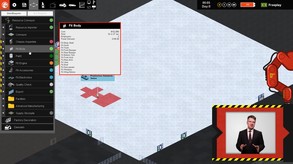
Production Line: Car Factory Simulation, developed and published by Positech Games, is a highly focused management simulation that revolves around one central idea: designing an efficient car factory from the ground up and continuously refining it until every part of the production process runs smoothly. Rather than offering a broad tycoon experience filled with distractions, the game commits fully to the logic of manufacturing, optimization, and industrial problem-solving. It is a title that rewards patience, planning, and a genuine interest in how complex systems interact over time. At the start, the game presents players with a deceptively simple task: produce cars and sell them for profit. Early factories are small and inefficient, often relying on single stations that perform multiple tasks. As production begins, it quickly becomes apparent that this approach will not scale. Cars slow down, queues form, and profits stagnate. The real depth of the game emerges as players unlock research options that allow large, slow tasks to be broken down into smaller, specialized processes. This gradual decomposition of work is the heart of Production Line, and it mirrors real-world manufacturing principles in a way few games attempt. Factory layout plays a critical role in success. Every conveyor belt, machine, and robot must be placed with intention, as poor positioning can create bottlenecks that ripple through the entire operation. Players are constantly encouraged to analyze flow, identify inefficiencies, and redesign sections of the factory to shave seconds off production time. Watching a once-cluttered factory floor transform into a streamlined system where vehicles move effortlessly from one stage to the next is deeply satisfying, especially for players who enjoy optimization and logical problem-solving. Beyond the physical layout, economic and strategic decisions add another layer of complexity. Research choices determine what technologies become available, and these decisions can significantly alter how a factory evolves. Investing too heavily in advanced technology too early can strain finances, while neglecting innovation can leave your company lagging behind competitors. Pricing strategies, production volume, and quality all interact, forcing players to balance cost-cutting with market demand. The game does not hold your hand in these areas, making mistakes an expected and instructive part of the learning process. The pacing of Production Line is deliberately methodical. Early gameplay focuses on learning systems and correcting obvious inefficiencies, while later stages revolve around marginal gains and long-term planning. Progress increasingly becomes about fine-tuning rather than dramatic expansion, which can feel immensely rewarding for some players and overly granular for others. This design choice makes the game particularly well-suited to players who enjoy steady improvement and analytical thinking rather than constant novelty. Visually, the game adopts a clean, utilitarian style that prioritizes clarity over spectacle. The isometric view provides an excellent overview of the factory floor, allowing players to quickly assess flow and identify problem areas. While the graphics are not flashy, they are functional and readable, which is essential for a game built around precision and efficiency. The interface, while comprehensive, can feel dense and slightly dated, especially for newcomers, but it becomes more intuitive with familiarity. One of the game’s strengths is its respect for the player’s intelligence. It rarely simplifies systems or obscures consequences, trusting players to experiment, fail, and learn. This approach contributes to a steep learning curve but also to a strong sense of ownership over success. When a factory finally reaches peak efficiency, the achievement feels earned, the result of careful planning rather than scripted progression. That said, the game is not without limitations. Once an optimal factory layout is achieved, the sense of challenge can diminish, and long play sessions may begin to feel repetitive. The lack of dramatic events or varied scenarios means that replay value largely depends on the player’s desire to experiment with different layouts or strategies. Additionally, players looking for narrative context or visual flair may find the experience dry compared to more theme-driven simulation games. Ultimately, Production Line: Car Factory Simulation excels by knowing exactly what it wants to be. It is a thoughtful, detail-oriented management game that transforms industrial efficiency into a compelling puzzle. Its appeal lies not in spectacle or storytelling, but in the quiet satisfaction of watching a complex system work perfectly. For players who enjoy logistics, optimization, and the challenge of turning chaos into order, it offers a deeply rewarding experience that stands out within the simulation genre. Rating: 8/10
After 20 hours seems I'm just getting started, the complexity in this game is pretty high!
Love this game
El juego esta muy bien, la economia algunas veces cuesta de entender o se rompe, pero en general no es un juego que a medida que avanza se ponga mas facil como passar con otros Tycoons si no se complica por problemas de espacio o cuellos de botella. Muy recomendado siempre que se compre en oferta por menos de 15euros
This is just factorio with no creative freedom
Muito bom
I really enjoyed this game. If you like a production management game this is a must play. It can be difficult to learn how things work in some situations and you have to pay attention to the order your production is in. For instance if you have two of the same operation twice it doesn't always notice and you spend the time and materials twice for what was one operation. Bought it at 80% off have already put in more than 20 hours and will put in more. Things I would like: 1) The ability to set the number and difficulity of the opposing AI 2) To look at what each AI competator has researched / is producing 3) Economy swings way too fast from boom to recession - slow it down, good game mechanic but, as it very difficult to leverage for the player
Related
Related
Trends
Modeled estimate over time, reconstructed from Steam's monthly review histogram.
Momentum
Pace estimated from the game's recent review growth (our daily snapshots) at its own sales-per-review ratio — a momentum signal, not booked sales.
Audience
Estimated from the language of this game's reviews — a proxy for where players are, not official Steam demographics.
Related
| Quake II | $2.5M | 10.2K | 95% | $9.99 |
| Alan Wake's American Nightmare | $2.5M | 10.6K | 74% | $8.99 |
| METAL GEAR SURVIVE | $2.5M | 5.7K | 66% | $17.99 |
| UnEpic | $2.5M | 8.2K | 91% | $12.99 |
| Outlaws of the Old West | $2.5M | 5.6K | 58% | $19.99 |
| Fallen Aces | $2.5M | 6.3K | 97% | $14.99 |