Penny Arcade’s “On the Rain-Slick Precipice of Darkness 4” concludes the saga of Tycho Brahe, Scion of The Long Project, and his almost certainly human partner Jonathan Gabriel. The world has been destroyed, but existence extends beyond this mortal plane in the gruesome Underhell!
Revenue comes from in-game items and microtransactions, which our price-based model doesn't estimate. Copies below reflect the player base, not paid sales.
Media

About
Stats
All-time low is the lowest price we've recorded for this game since we started tracking it.
Languages: English**languages with full audio support
Engagement
Reviews
Themes across 117 recent reviews and how positive each mention is. A keyword signal, not full sentiment analysis.
Reviews
7/10
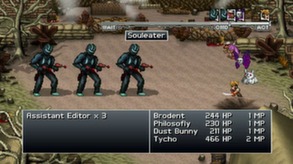
I played Precipice of Darkness 3 before this game. That game felt like it had potential but never quite got there. Precipice of Darkness 4, however, is better in almost every ways. This game is a direct continuation from Precipice of Darkness 3 which isn't compulsory to play unless you would like to get to know the characters and story a bit better. Precipice of Darkness 4 is a turn-based RPG with humor and absurdity in nature. You spent almost an entire game in a plane of existence called Underhell which is incredibly well designed. The game isn't linear like the previous installation and let you explore the world of Underhell. There are many interesting and locations you get to visit such as crystal caves, a demon train, a zoo, a futuristic tower and many more. I love a lot of these locations since they felt so unique and the soundtracks that play alongside them are spectacular. Speaking of the soundtrack, Precipice of Darkness 4's OSTs and overall sound design are also a significant improvement from the previous title. Many tracks are very memorable and become one of my favorites of all time such as tracks like Jungle, Corrupted Tower and Yggdrasil. As for the combat, your characters don't get to fight the enemies yourselves as you will collect monsters and let them fight for you, up to 4 monsters per battle. The monsters also gain the abilities from the 'trainer' which is one of your character. The combat is 'speed-based' which means the more speed you have, the faster you are able to act. You also have an ability to interrupt enemies so their turn to act gets pushed back further. So far, It is a pretty unique combat system and let you try many abilities and combos. I'm surprised by a huge amount of monster designs this game has. Some looks ridiculous, some looks amazingly creative. The story of the game is quite absurd, a bit too absurd for my taste. The overall tone is meant to be Lovecraftain style but the writing actually doesn't take itself too seriously, you will sometimes see some parodies and 4th wall breaking. Overall, Precipice of Darkness 4 is a JRPG-style hidden gem which is recommended to the genre's lover. It managed to set itself distinct from other JRPGs and be unique and memorable on their own. My score: 8.25/10
Related
Related
Trends
Modeled estimate over time.
Hours played at review time, across 117 reviews with recorded playtime.
positive critical· bar length = how often the theme comes up
The final part of Penny Arcade's Precipice of Darkness continues and concludes its epic tale with everything you would expect: humour, fun gameplay and a worthwhile ending. Definitely worth completing if you have played the previous games and found them enjoyable. This one has a slightly more 'dark' vibe to it but still maintains the previous games charm. Highly recommended, the class system from game 3 however is missed, although replaced by monster combat and training highly comparable to pokemon. Story: 8/10 Soundtrack: 8/10 Gameplay: 8/10 Voice acting: N/A Graphics: 16 bit
Good game. Lots of room for improvement, but for $2 there are a lot of great elements. The humor is what carries it, and the battle mechanics are solid. The plot, while not exactly deep, serves its purpose. Fully healing/restocking between battles means each battle can be approached as a puzzle, rather than needing to grind out value to preserve resources. The characters are diverse and the character customization tends to provide simple but potentially meaningful choices. I do need to talk about the unfortunate staticness that permeates the entire game. There are no dialogue choices or decisions of that nature, ever. There is a single lever in the game to open a closed path and a single key to open a locked door (in the same, early dungeon) -- other than that, there are no locked doors, no puzzles, nothing to interact with besides monsters to clear from your path. There are very, very few examinable objects, which makes towns feel generic and can make dungeons feel lifeless. NPC dialogue never changes, even in cases where what they're saying no longer makes any sense. No town serves any greater significance than "place you pass through to read some funny dialogue and buy new items from the same three vendors on the way to the next dungeon." There are no side-quests beyond straying off the main path to find an extra treasure or an optional battle. Aside from a few locations becoming impossible to visit later, nothing ever changes. It's not just that nothing changes. It's because nothing CAN change that a lot of the writing, while charming and witty, ends up feeling assertively meaningless. No NPC can have meaningful dialogue because what they say CAN'T have anything to do with the context of your characters or their journey. No NPC can have a problem for you to solve, or an insight about what to do next, or a choice for you that will affect something later. So what you get from everything outside of plot moments is a constant, aggressive silliness (like a town where everyone talks about Strangling like it's a local custom) devoid of any deep significance. This is true of battles, too. No boss has so much as a second phase or a change in their fighting style. If there were boss with learnable patterns that could be responded to, I never noticed those patterns. No enemy has an interesting gimmick that forces you to approach them differently, aside from some end-game enemies that could drain your MP. A lot of battles end up playing out basically identically. It was a game I had to play in short bursts, because despite the whimsical enemy designs, the fighting was so samey in many places. Especially in the early game, when fighting mostly revolves around setting up a lot of damage-over-time effects and then winning through attrition. Mercifully, the further you go into the game, the better your multi-target abilities become. On the plus side, this makes random encounters go much faster; on the down side, it makes fights play out literally identically, as you apply the same buffs in the same order and then use your big multi-target spells to win in a few attacks. Random encounters become solved problems, no longer requiring you to balance offense and defense. It's a shame, but the fundamentals ARE there. The writing is effective and funny, the basic mechanisms of battle (gaining 1 MP a turn, interrupts to push back enemy turns, items recharging between battle, etc.) are extremely thoughtful and enticing, and the plot works despite the limitations of the static world. I found myself drawn back to the game again and again, even the samey battles and the certainty that there could be no real surprises outside of plot twists. It's a weak recommend for me, but if you're a fan of RPGs, hey, it's only $2.
The writing is entertaining and the music is surprisingly awesome. The basic gameplay loop is also very engaging for a game of this length, and some of the pixel art is very effective. Other parts feel... like they were made in a big rush. Animations are... minimal. Controls are chunky. The town and level design is sparse; towns tend to have one npc per building with one line of dialogue each, most levels are basically linear, and there is a lack of payoff for exploration.
Game make funny i Appreciate it.
Fantastic series
baloney
Just like the third one.. If you liked the first two games, don't play this one. Everything you loved about the two first games.. gone. This title has no humour, the gameplay is just hours of mindless FF style fights, and there are no secrets to discover. Stay clear!
So after part 1 and 2 were created by Penny Arcade, parts 3 and 4 were created by Zeboyd games and produced by Penny arcade. This game continues from the third game with the same meaningless and verbose dialogue, and this time around, I'm not even sure what happens to the plot. Things really don't make a whole lot of sense this time around and I'm not sure why “insert spoiler here” does what he does, other than wanting to end the world because “why not?”. I've never really been a big fan of the plot per se in this series. I think I enjoy the comedy more on the Zeboyd games and the plot a little more on the Penny Arcade games, mainly because there aren't big time jumps and a lack of explanation in the first two games. The pixel art received an upgrade here and I like it even more than before. The backgrounds are detailed, the colors are bright and each area looks distinctive, save for the caves, which all kind of look the same. However, those caves are pretty much all side areas, so that's fine with me. The sprites are very much the same (if not exactly the same) as they were in game 3 and they fit in with the rest of the world here too. I like having the world to explore again as the world map is now free roaming and there are a number of side dungeons that pop up and various dead-end paths in each dungeon with secret characters and extra treasure. I really enjoy having the world map back to explore and since there are so many extra characters to find and even an airship to explore areas that you couldn't get to before or revisit areas you missed the first time though. They even through in the first dungeon from Breath of Death VII (visually updated of course) for a gag side dungeon that had me hyped. I think they outdid themselves with the combat once again here as well. The combat has evolved from game 3 where it felt like a mash up of the original Penny Arcade style, with Final Fantasy V, and Cthulhu Saves the World all mixed together. This time, we still get to mix a number of job classes together, but they've added a trainer and monster system, meaning that one job class comes from the trainer and the other one comes from the monster. The game tells you in the first 5 minutes that our characters cannot battle in the new world that game 4 takes place in and so they command monsters to fight in their place. Early on, the difficulty was reasonable, but around the halfway point in the game you start getting really powerful, all-targeting spells that lay waste to most normal enemies in a round or two. I like the creativity involved in having your monsters be either more tank-focused, magic-focused, support-focused, or physical-focused. The amount of characters is kind of overwhelming at times and with a whole string of level ups after some battles with far too many new abilities scrolling by, it sometimes leads to stalling the gameplay to re-check all of my monster's abilities to see if I need to adjust my strategy on account of a new attack. Don''t get me wrong, I like the combat here probably as much if not more than any other battle system in the series. The amount of variety of moves and styles and the ridiculousness of the monster designs kept me intrigued all game long. What other game can you have a vending machine as a party member? The music here is also well done. They seem to have fixed the looping issue from game 3 and what is here isn't anything ground breaking, but it's fun to listen to the dungeon themes and and they seem to fit the theme of the dungeon or the mood of the characters going into a dungeon at least. They even threw in a vocal track for the “Team Rocket” equivalent group and it's funny and stupid as you might expect. Overall, I have enjoyed this series as a whole and I enjoyed this game too. The series improved over time with each new instalment. The plot is nonsense, but the gameplay and the turn based combat in each game is interesting enough on its own to keep a veteran player of the JRPG genre interested.
Momentum
Pace estimated from the game's recent review growth (our daily snapshots) at its own sales-per-review ratio — a momentum signal, not booked sales.
Audience
Estimated from the language of this game's reviews — a proxy for where players are, not official Steam demographics.
Audience
Games most often reviewed by the same players — an audience-affinity signal from our review sample, not full ownership data.