[h3] Graphics [/h3]
☐ Amazing
☐ Beautiful
☑ Good
☐ Decent
☐ Bad
☐ Don‘t look too long at it
[h3] Gameplay [/h3]
☐ Very good
☐ Good
☐ It's just gameplay
☑ Mehh
☐ Dull and boring
[h3] Audio / Sound Design [/h3]
☐ Eargasm
☐ Very good
☑ Good
☐ Not too bad
☐ Bad
[h3] PC Requirements [/h3]
☐ Potato
☑ Medium
☐ High
☐ Very High
☐ AI Workstation
[h3] Difficulty [/h3]
☐ Just press 'W'
☑ Easy
☐ Easy to learn / Hard to master
☐ Significant brain usage
☐ Difficult
☐ Extremely difficult
[h3] Grind Level [/h3]
☐ Nothing to grind
☐ Isn't necessary to progress
☐ Average grind level
☑ Too much grind
☐ You'll need a second life for grinding
[h3] Story [/h3]
☐ No Story
☐ Some lore
☑ Average
☐ Good
☐ Very good
☐ Amazing
[h3] Game Time [/h3]
☐ Short
☑ Average
☐ Long
☐ Eternal
[h3] Price [/h3]
☐ It's free!
☐ Worth on full price
☐ Worth on a small sale (20%~30%)
☐ Worth on a big sale (30%~60%)
☑ Worth on a huge sale (60%~90%)
☐ Not recommended at all
[b] TL;DR: Don't be fooled by how it looks, because this is not an open world game. Just a handful of landscapes with procedurally generated forests and randomly placed loot, structures and anomalies to avoid. Additionally, its "radio podcast" driven narrative feels dull, with zero twists and a rather boring final outcome. Not worth the full price tag. Grab it if on a significant sale (80% or more). [/b]
---{ 6 / 10 }---
[h1] Deep Dive [/h1]
Pacific Drive presents itself as a first-person driving and survival game in which an old station wagon is the player’s only companion. It combines resource gathering, mechanical maintenance, component crafting and route planning through the Olympic Exclusion Zone, were you will have to deal with "supernatural" hazards.
This premise sounds pretty original, but conceptual originality does not automatically translate into solid game design. The central problem with Pacific Drive is that it attempts to combine too many ideas without establishing a clear hierarchy among them. It is simultaneously a driving game, a survival game, an extraction game, a crafting game, an inventory-management game, a vehicle-maintenance simulator, a procedurally structured exploration game, an environmental horror experience, and a radio-driven narrative.
[b] Sadly, the result is a game that is more memorable for what it attempts to do than for how consistently it does it. [/b]
[h2] Gameplay [/h2]
The core loop consists of preparing the vehicle, selecting a route, crossing several junctions, stopping to collect materials, extracting energy from anchors, escaping a storm, and returning to the garage to repair and upgrade the car. On paper, the system offers an appealing rhythm of preparation, exploration, improvisation, and reward. During the opening hours, this works particularly well because every recovered component, discovered anomaly, and unlocked upgrade seems to meaningfully expand the player’s options.
However, the problem emerges once it becomes clear that progression primarily changes the quantities and demands involved, rather than sufficiently transforming the actions themselves. Later regions introduce new materials and hazards, but they rarely introduce genuinely different gameplay mechanics.
Rather than evolving, the loop becomes slower, more punishing, and more dependent on specific resources. And this keeps on going until the end of the game.
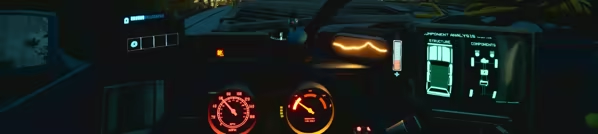
The station wagon is, by far, the game’s best-developed element. Its functional dashboard, switches, gearshift, windshield wipers, radio, gauges, and interchangeable parts create an unusually tactile relationship between player and vehicle. However, this not an especially deep driving game in the traditional sense. The vehicle has weight, degradation, and noticeable differences between tires and components, but the roads and handling model do not provide enough precision or complexity to make every trip a compelling automotive challenge on its own.
The car is not simply your mean of transportation. It is a shelter, an inventory, a tool, a progression system, and a physical representation of the current state of the run.
Driving works better as a source of atmospheric tension than as a sophisticated technical system.
Paradoxically, Pacific Drive forces the player to spend a significant portion of the game outside it. The sections on foot are mechanically underdeveloped. The character has basic movement, functional tools, and few meaningful interactions beyond collecting, dismantling, repairing, and carrying objects.
This creates a central contradiction: the best mechanic in the game is driving, yet the resource economy constantly requires the player to stop driving.
[h2] World [/h2]
Although its presentation suggests a journey through a mysterious territory, the Zone is not a continuous open world. It is divided into separate maps called junctions, connected through a route-planning screen.
This structure supports variable routes and procedurally arranged hazards, but it weakens the feeling of undertaking a genuine journey. Locations function more like resource-gathering arenas than persistent places. The player learns environmental categories and resource patterns, but rarely develops a deep spatial relationship with the territory. Reaching the more distant regions also requires repeatedly crossing familiar junctions. Routes become longer not because every section contributes something new, but because they are part of the logistical cost of reaching the destination.
[b]As a result, travel gradually stops feeling like exploration and begins to feel like a procedural requirement.[/b]
One of the best things of this game, along with your "companion" wagon, are the anomalies. They are among the game’s most imaginative visual elements. Some alter the terrain, while others attack the car’s components, trigger electrical discharges, move the vehicle, or contaminate entire areas.
When they are properly signaled, they create interesting decisions: take a detour, protect a particular section of the car, perform repairs under pressure, or accept damage in order to save time. However, the game relies too heavily on stacking anomalies on top of one another. You might be dealing with a flat tire produced by running over an anomaly, while a radiation storm reaches you, lowering your health while repairing your tire.
[h2] Story/Lore [/h2]
The mystery of the Zone, the ARDA experiments, and the nature of the connection between driver and vehicle provide a compelling foundation. The radio characters have personality, and several narrative moments are somehow effective, yet insufficient for the narrative to take hold on the player. Additionally, the scientific, bureaucratic, and paranormal atmosphere also avoids many of the most predictable conventions of the horror genre.
The limitation lies in the way the story is communicated. Much of the dialogue plays while the player is driving, consulting the map, avoiding anomalies, managing fuel, or searching for resources. The narrative directly competes with actions that demand attention. This physical absence of the characters reduces their dramatic impact. They are interesting voices, but they remain distant for almost the entire adventure.
The repetitive structure further damages the story’s pacing. Several expeditions focused primarily on collecting materials or unlocking a route may separate one major revelation from the next. The mystery moves forward at intervals, while mechanical routine fills the space between them.
[b]The world is more convincing as an atmosphere than as a fully developed narrative. The Zone inspires curiosity, but the story does not always adequately reward the time required to cross it.[/b]