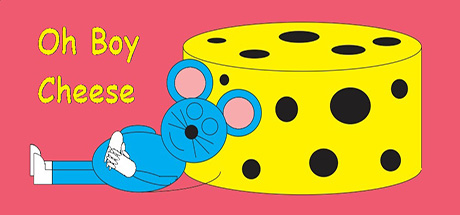
Have some cheesy fun with two modes of cheesy madness. Try tojump onto scoreboard by collecting the cheese or just have some casual fun. Play one wacky mode, with trampolines, planes, presents and explosions. Whatever you choose it will be cheesetastic.
Modeled estimate, not a reported figure. How we estimate →
Media

About


Stats
All-time low is the lowest price we've recorded for this game since we started tracking it.
Languages: English
Reviews
As a cheese lover, I was intrigued when I was gifted this game by one of my dear friends, Bryan. I can only assume he saw the game and thought it would be perfect for me, as it sits nicely with my hobbies of attending monthly cheese club meetings and making my own cheese. Oh Boy, was he right! The protagonist, Mr Blue Mouse (featured in the game title picture above), and his girlfriend Mrs Pink Mouse are two hungry meese on the hunt for cheese. The games lack of plot or coherent story line allows you to use your own imagination to paint a picture of why these two star crossed lovers would be reduced to using a paint brush to propel each other into the air in order to catch ever-more mouldy bits of cheese (spoiler). I like to imagine they are the last two mice on earth after a nuclear explosion destroyed most of the planet, throwing off the centre of gravity, causing cheese to float (the mouldier it gets, the higher it floats) and in their efforts to stay alive and repopulate the earth with new mice they must propel each other towards the floating cheese using the only thing they have left - the paint brush. But really, the story is down to you. I have lost myself for hours in this world of nuclear destruction, mice, and survival to the end. One day I will achieve the high score, and on that day I shall consider my life complete. 10/10 made me hungry
cheese
OH BOY CHEESE!!! This game is a cheesy masterpiece. Writing this as I have 7.2 hours but I guarantee I will play this for at least 50 hours and it will NEVER get old. If you are in the mood to get absolutely hype and eat some good ♥♥♥♥♥♥ cheese I can only recommend this game. I was gifted this game by my homeboy from Uganda. He didn't have any money for food this week but he still bought me Oh Boy Cheese because he is an absolute CHAD. As soon as I played for the first time I knew how big of a favor he did for me and I HAD to return the favor. So I sent him my leftover mac n cheese from last night because I knew it had been a few days since he ate. LONG LIVE THE QUEEN!!!
Oh! Cheesus! What a game! When my good friend Bryan gifted me this game I had no idea what to expect. Excited, and a tad nervous, I plunged feet first into an epic survival game to collect as much cheese as I could for my adorable mice to survive. As my hunger for collecting Cheddar grew I soon became engulfed by my desire to get the high score and proudly display my name on the leader board. And now I can say, by the grace of Gouda! I DID IT, MOM! I 100% recommend this game!
This game is incredible, but to understand it we must first take a journey into Hegelian dialectics. “Hegel’s dialectics” refers to the particular dialectical method of argument employed by the 19th Century German philosopher, G.W.F. Hegel), which, like other “dialectical” methods, relies on a contradictory process between opposing sides. Whereas Plato’s “opposing sides” were people (Socrates and his interlocutors), however, what the “opposing sides” are in Hegel’s work depends on the subject matter he discusses. In his work on logic, for instance, the “opposing sides” are different definitions of logical concepts that are opposed to one another. In the Phenomenology of Spirit, which presents Hegel’s epistemology or philosophy of knowledge, the “opposing sides” are different definitions of consciousness and of the object that consciousness is aware of or claims to know. As in Plato’s dialogues, a contradictory process between “opposing sides” in Hegel’s dialectics leads to a linear evolution or development from less sophisticated definitions or views to more sophisticated ones later. The dialectical process thus constitutes Hegel’s method for arguing against the earlier, less sophisticated definitions or views and for the more sophisticated ones later. Hegel regarded this dialectical method or “speculative mode of cognition” (PR §10) as the hallmark of his philosophy and used the same method in the Phenomenology of Spirit [PhG], as well as in all of the mature works he published later—the entire Encyclopaedia of Philosophical Sciences (including, as its first part, the “Lesser Logic” or the Encyclopaedia Logic [EL]), the Science of Logic [SL], and the Philosophy of Right [PR]. Note that, although Hegel acknowledged that his dialectical method was part of a philosophical tradition stretching back to Plato, he criticized Plato’s version of dialectics. He argued that Plato’s dialectics deals only with limited philosophical claims and is unable to get beyond skepticism or nothingness (SL-M 55–6; SL-dG 34–5; PR, Remark to §31). According to the logic of a traditional reductio ad absurdum argument, if the premises of an argument lead to a contradiction, we must conclude that the premises are false—which leaves us with no premises or with nothing. We must then wait around for new premises to spring up arbitrarily from somewhere else, and then see whether those new premises put us back into nothingness or emptiness once again, if they, too, lead to a contradiction. Because Hegel believed that reason necessarily generates contradictions, as we will see, he thought new premises will indeed produce further contradictions. As he puts the argument, then, the scepticism that ends up with the bare abstraction of nothingness or emptiness cannot get any further from there, but must wait to see whether something new comes along and what it is, in order to throw it too into the same empty abyss. (PhG-M §79) Hegel argues that, because Plato’s dialectics cannot get beyond arbitrariness and skepticism, it generates only approximate truths, and falls short of being a genuine science (SL-M 55–6; SL-dG 34–5; PR, Remark to §31; cf. EL Remark to §81). The following sections examine Hegel’s dialectics as well as these issues in more detail. Hegel provides the most extensive, general account of his dialectical method in Part I of his Encyclopaedia of Philosophical Sciences, which is often called the Encyclopaedia Logic [EL]. The form or presentation of logic, he says, has three sides or moments (EL §79). These sides are not parts of logic, but, rather, moments of “every concept”, as well as “of everything true in general” (EL Remark to §79; we will see why Hegel thought dialectics is in everything in section 3). The first moment—the moment of the understanding—is the moment of fixity, in which concepts or forms have a seemingly stable definition or determination (EL §80). The second moment—the “dialectical” (EL §§79, 81) or “negatively rational” (EL §79) moment—is the moment of instability. In this moment, a one-sidedness or restrictedness (EL Remark to §81) in the determination from the moment of understanding comes to the fore, and the determination that was fixed in the first moment passes into its opposite (EL §81). Hegel describes this process as a process of “self-sublation” (EL §81). The English verb “to sublate” translates Hegel’s technical use of the German verb aufheben, which is a crucial concept in his dialectical method. Hegel says that aufheben has a doubled meaning: it means both to cancel (or negate) and to preserve at the same time (PhG §113; SL-M 107; SL-dG 81–2; cf. EL the Addition to §95). The moment of understanding sublates itself because its own character or nature—its one-sidedness or restrictedness—destabilizes its definition and leads it to pass into its opposite. The dialectical moment thus involves a process of self-sublation, or a process in which the determination from the moment of understanding sublates itself, or both cancels and preserves itself, as it pushes on to or passes into its opposite. Now that we've covered this, I can move on to the bulk of the review. Oh boy cheese! 10/10
very gud
oh boy its my favorite game, a deep murder mystery thriller its is all hidden behind an innocent game fo a rat and his cheese You can move on your own cheese adventure with up to 2.3 modes have some cheesy fun and be dairy-ing in experiencing this cheesetastic game Struggling with loss and trauma well this little sketchy boy tiny man rat knows just the thing his hit game OH BOYYYYYYYYYYYYYY CHEESE Who killed franz Ferdinand, none other than the cheese itself help this little teeny rat mouse ratty rat boy collect the cheese and put it through the UN court for its actions This ratty boy fought and killed hitler That very night this rat fell in love speaking Cheesia Cheesia where art thou, your holes shine like that of the sun at dawn. Where art though cheesia; oh how our competing families despise us, now with this we must depart to the friar to prepare our marriage henceforth Then the friar spoke @Middledong play rat and cheese or else and with that ratio and cheesia moved on in their lives to kill Hitler and bring world peace through their enlightening experience with the game OH BOY CHEESE a hit classic on the steam store Well little did they know a cursed day had come september 11th, in which the twin cheese wheels fell Oh cursed wretched day how hast though blightened this deep luminous pain upon us but out from the cheese shreds a chorus arose "Oh cheesy tis of thee sweet mice of liberty and this we "OH BOY CHEESE"
when my good friend super vicente recommended me this amazing game, i decided to play it. i have never seen a better game. wacky mode is especially good
a masterpiece of the century
To understand Oh Boy Cheese, one first has to understand Diagetic UI design. Diegetic interfaces are interfaces that characters in the game can also see (such as the number of ammo indicated on the actual gun in a first person shooter), while non-diegetic interfaces are interfaces that only the player can see (such as health bars and mini-maps) (http://www.gamasutra.com/view/feature/132674/game_ui_discoveries_what_players_.php ). In the aspect of non-diegetic interfaces, the designer has a problem of determining what components to show on the screen at all times and how these components will interfere with the game’s overall engagement. Constant in-game screen components give designers of games with primarily non-diegetic interfaces a bit more worry about screen components cluttering and if it would conflict with the minimalist principle. Mini-maps, for example, can show essential information in a game, but also take up essential screen space, which may cover parts of the game world and get in the way of player engagement. Primarily diegetic interfaces, on the other hand, don’t have as much components constantly on screen, so they don’t have to worry as much about screen clutter throughout the game. Of course, they still have to worry about clutter in traditional START menus, but not so much with the actual in game screen. However, the drawback is that they have to worry more about how to display essential information. Good UI design tries to balance aesthetics with information. Meaning, it tries to incorporate a clean and simple interface while at the same time presenting essential information. Non-diegetic interfaces seem to weigh more towards the side of presenting essential information, while diegetic interfaces seem to weigh more to clean interface design. Thus, I feel that it’s essential to balance both diegetic and non-diegetic components in a game. Of course, that might not apply as much to simple games like Tetris, but it’s definitely something to think about in games with more mechanics like larger-scale RPG and shooter games. Now that we've got that out of the way we can move on to the bulk of the review. Oh Boy Cheese! 10/10
Related
Related
Trends
Concurrent players on Steam, sampled daily since tracking started.
Related
| Glasses and Girls | $315.6 | 51 | 82% | $0.99 |
| Bongo Quest | $315.6 | 51 | 45% | $0.49 |
| Food and Girls | $315.6 | 51 | 86% | $0.99 |
| Dances and Girls | $322 | 52 | 83% | $0.99 |
| Anime Sunset Ride | $334.4 | 54 | 67% | $0.49 |
| Carnival and Girls | $334.4 | 53 | 85% | $0.99 |