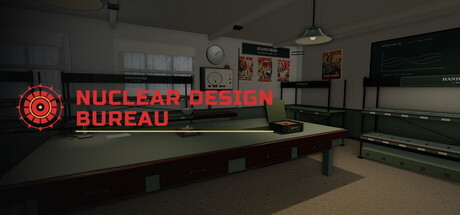
Design. Simulate. Detonate. As a junior engineer at the Kurchatov Institute, you design atomic devices to satisfy the demands of the State. A hardcore physics game simulating hydrodynamics, neutron transport, and thermonuclear fusion.
Modeled estimate, not a reported figure. How we estimate →
About
NUCLEAR DESIGN BUREAU is a hardcore sandbox engineering game where you design and test nuclear devices.
You are a junior engineer at the Kurchatov Institute. The State gives you a target and a warehouse full of dangerous materials. Some directives limit what you are allowed to use. Your job is to build a device that does what the directive asks.
This game is built in the open. The campaign, the physics and the tools change based on what players build, where they get stuck, and what they ask for. That is the whole reason it is in Early Access.
HOW IT WORKS
- Receive a directive: Technical requirements and constraints, with material limits on some jobs.
- Measure it by hand: The criticality lab is first person. Set the core in its cradle, lower the beryllium reflector onto it, and watch the counter on the wall while the live k estimate climbs toward one. Push it too far and the dose lands on your hands, not on a number.
- Design: Paint materials straight onto the blueprint grid. Build the primary, the casing, and the supporting systems.
- Simulate: Hit the red button and run full detonation physics in real time.
- Refine: If it fizzles, fails, or wastes material, work out why and change it.
CORE FEATURES
- Physics-Driven Simulation: Shockwaves, heat, radiation, and chain-reaction behavior are modeled in real time.
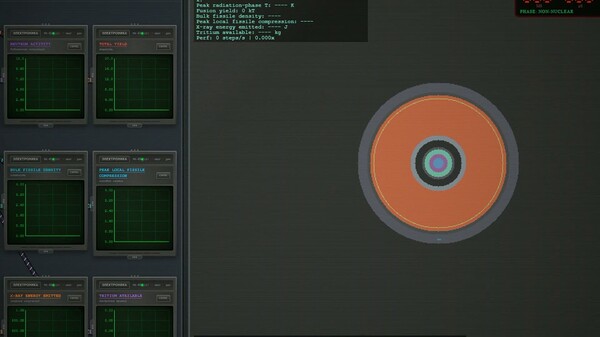
- Criticality Lab: A first person room where you handle the real parts. Live Monte Carlo k-effective, a wall counter that lags the way the instrument actually would, and radiation exposure that shows on the operator instead of in a readout.
- Detonation Viewer: Observe detonations as they unfold, with live visual feedback on blast behavior.
- Campaign Directives: Structured mission progression with technical goals and constraints.
- Sandbox Mode: Unlimited experimentation with full design freedom.
- Iterative Engineering Loop: Build, test, diagnose, and optimize.
EARLY ACCESS STATUS (CURRENT BUILD)
The current Early Access build is playable end to end and includes the core gameplay loop:
- Design -> Simulate -> Detonate -> Refine
- The criticality lab
- Sandbox mode
- Campaign directives
- Save/load systems with ongoing stability improvements
This is an active development build. Expect balance changes, physics work, and campaign iteration during Early Access.
EARLY ACCESS ROADMAP (SUBJECT TO CHANGE)
Physics and Simulation
- Refining the detonation viewer (better shockwaves, damage radius and thermal radiation modeling, destructible buildings and targets)
- Finer grid resolution for stronger PCs and GPUs
- More to do in the criticality lab
Campaign and Content
- Expanding the campaign with unique challenges
- Many more directives/missions
- Voiced campaign
- Additional bomb concepts (high-radiation designs, clean bombs, neutron bombs)
- More advanced materials
Presentation and Audio
- More music tracks
Community and Meta
- Public leaderboard
- Statistics on every campaign directive, so you can compare how efficient your design was against everyone else's
DEVELOPMENT APPROACH
Design. Simulate. Detonate.
Early Access is where this game gets shaped in public. What players build, where they get stuck, and what they ask for decides what gets worked on next. Most of the day to day happens on Discord.
"The atom is not a soldier, Comrade. It is a force of nature. We merely tell it where to go."
Genres
Stats
All-time low is the lowest price we've recorded for this game since we started tracking it.
Engagement
Reviews
Themes across 123 recent reviews and how positive each mention is. A keyword signal, not full sentiment analysis.
Reviews
Had no idea science was this fun 10/10
It's megatons of fun.
I really enjoy the idea, however, the tests and simulations take an extremely long time to complete. I do understand that this is in early access but holy smokes is this ever kind of a drag. I do recommend this game for those who are interested in nuclear physics, but I would like to see optimization to help the speed of the tests and simulations. Also the first person annex is sluggish and I am running an ASUS TUF GAMING laptop in turbo mode and I am still having issues. 6/10 until improvements are completed.
Media

Related
Related
Price dynamics, follower growth, revenue and sales trajectories with interactive tooltips
This and every other Pro feature is free until October 20, 2026. A free account is all it takes.
Languages: English
Hours played at review time, across 123 reviews with recorded playtime.
positive critical· bar length = how often the theme comes up
Big Bomb= Me Like
I think this has strong bones, but it is very rough currently. Main issue I have is the basic editing controls (the main thing you use while playing) are atrocious and extremely clunky. Fullscreen and windowed fullscreen settings don't seem to work for me either. Still worth the low price of entry at the moment though if this piques your interest.
It's definitely early access, there are bugs, and the simulation is slow, but it's doing hydrodynamic math, it was always going to be slow. If you can handle it being slow, then 10000% recommend it. It's everything I could have asked for, and more. It's truly beautiful.
A fun, light-weight sim/game. I honestly am impressed with how compelling the simulation is. I went into the campaign with a generalized understanding of what actually goes on with fission/fusion reactions ... only to realize that I barely had a clue. I genuinely cannot express how satisfying it is to see a design work. 10/10 - It's an absolute blast (yes, I did the thing, no regrets)
This is another game that makes me wish there was a neutral recommendation. There is a lot I like about this game, though I think I have trouble recommending it to people who weren't already excited about the core concept. Granted, it is in early access, and I have faith that it will improve substantially. I think there's enough novel about it that people should give it a try and I hope that the dev will get the resources to make it what I think it has the potential to be, so I'll give it a tentative recommend. The good: it's a really cool and enlightening idea and there's nothing else like it. It has that quality of the old powder simulator flash games but only the most exciting part and dialed up to 11. I really enjoyed it until I got to the Lithium Deuteride and HEU sparkplug, which I could not get to activate after hours of attempts (I think maybe it has to do with the timing of fast neutrons hitting the sparkplug vs the x-rays, but I have no idea). I saw another review with a similar problem. The place where I give the game more grace than a lot of reviews: I suspect that what people are identifying as poor performance is not so much poor framerate as it is different physics operating at very different timescales - propagation of x-rays and neutrons vs propagation of a mundane explosion front are orders of magnitude different in speed. I think the game is running at the speed of the slowest phenomenon. Yes there is a lot of room for performance improvements, but I think slowdowns are inevitable. I think the game needs a more graceful way of doing this; perhaps performing the calculations and saving to file without rendering, then showing the result as more of a recording that can be panned through at the speed of the viewer's choice. This would also make diagnosing a build that doesn't work well much easier. Another thought is perhaps trying to coarse-grain the slowest elements (i.e., instead of waiting for individual neutron emissions and ratcheting down to ns timesteps, calculate a probability distribution for number of neutron events in a 10 ns window and run the calculation accordingly). The place where this game has absolutely no excuse: Every written word in this game needs to be proofread. Much of the tutorial text is confusing or misleading. This just needs a person to spend a day making it legible. Related - the hints that pop up after you fail; you should be able to scroll through those at will. Other things that need work: 1) Whatever kind of finite element simulation is going on is a little janky. Everything sort of puffs up and rounds out once the simulation starts - it's very inconvenient given how gun-type designs require an object to slide seamlessly through a channel. Everything in general is very bouncy and squishy in a manner that makes the core mechanic of the game - timing a compression event perfectly - seem very RNG-based. I'm not sure if this is consistent with what we should expect from shock-loading, but it feels off. 2) The building tools and UI in general are a bit awkward. It's difficult to be precise, which is bad in a game where precision engineering is key. 3) It would be good to have temperature/stress/neutron flux/photon flux overlays for the visualization. This would play well with my previous comment about making the simulation a recording you can seek through rather than a real-time calculation. At the moment, the consoles on the left that show peak quantities over time are of marginal utility when you reached peak fissile density 100 ns ago and can't go back and see what the state of the simulation was then. 4) Better tutorials in general. There's what I guess you could call a difficulty spike, but more accurately a "5 new mechanics were just introduced with barely explanation" spike once the game progresses to thermonuclear. A set of pre-built devices that can be loaded in the sandbox and demonstrate different mechanics wouldn't go amiss.
Simplifies enough to make the game casual while still providing a challenge to maximise effecency and make a big ass boom
Fantastic so far. Needs polish, but I'm already having a lot of fun. Great work!
Selling now
See how fast this game is selling right now — estimated copies and revenue per day from recent review growth.
Active players
Estimated daily and monthly active players (DAU/MAU) modeled from peak concurrency.
Players by region
Where this game's players are, estimated from review languages.
Players also reviewed
The games this title's players most often review too — audience affinity.
Related
| Game | Estimated lifetime revenue | Reviews | Review score | Price |
|---|---|---|---|---|
| $2.5K | 19 | 89% | $4.99 | |
| $170.5K | 207 | 92% | $19.99 | |
| — | 0 | — | — | |
| — | 0 | — | — | |
| $285.6K | 1.4K | 86% | $9.99 | |
| $199.5K | 321 | 92% | $14.99 |
Related
| Game | Estimated lifetime revenue | Reviews | Review score | Price |
|---|---|---|---|---|
| $78.1K | 915 | 79% | $3.99 | |
| $78K | 548 | 73% | $7.99 | |
| $78.1K | 142 | 71% | $19.99 | |
| $78.1K | 599 | 71% | $4.99 | |
| $78.1K | 751 | 67% | $5.99 | |
| $78.1K | 344 | 74% | $6.99 |