Save the Imperial Capital from supernatural invasion in a 90s-style adventure that uses real deduction and research skills. Explore Tokyo, snap photos and analyse evidence for 40+ landmarks, from prehistory to the present. Confront a cast of wandering spirits to separate truth from fiction.
Modeled estimate, not a reported figure. How we estimate →
About
In Mysteries of Old Tokyo, you’re the brand new investigator for the Tokyo branch of the secretive Rare Items Acquisitions Ltd. Puzzle your way through 11 chapters that each explore a different aspect of the city's history.
Mysteries of Old Tokyo is inspired by the CD-ROM "multimedia experiences" of the 1990s like Encarta '96 and Cosmology of Kyoto, as well as modern detective games like The Roottrees are Dead and the Golden Idol series.
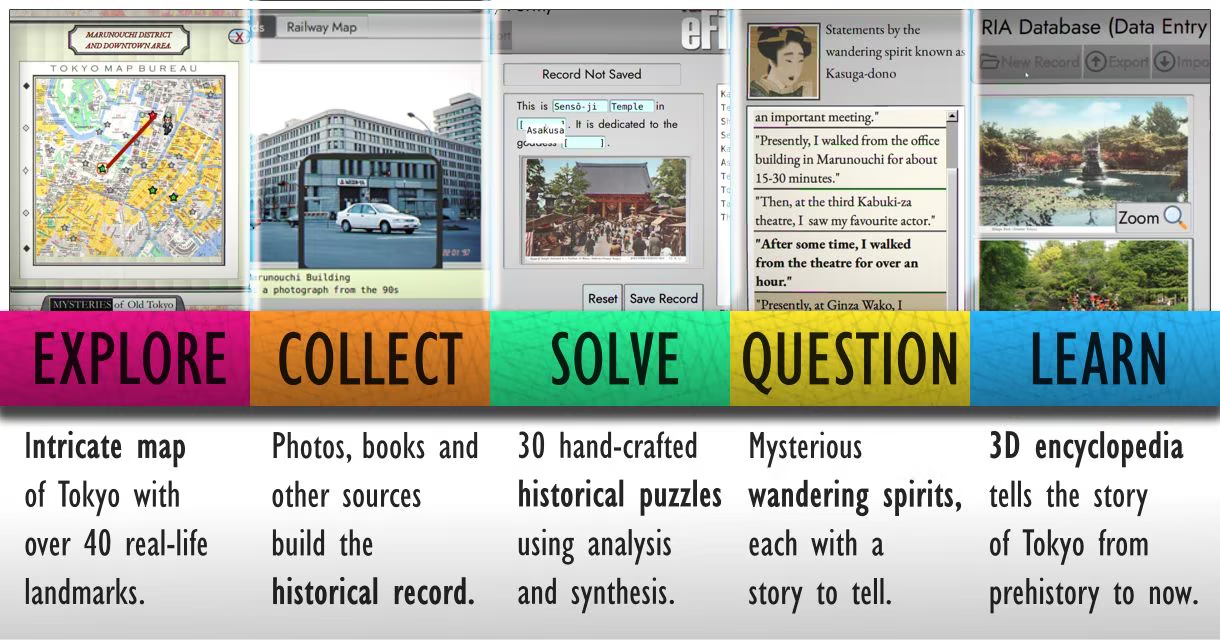
You’re a historian now! 30 hand-crafted puzzles explore the fascinating history of the Imperial Capital. Each week, you'll explore three new locations based on a 1930s postcard:
Take a photo to show the present day view at the very same spot.
Collect evidence linked to the site: books, magazines, maps, paintings, archive photos, and more.
Use analysis and synthesis to build the complete picture from multiple sources, just like a real historian.
Extract words to correct the historical record in "fill-in-the-gap"-style gameplay.
Why did the Forty-Seven Ronin kill [ ]?
Why is [ ] vital to the spiritual defence of the entire city?
What became of the Three Human [ ]?
Analyse your photos to compare the changes between the 1930s to the 2020s.
You’ll fill in the gaps for each postcard and help your mysterious employer create a detailed database of Tokyo’s history, all based on real historical sources.
You won’t be alone as you explore Tokyo. A supernatural dam has burst, spilling confused ghosts from the Iron Age to the 1980s across the city. As they tell their stories, not everything they say will add up.
Encounter spirits of the "Edokko" ("children of Tokyo") at new and old locations as you explore the city.
Build up their story bit-by-bit in the Spirit Report.
Explore 15 hand-crafted narratives each telling the story of a single day in Tokyo's long history.
Use the Encyclopedia and your personal experience of Tokyo to identify the errors and lies.
Chigau! I object! J'accuse! Highlight the inconsistencies and catch them out to help them clear up their memories.
Each time you submit a Spirit Report, you'll build up trust with the spirit and unlock more of their backstory, based on the real lives of the Edokko: there are five uniquely-written spirits to meet, from flirty courtesan Kasuga-dono to bubble-bound salaryman Yoshida-san.
After you finish the main storyline, continue playing in the post-game to unlock all 15 narratives and character stories.
You're not just a desk jockey. Each week, with PDA and digital camera in hand, you’ll set out from your office to visit three new locations.
Go by foot or by train from your home base in Marunouchi to view each postcard in its real-world geographical context across four maps: Central Tokyo, Downtown Marunouchi, Tama River and Haneda.
Discover each location using your PDA Directory and a nearby station's Location Board.
Revisit old haunts based on paranormal analysis to discover new stories for the Spirit Report.
Plot a route to some of the most famous Tokyo landmarks:
Ginza
Asakusa Sensō-ji Temple
Ueno Station
Shinjuku Street
Haneda Airport
Meiji Shrine
And many more!
Unlock new evidence by visiting special points around the map.
Use the Similarity Finder to precisely line up present-day photographs with the original postcards.
With the Time Loupe in Direct Mode, compare past and present and identify common features.
In Parallels Mode, tease out the tiniest similarities in views that have changed almost completely since 1935.
And in the Treasure Browser, unlock ten hand-crafted artefacts in glorious 360 degree 3D, each telling their own story of the Imperial Capital: from a "Galapagos phone" to a samurai sword.
For lovers of Tokyo, this might just be the most authentic interactive recreation ever made.
Painstaking research reveals the history behind a set of antique 1930s postcards, discovered at a flea market in Shibuya and scanned in high quality.
Each postcard is complemented by the original description, human-translated from Japanese for the first time. Illustrations, modern-day photographs, and an author's commentary provide the full picture.
From Akabane to Zoshigaya: Ride the rails on a meticulous recreation of 18 real-world train lines and over a hundred stations in Tokyo.
Go back in time with a complex four-dimensional map of Tokyo's transit, covering every year from 1872 right up to the present day.
Hundreds more Tokyo locations in the landmark database, visited by mysterious spirits, from the Imperial Hotel to the Tokyo Skytree.
A huge encyclopedia based on extensive research, telling the whole story of Tokyo from prehistory, through the Edo period, to the 80s bubble and beyond.
Ancient fortresses crumble. Long-forgotten spirits flood the city. A powerful supernatural force threatens to upend the everyday lives of Tokyo’s 14 million residents. Each week, as you unlock more postcards, you’ll uncover more of the backstory with interludes and FMV cinematics, and ultimately save the city.
Genres
Stats
All-time low is the lowest price we've recorded for this game since we started tracking it.
Engagement
Reviews
Themes across 45 recent reviews and how positive each mention is. A keyword signal, not full sentiment analysis.
Reviews
Nice! I wish more small-scale devs had the guts to experiment like this and to deliver a complete product. I wish I had the guts. The game is curious and relaxing. The mechanics could've been harder, but maybe the difficulty will escalate with my progression.
Never knew I needed a Where in Tokyo is Carmen Sandiego, but I did and this game is it. Fantastic game, educational and super engaging. Really enjoy it!
Surprisingly good game for the right kind of nerd. The Roottree / Golden Idol inspiration is pretty clear, but it's not exactly the same kind of game. Essentially, each chapter of the game has you visiting some locations in modern Tokyo, collecting information and taking photos, then solving two different puzzles: the first is matching elements from modern-day photos with historical postcards, then filling in information about the location, Golden Idol style. That might seem simplistic, and it does start simple, but later on you have to figure out what role a certain location played in complex historical events, by collating information from different sources, so there is some actual challenge to it. There's a search feature to look through ALL the information you've found in all chapters, and it works quite well. The second puzzle you have to solve is meeting a handful of ghost NPCs and finding contradictions in their stories by relating them to the times and places you just found out about. This is frequently an excuse to delve into the history of Tokyo's rail and subway lines (could they have gotten from here to there that quickly in that year?) and you have a dedicated sort of Historical Tokyo MapQuest tool to help, but ultimately the contradictions you have to find are pretty varied, so it doesn't feel like it's just about looking at rail maps, either. The ghost may be conflating historical events that happened at different times, or making some other mistakes. As you complete those, you reveal more about the personal history of those ghost NPCs, that are basically first-person narratives of people living in Tokyo at very different times, from antiquity to the modern day. Those are all surprisingly well-written. There's a supernatural theme and vaguely spooky undertones (the main element of which you can turn off from a menu if you don't like it), but ultimately I would describe it as an edutainment spin on a Roottree or Golden Idol-style deduction game - and it's great!
Media

Related
Related
Price dynamics, follower growth, revenue and sales trajectories with interactive tooltips
This and every other Pro feature is free until October 20, 2026. A free account is all it takes.
Languages: English
Hours played at review time, across 45 reviews with recorded playtime.
positive critical· bar length = how often the theme comes up
“Welcome to the Old Tokyo” is a love letter addressed to the city itself - to its turbulent history, its complex development, and its habit of being reborn and rebuilt every few decades. It’s clear that the developer loves this city and its spirit, and wanted to share that feeling with us. It’s also obvious that he loves trains. The gameplay resembles that of the game “Golden Idol”. You travel around the city in search of POI postcards; then you read and analyze a lot to find keywords that fit the missing sentences in the data entries. That’s the research part; the detective part becomes available if, during your travels, you encounter one of the spirits inhabiting the city. From that point on, you must use the knowledge you’ve gained to catch that ghost in a lie. If you succeed, the ghost will reveal a part of its life story as a reward. [b]Would I recommend it? Definitely yes. [/b] This game is a must-play for anyone who enjoys titles that offer virtual city tours and/or historical excursions as a supplement to the main gameplay. Besides, the gameplay itself is very similar to games like “The Roottrees” or “Golden Idol.” ✅[list] [*] Game doesn't actually feature its own graphics, but rather postcards (provided by the Tokyo City Library along with the corresponding links), current photos (possibly provided by the game's developer) , works of art, some old topographic, and urban planning maps. Almost everything includes links to real websites. [*] UI is great - clear, concise, and easy to use. It also evokes the style of devices from the 1990s. By default, the game runs in CRT mode, allowing you to enjoy the same graphics as if you were playing it back then. [*] Well-optimized, bug free and will run on a potato PC. [*] Tutorial is well-designed. Two missions cover everything you need to know about the game mechanics. There’s also a downloadable manual that you can print out yourself to get something similar to the game manuals from the ’90s. [*] Soundtrack consists mainly jazz-inspired tracks and fits the game well. Soundscape features ambient city noises, and also fits the overall setting perfectly. [*] Main gameplay loop is very similar to The Roottrees. Just like in that game, you analyze the documents you've collected and fill in the entries with specific facts. It's a fun and enjoyable experience, and the gameplay loop itself is quite addictive. [*] Main story is actually well done and doesn't feel overly intrusive. It sort of accompanies us and provides context that we won't fully understand until the end of the game. [*] Spirits do not represent specific, real people, but rather general concepts, factual information, and typical life paths associated with widely recognized archetypes, such as a geisha, a typical Japanese salaryman or a Buddhist monk. Each of them also symbolizes a specific historical period, and their stories offer a glimpse, in a sense, into the daily life of those times. [*] Game does not shy from hard topics. It examines them through the impersonal lens of history – so no excuses, no evasions, no justifications, etc. [*] Game has an additional gameplay mode where you can simply ride the Tokyo subway between different stations. [*] It’s a great educational and promotional tool for the city. The game provides a wealth of information about lesser-known places, figures, customs, culture, religion, daily life, and the region’s history. In my opinion, it does a better job than JNTO. [*] An additional menu dedicated to objects that have played a significant role in the region's development. [*] Main menu includes various interesting trivia as an added bonus. From information about Yoko Ono's grandfather to obscure facts about bridge construction. [*] Achievements are easy to get and tied to the story. [*] Price/length ratio is well balanced. [/list] 😐 When wrapping up certain storylines in the post-game content, the ghosts reuse the same stories that appeared earlier in the game. That’s a bit of a shame, considering we didn’t explore all the locations available in the game. ❌ I think the game should offer hints not only for spirit reports but also for data entries. Or it might be worth adding an option to highlight which fields were filled out incorrectly, because the current method - “2 or fewer errors” - isn’t generally very helpful. Why am I writing about this? Because with some entries, especially those involving determining directions, it often came down to trial and error.
A super fun game to learn about the history of Tokyo. The UI is nostalgic and fun. The main gameplay loop involves investigation, exploration, and then a bit of a knowledge check. There are many real old pictures, postcards, maps, etc of Tokyo that add to the authenticity. One of my favorite features is an opacity slider to compare an old picture from a postcard to the same angle shot today. Super fun! I technically got my copy for free for beta testing, but I immediately bought a copy on release for a friend I think will enjoy it. If you are into casual puzzle/exploration point and click type games (and/or Japan) definitely check this out. PS: Plays great on Steam Deck and on PC with the new Steam Controller.
An edutainment style game that once in a while gives you the impression it is more than that. I want to give a big disclaimer that this game is precisely what it claims to be and not much more. In this age with meta narratives, subvertion of expectations and various twists. It is easy to be fooled that we are building towards a narrative payoff. In this case temper your expectations and realize. Just learning about stuff is worthwhile on its own. You are given postcards and are asked to fill in the blanks of various trivia related to them. While doing so you will travel around Tokyo using a strikingly accurate simulation of the Tokyo train lines. Once in a while you will do ace attorney style interrogations where you are tested on your knowledge. To me it is a similar satisfaction as solving a weekly crossword puzzle. The format of the game is paced across multiple weeks where you explore various parts and eras of Tokyo. The game is at its strongest when it presents an compelling story and asks you to draw conclusions to fill in the trivia. It is at its weakest when the trivia you are asked to fill in is either. An excessive box of blank spaces where if you speak English as a second language you will struggle. Asking you to recall obscure details, or asking you to basically just orient yourself with the cardinal directions on a photo. that said the good outweighs the bad. If this appeals to you at all. This is all there is to the game. Buy it. You will enjoy it. I did. Don't overthink it. If this game is appealing to you. Just buy it.
loved it, need more!!
( full review with screenshots: https://gaming-parrot.com/post/mysteries-of-old-tokyo-review-the-more-you-know/ ) Mysteries of Old Tokyo is a good game made of a bunch of parts that don't necessarily combine well. It is ostensibly a mystery puzzle game in which you use a 90's computer interface to navigate around Tokyo, find documents, and then use information from those documents to complete reports about the locations you visited. That said, the mystery element is really barely there and the puzzles are generally very easy. It's best approached as an edutainment game for people who want to learn about some lesser-known parts of Tokyo. Luckily, that's fine for me. Mysteries of Old Tokyo takes place over 11 weeks, with each one tasking you with going to about three thematically linked locations. You always start from the Marunouchi Building next to Tokyo station, and you can use your handy PDA to plot a route on the train system to each of your assigned locations in turn. Once you arrive, you'll get a couple of short documents about the place, possibly be assigned a new place, possibly meet a spirit, and then need to take a photo. Confusingly, despite the retro interface, all the photos, train network, and documents all make it clear that the game is set in 2025. Once you've done that at all locations for the week, it's time to return to the office. You'll then need to match a few locations in your photographs to pieces of postcards of the same area about 100 years ago and fill in 5-10 blank spots in reports about the area with words from a word bank. This is the puzzle part of the game, but you should know that these are usually very easy. At least two of the blank spots are usually just the name of the location you're looking at, and even when the answers aren't completely obvious, there just aren't enough combinations for it to ever be very difficult. Thankfully, while it's not the greatest puzzle ever, the reports you unlock on the location afterward are genuinely interesting and full of fun trivia. Finally, there are those spirits you may have talked to. After you're done with your main report, you can optionally complete a spirit report, where you'll be presented with everything the spirit said and asked to determine the year its story was set and which of its 5-10 statements was a lie. I think these could be a good bit more challenging as puzzles if you're not very familiar with Tokyo, but if you are, a lot of the lies involve travel times or stations that you'll immediately recognize as impossible even before you have all the clues. The stories also reuse dates a lot, so once you know when the Great Kanto Earthquake or Ii Naosuke's assassination happened, that piece of future reports is basically free. Still, the writing comes to the rescue again. Even if these aren't amazing as puzzles, the stories you unlock for completing them are worth the small effort. Once you accept that this is really an edutainment game, you can appreciate a lot of otherwise pointless optional details scattered throughout. There are postcards with writeups and trivia for about a dozen locations you don't actually need to visit. There are 3D models with detailed articles about a similar number of pieces of technology you can buy with money you save from being efficient with your travel. Not only is the train network fully modeled, there's even a tool you can use to view its status in any year from 1860 to 2025 and plot a route between any two stations or postcards in any year. The postcards are from a real set someone made and include the original Japanese text alongside a translation. You can tell this was a labor of love.
Great idea for a game and great execution. It was all very informative, educational and fun, I took many notes and screenshots that will be very useful when I'll visit Tokyo!
I've played games such as Ms Detective for FM-Towns ages ago, and this game reminds me of this. It's like travelliing both in space and time. If you're into chill point and clicks, culture and history then you'll be at home. The retro aesthetic and the score are also on point for this type of game.
Selling now
See how fast this game is selling right now — estimated copies and revenue per day from recent review growth.
Players by region
Where this game's players are, estimated from review languages.
Related
| Game | Estimated lifetime revenue | Reviews | Review score | Price |
|---|---|---|---|---|
| $11.1K | 67 | 90% | $8.49 | |
| $11.1K | 64 | 97% | $4.99 | |
| $11.1K | 226 | 95% | $2.99 | |
| $11.1K | 91 | 92% | $3.54 | |
| $11.1K | 446 | 46% | $0.99 | |
| $11.1K | 132 | 77% | $9.99 |
Related
| Game | Estimated lifetime revenue | Reviews | Review score | Price |
|---|---|---|---|---|
| $1.2K | 23 | 78% | $3.99 | |
| $3M | 9.7K | 96% | $19.99 | |
| — | 0 | — | — | |
| — | 0 | — | — | |
| $155.8K | 394 | 96% | $9.99 | |
| $57K | 288 | 92% | $9.99 |