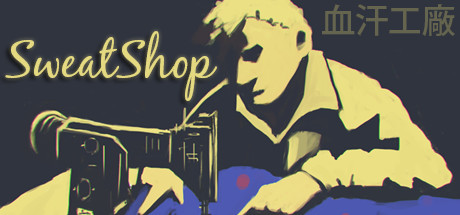
SweatShop, developed by DUCK and published by Sometimes You, is a minimalist incremental simulation game that offers a deliberately simple take on the idle-management genre. It puts players in the role of a factory owner running a low-cost clothing operation—a “sweatshop”—and challenges them to grow the business by hiring workers, upgrading production, and maximizing profit. It’s a premise that is at once darkly ironic and mechanically straightforward: a game about exploitation that functions as an endlessly repeating loop of numbers going up. Like many clicker-style titles, it relies on the inherent satisfaction of progression rather than deep systems or complex storytelling. The player’s goal is singular and unrelenting—make as much money as possible, as quickly as possible.
The gameplay follows the familiar rhythm of idle and incremental games. You begin with limited resources and a handful of employees working on the production line. As revenue accumulates, you reinvest in additional workers, purchase upgrades to improve efficiency, and unlock new levels of productivity. Every upgrade accelerates your progress, allowing the game to gradually play itself as you automate more of the process. This structure makes SweatShop initially addictive in its simplicity—the feedback loop of hiring, earning, and upgrading provides immediate gratification. However, it also exposes the limits of the design fairly quickly. Once the first few layers of upgrades have been purchased, the game settles into a repetitive pattern that lacks strategic variation. There are no major shifts in mechanics or new challenges to tackle, only incremental boosts to production speed and output. For some players, this simplicity provides a relaxing, almost hypnotic experience; for others, it quickly becomes monotonous.
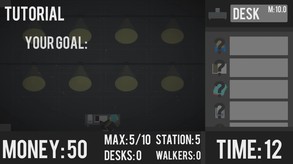
Visually, SweatShop adopts a minimalistic presentation that suits its genre but does little to elevate it. The interface consists mostly of static screens, simple icons, and progress bars representing production and revenue. The color palette is plain, the animation is sparse, and the sound design—if present at all—offers little beyond basic clicks and chimes. There’s no attempt to simulate the physicality of the factory or the human cost implied by the game’s title. This stripped-down aesthetic underscores the game’s mechanical focus but also contributes to its flat emotional tone. The result feels more like a software prototype or mobile idle app than a fully fleshed-out PC game. While that may appeal to players who enjoy straightforward resource management without distractions, it limits immersion and replayability.
One of the more provocative aspects of SweatShop is its theme, which uses the idea of exploitative labor as a backdrop for incremental gameplay. The concept of profiting from underpaid workers could have been an opportunity for satire or commentary on consumer capitalism, but the execution remains purely mechanical. The game neither condemns nor explores the ethics of its premise; it simply treats the sweatshop as a business simulation devoid of moral framing. For players who take the title at face value, this can create discomfort or even distaste, as it transforms a grim real-world issue into an abstract economic exercise. For others, the irony of the concept—a game that turns human suffering into an efficiency puzzle—might serve as unintentional dark humor. In either case, the lack of context or narrative depth leaves the theme underdeveloped, reducing what could have been biting social commentary to a neutral clicker loop.
In terms of pacing and progression, SweatShop is designed to be played in short bursts rather than long sessions. Its balance is tuned to provide rapid early advancement, encouraging players to stay engaged long enough to unlock a handful of upgrades before the inevitable plateau. However, because the game offers no real endpoint or evolving objectives, the sense of achievement fades once the automation takes over. There’s little reason to return after a few hours unless one is simply chasing higher numbers or enjoying the idle satisfaction of passive profit accumulation. Compared to other idle games with layered prestige systems or evolving mechanics, SweatShop feels static—content to remain simple rather than expand its systems.
Ultimately, SweatShop is a straightforward but shallow entry in the idle-management genre. It succeeds in delivering a basic, functioning incremental loop and may briefly satisfy players who enjoy the simple pleasures of watching numbers rise. Yet beyond that, it offers little in terms of depth, aesthetic appeal, or commentary. Its theme could have lent itself to satire or moral complexity, but the execution remains mechanical and detached. For some, this minimalism will be enough—a quick, low-cost distraction requiring no thought or investment. For others, it will feel like a missed opportunity, a game whose provocative premise deserved more than surface-level simulation. In the end, SweatShop functions as both an idle game and an unintentional metaphor: a system that runs on repetition, rewards efficiency, and forgets the human element entirely.
Rating: 4/10